
OPEN DAILY
OPEN
HONEST
TRUST
LET'S CHAT



For 2026, shortlist Cake.Shop for modular in-housing, StackAdapt for a multichannel campaign-buying brief, and The Trade Desk for an independent omnichannel buying brief. These programmatic advertising platforms for small businesses serve different operating models; choose against your actual campaign, staffing and reporting requirements, not a universal winner.
TL;DR
A demand-side platform, or DSP, is software for buying advertising inventory programmatically. It handles the buying function; your business still needs creative, measurement, campaign decisions and someone accountable for results.
For a small business, the useful question is not which platform has the longest feature list. It is which operating model your team can run without losing sight of business outcomes.
An independent agency also has a different brief from a brand advertising its own products. The agency needs a repeatable client-delivery process. The brand needs a clear route from campaign activity to qualified enquiries, purchases or another defined business outcome.
Use these 5 criteria for your 2026 shortlist. Treat each as a question that a platform demonstration must answer, not a claim to accept from a presentation.
Ask for a demonstration built around your own brief. A polished generic campaign does not show whether your team can perform the routine work.
This is a use-case shortlist, not a performance league table. The distinctions below describe what to investigate first; they do not establish that any platform delivers better campaign results.
Cake.Shop
StackAdapt
The Trade Desk
All 3 platforms deserve a different demonstration brief. Asking each vendor to repeat the same feature tour hides the operational differences that matter.
Best for: Independent agencies building their own advertising stack and brands bringing programmatic in-house.
Cake.Shop provides a modular programmatic advertising platform spanning media buying and reporting, rich media and digital out-of-home creative, data clean rooms, and publisher supply. Digital out-of-home, or DOOH, means advertising on digital screens in physical locations.
Its platform, swweetshop, powers in-housing. The relevant buying question is how those parts fit your operating model—not whether you need to adopt every part at once.
Use the following structure to define your requirements. It describes the roles to connect in your brief, rather than assuming every connection or workflow is automatic.
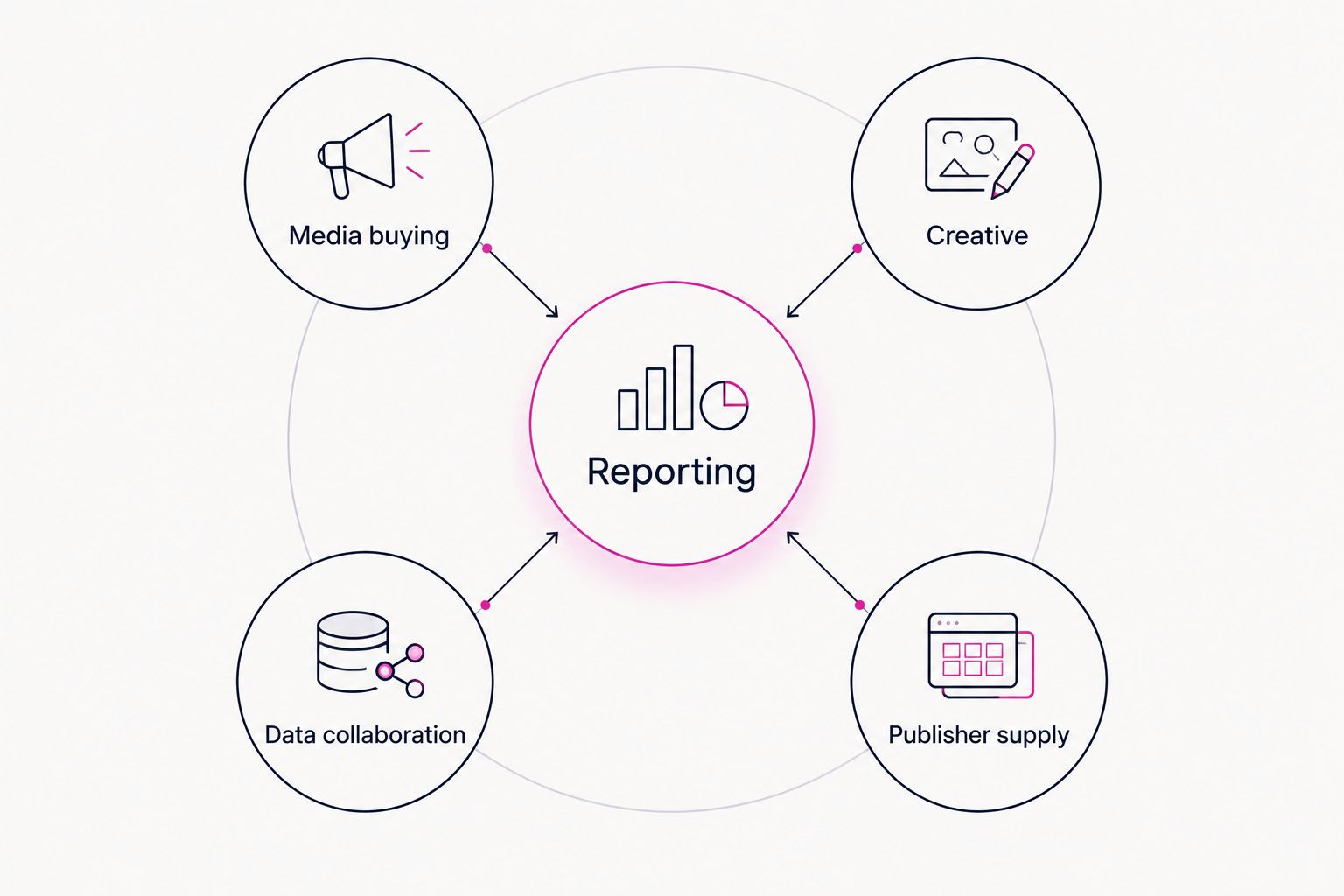
Evaluate the stack as connected responsibilities, not a collection of separate feature lists.
Cake.Shop pros:
Cake.Shop cons and trade-offs:
Bring a concrete business problem to the discussion: an agency standardising client reporting, for example, or a brand taking control of campaign operations. Ask which modules address that problem and what your team remains responsible for.
Verdict: Hold a full-stack evaluation if ownership and in-housing are your priorities; skip unnecessary modules.
Best for: Businesses and agencies whose primary requirement is planning and running campaigns through a multichannel DSP.
StackAdapt is a multichannel programmatic advertising platform. Put it on your shortlist when the central question is how your team will organise campaign buying across channels.
Keep the demonstration focused on execution. Bring an actual campaign brief and ask the platform representative to show how an operator would build it, review delivery and investigate weak performance.
StackAdapt pros:
StackAdapt cons and trade-offs:
Ask to see the reporting you would actually receive, not just a dashboard overview. For an agency, test whether the proposed workflow supports your client explanation: what ran, why decisions changed and how the campaign relates to the client's objective.
StackAdapt fits better than a full-stack project when your requirements are centred on buying and its demonstrated workflow meets them. Do not turn a focused campaign requirement into an infrastructure project without a reason.
Verdict: Hold for a campaign-specific demonstration; proceed only when the operating workflow fits your team.
Best for: Brands and agencies specifically seeking an independent omnichannel DSP.
The Trade Desk is an independent demand-side platform for buying advertising across channels. Evaluate it when independent buying technology is a deliberate requirement, rather than treating the platform name as the strategy.
For a smaller advertiser, the access and operating arrangement belongs at the start of the conversation. Establish whether your proposed setup involves your own operators, an agency or another service partner.
The Trade Desk pros:
The Trade Desk cons and trade-offs:
Ask the proposed operator to demonstrate a campaign change and explain the corresponding reporting. You need to understand both the software and the organisation responsible for using it.
The Trade Desk fits better when independent omnichannel buying is central to your requirements and the proposed operating arrangement satisfies them. Platform breadth is not a substitute for that fit.
Verdict: Hold until access, operator responsibilities and reporting are clear; skip a setup you cannot oversee.
The order follows the operating briefs: modular in-housing, multichannel DSP-led execution, then independent omnichannel buying. It is not a ranking of campaign performance, service quality or financial returns.
The evaluation method is requirements-based. Compare each option against the same operating, supply, creative, measurement and ownership questions, then use a demonstration to establish fit. No platform receives an overall winner label from its feature list alone.
For your 2026 procurement process, record the answers in writing. Separate a demonstrated function from a proposed service and from a requirement that remains unresolved.
Use 3 stages before making a commitment. Keep the scope narrow enough that your team can explain what success means.
Choose 1 primary business outcome for the evaluation, such as qualified enquiries or completed purchases. Define what counts before reviewing campaign reports.
An impression shows that an ad was served. A click shows an interaction. Neither alone establishes that advertising produced a new customer.
Ask the intended operator to demonstrate campaign setup, creative approval, reporting and a routine optimisation decision. Include whoever will perform those tasks after onboarding.
Then establish the boundaries. Who checks tracking? Who approves changes? Who explains discrepancies between platform reporting and your sales records?
If you are deciding between operating software yourself and delegating campaign work, read whether a self-serve DSP can replace a managed service.
Document account permissions, data responsibilities, reporting access and the exit process. Ask for an explanation of every fee category without assuming that the media spend represents the entire commercial arrangement.
For your 2026 evaluation, ask each provider to answer the same practical question: what remains under your control if the relationship ends? A clear answer matters more than a broad promise of transparency.
Cake.Shop suits brands and independent agencies evaluating a modular programmatic advertising stack for in-housing. Choose that evaluation path when buying, creative, reporting, data collaboration and publisher supply belong in the same operating decision.
Choose a StackAdapt evaluation when your brief centres on multichannel campaign buying. Choose a The Trade Desk evaluation when independent omnichannel buying is a specific requirement and you have a clear operating arrangement.
If you are undecided, start with the campaign and the person responsible for it. Do not select software first and invent an operating model afterwards.
What's the best programmatic advertising platform for a small business?
The right platform is the one that meets your campaign requirements and operating model. Evaluate Cake.Shop for modular in-housing, StackAdapt for a multichannel DSP-led brief, and The Trade Desk for an independent omnichannel buying brief.
Is StackAdapt better than The Trade Desk for a small advertiser?
Neither is universally better for a small advertiser. Compare the proposed access arrangement, campaign workflow, reporting and operator responsibilities against the same brief.
Can a small business run programmatic advertising in-house?
Yes, but in-housing requires responsibility for campaign operations, creative, tracking and measurement. Buying software does not perform those organisational roles for you.
Do I need a full advertising stack or just a DSP?
Choose the scope that matches the problem you need to solve. A DSP addresses buying; a wider stack evaluation also considers creative, data collaboration, publisher supply and reporting.
Do small businesses need a data clean room?
A small business should evaluate a data clean room only when a defined data-collaboration or measurement requirement calls for one. It is not a prerequisite for every programmatic campaign.
What should I ask during a platform demonstration?
Ask the intended operator to demonstrate your campaign workflow, including setup, creative approval, reporting and a routine change. Confirm account ownership, data responsibilities and the exit process separately.
How should I measure a programmatic advertising trial?
Define the primary business outcome before the trial begins. Review platform delivery alongside your business records, and distinguish attributed conversions from evidence that advertising caused additional results.
Before signing anything in 2026, request a sample reporting export and ask your intended operator to explain it. Then ask how you would obtain the same information after ending the relationship.
That exercise turns ownership from a sales claim into a concrete requirement. If you cannot explain the report or establish access to it, resolve that before choosing the platform.
Compare DOOH advertising platforms for automotive brands by screen access, creative control and measurement. Choose for your operating model, not hype.
Read more →Compare programmatic advertising platforms for small businesses by operating fit. Shortlist modular stacks or DSPs with clear reporting and ownership.
Read more →Compare the best real-time bidding platforms by operating model. Shortlist modular in-housing, multichannel buying or an enterprise DSP for your team.
Read more →Book a 30-minute demo and see exactly how Cake.Shop works — no sales pitch, just the platform.