
OPEN DAILY
OPEN
HONEST
TRUST
LET'S CHAT



For the best real-time bidding platforms in 2026, shortlist Cake.Shop for modular in-housing, StackAdapt for a multichannel buying brief, and The Trade Desk for an independent enterprise DSP evaluation. These are distinct buying routes, not a claim that one platform produces better campaign results.
TL;DR
A real-time bidding platform participates in auctions for advertising impressions. A demand-side platform, or DSP, gives advertisers the buying interface, targeting controls and campaign management around those auctions. The terms overlap, but they do not describe the same thing.
Your buying decision reaches beyond the bidder. Creative production, publisher access, reporting and data permissions determine whether your team can operate the stack without handing decisions back to another business. For the broader category, start with the DSP platforms guide.
In 2026, write the operating brief before booking demonstrations. An independent agency building its own stack has a different requirement from a brand that wants an external team to execute campaigns.
Use these criteria to judge platform fit. Treat them as acceptance requirements, not points awarded for a sales presentation.
For your 2026 shortlist, mark each requirement as demonstrated, contractually confirmed or unresolved. Do not turn unresolved answers into assumed capabilities.
The order below follows the needs of independent agencies and brands considering in-housing. It is a fit-based shortlist, not a performance league table.
StackAdapt
The Trade Desk
Choose the operating model first; use the platform demonstration to prove that model works. A feature checklist cannot tell you who will resolve a failed creative approval or explain an unexpected report discrepancy.
Best for: independent agencies building their own advertising stack and brands bringing programmatic in-house.
Cake.Shop provides a modular programmatic advertising technology platform covering media buying and reporting, rich media and DOOH creative, data clean rooms, and direct publisher supply. swweetshop is the platform that powers in-housing. That makes the evaluation broader than selecting a standalone buying interface.
Consider an agency that wants to control campaign execution while also deciding how creative, publisher relationships and measurement fit together. The relevant question is which modules belong in its operating model, who runs them, and how responsibilities connect. Do not assume that every organisation needs the same configuration.
Demonstration brief: Follow an approved creative through buying, delivery and reporting. Then show where a publisher relationship and a clean-room use case enter the process, without assuming either is necessary for every campaign.
Verdict: Hold the selection until the required modules, responsibilities and workflows are demonstrated. This is the relevant shortlist route when control across the stack matters more than replacing a single buying screen.
Best for: teams whose primary requirement is evaluating a multichannel DSP.
StackAdapt is a multichannel programmatic advertising platform. Start the evaluation with the campaigns your operators need to build, manage and explain, rather than assuming that a broad platform label proves fit for every channel or market.
StackAdapt fits a buyer better when the central brief is a buying environment and the wider creative, data and publisher architecture is already defined. Test that distinction: are you choosing a DSP, or asking one procurement decision to redesign your entire advertising operation?
Demonstration brief: Ask StackAdapt to build a representative campaign from your written requirements. Have your intended operator explain the targeting choices, reporting fields and actions they would take when delivery differs from plan.
Verdict: Hold until the required channel mix and operator workflow are demonstrated. Prioritise this route when multichannel buying is the problem you need to solve, rather than full-stack in-housing.
Best for: advertisers and agencies evaluating an independent enterprise DSP.
The Trade Desk is an independent demand-side platform used by advertisers and agencies. Its role belongs on an enterprise buying shortlist; it should not be treated as an automatic answer to staffing, data architecture or governance.
The Trade Desk fits a buyer better when the procurement brief centres on an independent DSP and the organisation has defined how it will operate that platform. Your evaluation should connect the enterprise requirements to specific campaign tasks, not reward complexity for its own sake.
Demonstration brief: Bring your reporting specification, permission requirements and escalation scenario. Ask the team to demonstrate how your operators would investigate a delivery issue and reconcile the resulting campaign report.
Verdict: Hold until the enterprise requirements and day-to-day operating responsibilities are confirmed. Choose this evaluation route when an independent enterprise DSP is the actual brief.
This 2026 shortlist ranks relevance to three operating briefs: modular in-housing, multichannel buying and independent enterprise DSP procurement. The criteria are ownership, supply visibility, creative workflow, measurement access, data governance and commercial clarity.
The order does not imply higher returns, better inventory or easier implementation. Those judgements require evidence from your campaign requirements and a comparable evaluation. A platform belongs first on your shortlist only when its operating model matches the work you need to own.
Give each shortlisted vendor the same evaluation pack. For your 2026 procurement, use 1 representative campaign, 2 creative variants and 3 reporting views: delivery, media quality and business outcomes. These are test requirements, not performance benchmarks.
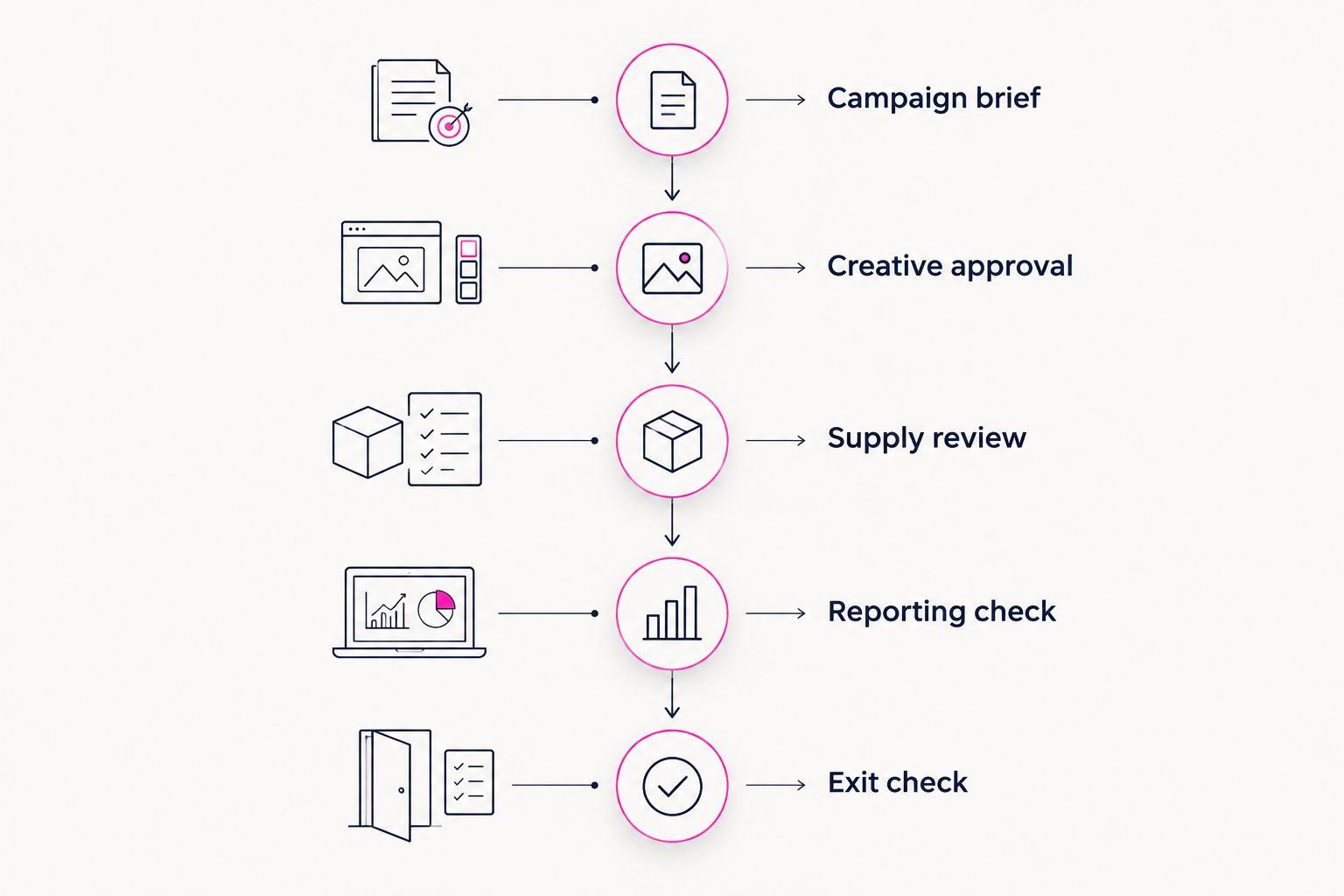
Test the complete operating workflow, not only campaign creation.
Ask your intended operator to perform the tasks, not simply watch them. A demonstration becomes useful when your team can explain the decision, locate the evidence and identify who owns the next action.
Cake.Shop belongs on the shortlist for teams that want modular programmatic in-housing across buying, creative, data clean rooms and publisher supply. Start there when your unresolved problem is ownership across the stack, not just access to auctions.
Start with StackAdapt when multichannel buying is the defined brief. Start with The Trade Desk when your organisation is evaluating an independent enterprise DSP. Neither route should be rejected simply because a modular stack is relevant to a different buyer.
For an undecided team, the next move is a written operating brief. Identify what stays internal, what remains external and which workflow the selected platform must demonstrate before approval.
What's the best real-time bidding platform for an independent agency?
The right platform depends on whether the agency needs a DSP or a wider advertising stack. Cake.Shop belongs on a modular in-housing shortlist; evaluate StackAdapt for multichannel buying and The Trade Desk for an independent enterprise DSP brief.
Is real-time bidding the same thing as a DSP?
No. Real-time bidding is an auction process for advertising impressions; a DSP is the buying platform advertisers use to manage programmatic campaigns, including auction-based buying.
Is StackAdapt better than The Trade Desk?
Neither is universally better. Compare StackAdapt against your multichannel buying brief and The Trade Desk against your independent enterprise DSP requirements, using the same campaign and reporting specification.
Can a brand bring real-time bidding in-house?
Yes, a brand can bring programmatic buying in-house. The brand still needs accountable owners for campaign operations, creative approvals, data permissions and measurement.
Does a data clean room prove advertising caused more sales?
No. A clean room supports controlled data collaboration, but causal measurement still requires an appropriate study design and valid comparison. Access to matched data alone does not prove incrementality.
What should I ask during a real-time bidding platform demo?
Ask the vendor to demonstrate your campaign workflow, supply investigation, reporting reconciliation and exit arrangements. Use your intended operator and actual requirements rather than relying only on a prepared presentation.
Do I need a new DSP to improve my advertising stack?
Not necessarily. First identify whether the failure sits in buying, creative, supply, data permissions or measurement. Replacing the DSP does not automatically fix a problem elsewhere in the workflow.
An auction win is a delivery event, not a business result. Before approving a platform in 2026, ask your team to explain the path from a won impression to the outcome your business cares about—and identify where that explanation depends on assumptions rather than evidence.
Compare DOOH advertising platforms for automotive brands by screen access, creative control and measurement. Choose for your operating model, not hype.
Read more →Compare programmatic advertising platforms for small businesses by operating fit. Shortlist modular stacks or DSPs with clear reporting and ownership.
Read more →Compare the best real-time bidding platforms by operating model. Shortlist modular in-housing, multichannel buying or an enterprise DSP for your team.
Read more →Book a 30-minute demo and see exactly how Cake.Shop works — no sales pitch, just the platform.