
OPEN DAILY
OPEN
HONEST
TRUST
LET'S CHAT


Automotive dealers’ DOOH advertising is paid placement on digital out-of-home screens with the aim of building local awareness and generating dealership enquiries. This 2026 guide explains how to match screens to your catchment, connect creative with your wider advertising stack, and measure results without confusing an ad play with a showroom visit.
TL;DR
A dealership serves a geographic market, but a screen near the showroom does not automatically reach that market. Road direction, access routes, nearby destinations and the dealership’s actual customer footprint all belong in the buying decision. Location is a planning input, not proof of purchase intent.
DOOH gives you an advertising surface outside browsers and apps. A roadside screen, shopping-centre display and pedestrian-facing panel create different viewing conditions; the same creative should not pass through all of them unchanged.
For your 2026 plan, start with what your own records show: where customers come from, which enquiries become appointments, and which areas sales teams can realistically serve. These are more useful planning inputs than an unsupported assumption that everyone within a radius is a prospect.
Cake.Shop provides modular media buying and reporting, rich media and DOOH creative, data clean rooms, and publisher supply. Cake.Shop is a fit for independent agencies and in-house brands evaluating a modular programmatic advertising stack. Dealer teams still need to confirm the relevant screen access, creative requirements and measurement arrangements before choosing a platform.
Build the plan in this order: define your objective, map your catchment, choose your route, build your creative, connect your channels and measure your outcome. Each decision should produce something your buyer, designer or dealership team can act on.
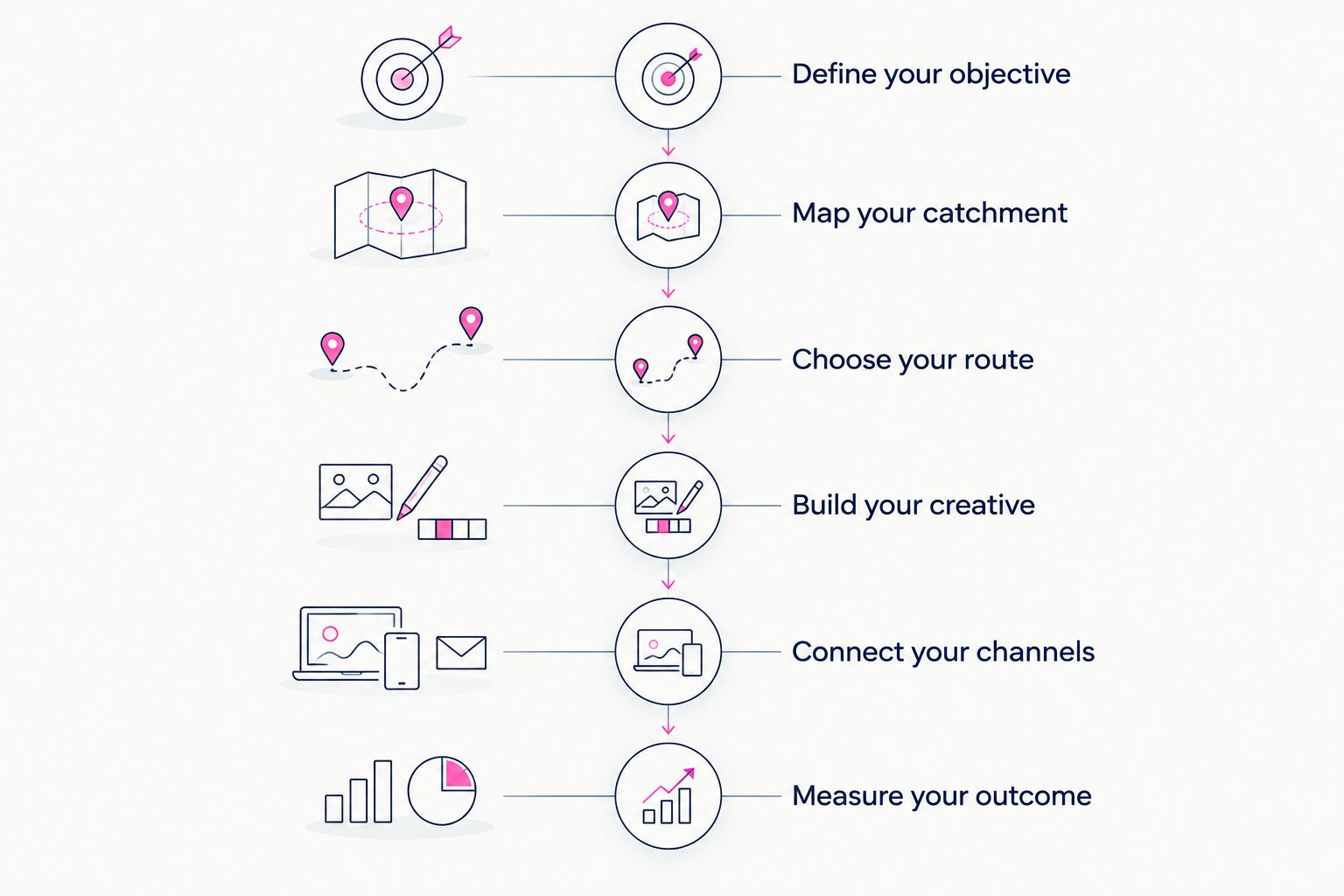
Choose the objective and catchment before selecting screens or designing the ad.
Use a shared document to set 1 primary objective per campaign. This is a planning recommendation, not a performance benchmark. Choose a business action you can observe: qualified enquiries, booked test drives or awareness within a defined catchment.
An awareness campaign and a test-drive campaign need different evidence. Awareness requires an appropriate research method; enquiries require consistent capture in your customer relationship management system, or CRM. Do not label a campaign successful against whichever measure looks strongest afterwards.
Your brief should explain what sales staff need to record, who owns follow-up and what counts as a qualified enquiry. For example, a submitted form and a completed test drive are separate events, not interchangeable conversions.
Start manually with a map and aggregated dealership records. Separate the area you want to reach from the area your customers already come from. A postcode outside your current footprint is a test opportunity, not an established source of demand.
Evaluate screen locations against travel routes and viewing context. A panel beside a major road requires different creative from a display where pedestrians can pause. Check the screen’s orientation and surroundings rather than relying on its address alone.
For a dealer group, document which location should receive each enquiry. A regional campaign that sends every prospect to one branch can undermine the local relevance you paid to create. Keep personal customer details out of shared planning files unless access and use are authorised.
Request a screen list and reporting example directly from the seller before buying. This manual approach establishes the basics: what you are purchasing, where the ad appears, how delivery is recorded and what the audience estimate represents.
Programmatic buying uses software to transact advertising inventory under defined buying rules. A demand-side platform, or DSP, is the buying system; it does not make every screen or measurement method equivalent. Ask which inventory is available through the proposed arrangement and which controls apply to it.
Cake.Shop’s programmatic advertising platform is relevant when you want to evaluate media buying alongside creative, reporting and publisher supply. Its modular scope is the reason to assess it; that scope alone does not establish access to your required screens. Use the DOOH advertising platforms guide to structure your 2026 shortlist.
Sketch the message yourself before producing screen-specific files. Use a clear dealership identifier, a recognisable automotive message and an action appropriate to the viewing environment. A roadside ad should not depend on a driver scanning a QR code.
DOOH creative must work within the publisher’s specifications, including permitted motion, file format and disclosure requirements. Browser-based rich media and DOOH serve different environments. Do not assume an interactive online ad can be transferred unchanged to a public screen.
Review artwork at its intended viewing context, not only on a designer’s monitor. If a message depends on reading dense terms, revise the concept and obtain the appropriate advertising review. Keep your 2026 creative tied to information the dealership has approved for publication.
Build a manual message map linking the screen advertisement to your online advertising and enquiry destination. A prospect who later searches for the dealership should find a consistent message, not a disconnected campaign with different claims.
Cake.Shop’s media buying and reporting, rich media and DOOH creative, data clean rooms, and direct publisher supply belong in the same stack discussion. Evaluate how those modules would support your plan together, while verifying the actual data flows and inventory arrangements. A list of modules is not proof that your proposed workflow is already configured.
A data clean room is a controlled environment for analysing data under agreed access rules. It is not automatic permission to use customer records, and it does not turn a public screen exposure into a confirmed individual conversion.
Start with a spreadsheet that separates delivery, audience estimates and business results. Delivery records show that an ad played; audience estimates describe potential exposure under a measurement method. Neither proves that an exposed person visited your dealership.
Track 3 enquiry fields consistently: dealership location, enquiry date and enquiry source. These recommended fields help organise analysis, but self-reported sources are incomplete attribution. Include qualified status or appointment progress separately so the sales team can distinguish interest from a completed business outcome.
Where a comparable design is feasible, use 2 geographic groups: campaign and comparison. This is a suggested study design, not a guarantee of causal measurement. Differences in dealer activity, other advertising and local conditions must be assessed before attributing an outcome to DOOH.
Choose the operating model before the platform. The useful comparison is who controls the plan, who supplies the screens, who produces the creative and who can explain the reporting.
For 2026, require each shortlisted provider to demonstrate the proposed workflow using your catchment and measurement brief. Commercial terms belong in that evaluation, but a headline platform description cannot settle the buying decision.
Direct screen-owner booking
Programmatic buying platform
Cake.Shop modular stack
Managed buying service
Best for labels describe buyer needs, not a performance ranking. Request the same placement list, creative requirements and reporting explanation from every provider. Otherwise, you are comparing different proposals under similar terminology.
A direct booking can be the appropriate choice when the plan centres on specific screens. A modular stack deserves consideration when your agency or in-house team needs to manage the relationship between buying, creative and supply. Neither approach removes the need for dealership-level accountability.
A screen near the dealership can face the wrong traffic flow or serve an unsuitable audience context. Inspect the placement and explain its role in the catchment plan before approving it. Do not substitute a map pin for a buying rationale.
An impression estimate and a dealership visit answer different questions. Ask for the methodology behind each reported result and retain the distinction in management reporting. A dashboard label does not establish an attribution method.
Interactive features, dense copy and small disclosures can fail in a public-screen environment. Review the message against the screen’s actual specifications and viewing conditions. Keep the core campaign consistent while adapting its execution.
A dealer-group total can hide which catchments and locations received enquiries. Report branch-level outcomes alongside the campaign total, and document how enquiries were routed. Avoid assigning a regional result to a branch without supporting evidence.
A buying platform cannot decide who approves creative or follows up an enquiry. Put named owners against buying, creative, data use, reporting and dealership response. Resolve those hand-offs before the first placement starts.
What is DOOH advertising for automotive dealers?
DOOH advertising for automotive dealers is paid advertising on digital out-of-home screens intended to reach a dealership’s market. The plan should connect screen location and creative with a defined business objective, such as qualified enquiries or local awareness.
Is programmatic DOOH better than booking screens directly?
Neither route is automatically better. Direct booking fits a defined screen requirement, while programmatic buying deserves evaluation when you need software-based buying across available inventory; compare actual access, controls and reporting.
How do I choose screens near my dealership?
Choose screens by catchment relevance, viewing context and access routes, not distance alone. Use aggregated customer records and inspect each proposed placement before approving it.
Can I reuse my online automotive ads on DOOH screens?
You should adapt online ads to the DOOH screen’s specifications and viewing environment. Interactive features and dense copy do not transfer unchanged to roadside or public displays.
How do I measure whether DOOH generates dealer enquiries?
Track delivery separately from qualified enquiries and dealership outcomes. Record enquiry location, date and source consistently, then assess other advertising and local conditions before attributing changes to DOOH.
What should an agency ask a DOOH platform provider?
Ask for the relevant screen inventory, creative specifications, delivery reporting and measurement methodology. Also confirm who owns approvals, data access, campaign operations and the explanation of results.
Does a data clean room prove someone saw my dealership ad?
No, a data clean room does not itself prove individual exposure to a dealership ad. Any analysis still depends on the available data, permitted uses and stated measurement methodology.
Ask every shortlisted provider to explain a sample report before signing off your 2026 plan. Pick an ad-play entry, an audience estimate and an enquiry result, then ask what each establishes—and what it does not.
If nobody can explain the difference, the reporting is not ready to support your buying decision. Fix that before adding more screens.
Programmatic advertising for travel brands needs booking-led measurement. Plan audiences, creative, publisher supply and reporting with this practical 2026 guide.
Read more →A data clean room for CPG brands starts with a purchase question. Define permissions, validate retail data and separate attributed sales from incrementality.
Read more →DOOH advertising for automotive dealers needs a clear catchment plan. Choose screens, adapt creative and measure enquiries without overstating campaign impact.
Read more →Book a 30-minute demo and see exactly how Cake.Shop works — no sales pitch, just the platform.