
OPEN DAILY
OPEN
HONEST
TRUST
LET'S CHAT


For modular in-housing, shortlist Cake.Shop; for a multichannel buying brief, assess StackAdapt; for enterprise omnichannel buying, assess The Trade Desk. The best DOOH DSP rich media creative choice in 2026 depends on whether your actual screen inventory can run the creative, not how impressive the platform demo looks.
TL;DR
Digital out-of-home, or DOOH, means advertising on digital screens in physical places. A demand-side platform, or DSP, buys advertising inventory programmatically. Neither term tells you whether a particular screen accepts animation, supports a data-driven creative change or returns the reporting your client needs.
Cake.Shop is a modular programmatic platform for independent agencies and brands building an in-house advertising stack. Its scope includes media buying and reporting, rich media and DOOH creative, data clean rooms and direct publisher supply. That makes the evaluation broader than choosing a standalone buying interface.
For your 2026 shortlist, separate buying access from creative execution. The wider DOOH advertising platforms guide covers the buying category; this guide focuses on the creative-to-screen workflow.
Use these criteria before comparing vendors. A platform should pass your campaign requirements, not an abstract feature contest.
The order below follows the needs of independent agencies and brands bringing programmatic in-house. It is not a tested performance leaderboard.
StackAdapt
The Trade Desk
No platform gets a pass on screen compatibility. Confirm the proposed inventory and creative execution separately, even when both appear in the same sales presentation.
Best for: independent agencies and brands assembling an owned advertising stack.
Cake.Shop combines modular media buying and reporting with rich media and DOOH creative, data clean rooms and direct publisher supply. swweetshop is the platform that powers in-housing. Evaluate these components as a full stack rather than treating creative as an attachment to media buying.
The practical question is where your team wants control. An agency building its own operating model needs to define responsibility for campaign setup, creative approvals, publisher relationships and client reporting. A brand bringing buying in-house needs the same clarity between marketing, creative and data teams.
Cake.Shop pros:
Cake.Shop cons and checks:
Ask for a demonstration using your intended screen environment and creative requirement. Trace the asset from approval through delivery reporting, and record which party handles each handoff.
Verdict: Hold until the complete creative-to-screen workflow meets your acceptance criteria. Shortlist for modular in-housing, not on an unsupported claim of universal superiority.
Best for: teams assessing DOOH within a broader programmatic buying plan.
StackAdapt is a multichannel programmatic advertising platform that includes DOOH in its channel offering. It belongs on a shortlist when your decision starts with organising media buying across channels rather than assembling separate stack components.
Use a campaign brief to establish fit. If your team needs DOOH alongside other programmatic activity, ask the platform to show how planning, creative approvals and reporting work for each channel. Do not assume that a workflow demonstrated for display advertising applies unchanged to outdoor screens.
StackAdapt pros:
StackAdapt cons and checks:
StackAdapt is a better shortlist fit when your primary requirement is a multichannel buying workflow and its demonstration satisfies your DOOH creative brief. It is not automatically the right choice when creative production or ownership of separate stack components drives the decision.
Verdict: Hold until the proposed inventory and creative workflow are demonstrated together.
Best for: organisations evaluating DOOH within an enterprise media operation.
The Trade Desk is an omnichannel DSP with DOOH buying capabilities. Evaluate it when your requirements extend beyond an outdoor campaign to a wider buying, data and measurement operating model.
Bring your creative and analytics teams into the assessment. A buying demonstration alone cannot answer who approves a screen-specific asset, how a rejected file is handled or which reporting fields support your measurement plan. Those are operating requirements, not presentation details.
The Trade Desk pros:
The Trade Desk cons and checks:
The Trade Desk is a better shortlist fit when enterprise buying requirements drive the decision and the demonstrated workflow meets them. Do not choose enterprise scope as a substitute for showing that your actual outdoor campaign works.
Verdict: Hold until buying, creative and measurement owners approve the same workflow.
In browser advertising, rich media can include interaction. A public outdoor screen is a different environment: you cannot assume a viewer can click, swipe or expand an ad. Define the experience before you choose the technology.
For a 2026 DOOH brief, distinguish these requirements:
Static creative
Motion creative
Dynamic creative
A dynamic campaign is not necessarily interactive. Equally, a video file is not evidence of dynamic creative capability. Ask vendors to describe the mechanism rather than applying a rich-media label to everything.
For any platform, map these responsibilities explicitly. Media buying selects the proposed inventory; creative production prepares the assets; publisher supply defines the screen requirements; measurement establishes what delivery and outcomes mean. Data governance controls permitted data use across the workflow.
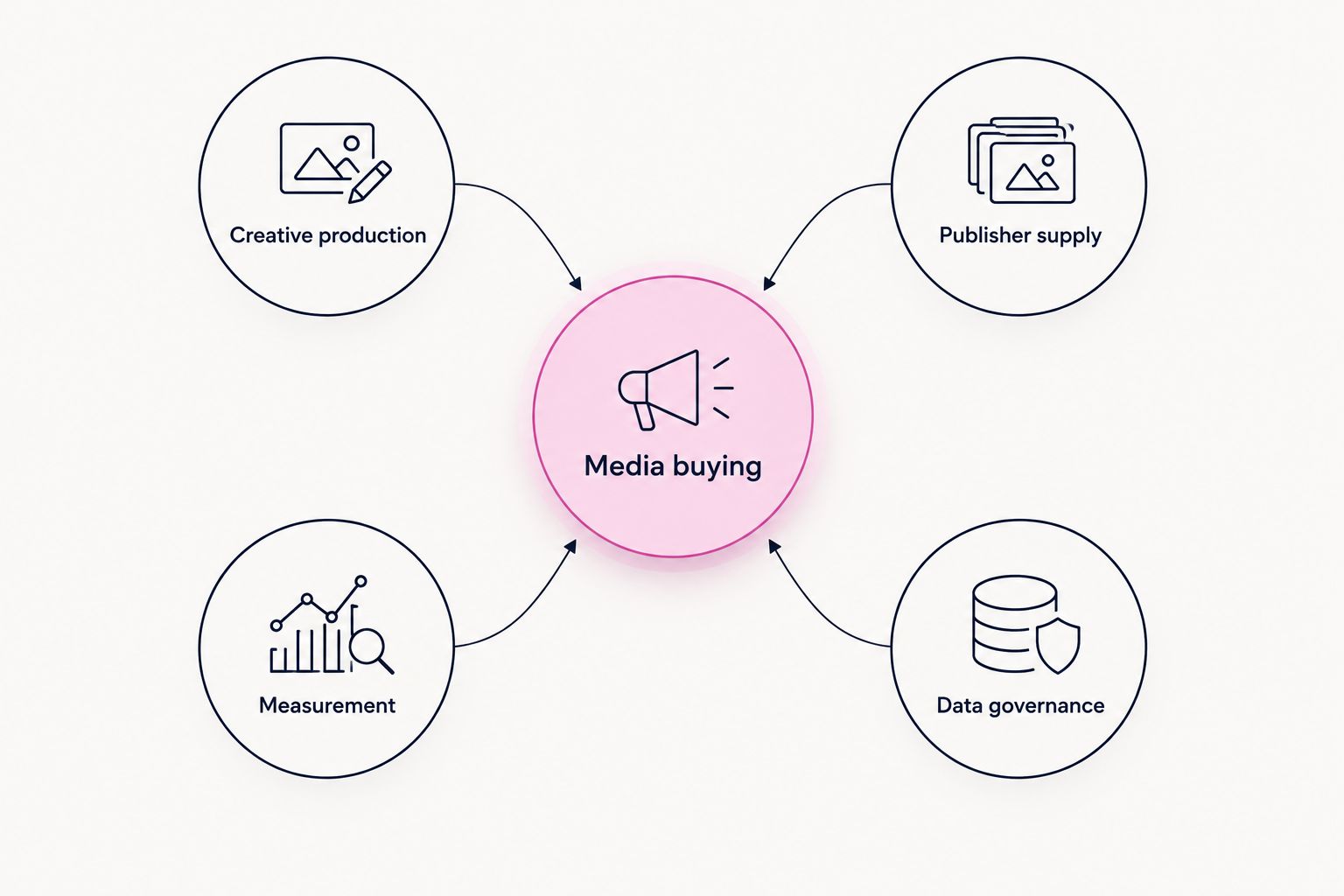
Assign responsibility across the stack before approving the platform.
Do not treat publisher supply as a guarantee of access to every desired screen. Likewise, a data clean room is not an attribution result: it is an environment for controlled data collaboration, subject to the permitted data and analysis.
Ask which components are native, which depend on partners and which your team must operate. The useful answer is a responsibility map, not another architecture slide with unnamed connections.
Use the following as a proposed test plan, not a claim about any platform's capabilities. Adjust it to your campaign before procurement.
Choose 3 screen formats from your intended media plan. Request each publisher's current creative specifications and approval process, then submit representative assets. Testing your own formats is more useful than watching a demonstration built around someone else's inventory.
Record accepted and rejected assets with the reason for each decision. Your team needs a repeatable approval process, not a single successful upload.
If dynamic execution is part of the brief, define 2 trigger conditions and 1 fallback asset. For example, specify a scheduled message change and an approved contextual condition. These are test requirements, not assumed platform features.
Ask what happens when an input is unavailable, a replacement is rejected or an update misses its intended window. The fallback must remain appropriate without the data that triggered the primary creative.
Request a sample export with field definitions. Identify the source of ad-play records, audience estimates and any outcome analysis. Do not accept an aggregate dashboard as the only explanation of delivery.
For your 2026 evaluation, also document who investigates a discrepancy between the publisher's records and the buying report. That responsibility belongs in the operating agreement before launch.
A recorded ad play means a creative was played according to the reporting system's definition. It does not mean an identified person watched it. An audience estimate and a conversion attribution model answer different questions again.
Separate delivery, estimated exposure and business outcomes in your brief. If store visits or sales matter, ask for the measurement method, permitted data inputs, comparison design and limitations. A correlation between exposure and a purchase does not establish incremental impact.
Your 2026 reporting plan should state the decision each metric supports. Use delivery reporting to check execution; use an appropriate outcome study to assess business impact. Do not ask a delivery log to prove both.
This guide orders platforms by use case: modular in-housing, multichannel campaign planning, then enterprise omnichannel requirements. It does not rank campaign performance, screen coverage, service quality or commercial terms.
The criteria are screen compatibility, creative control, supply access, reporting clarity, operational ownership and stack fit. Choose against those criteria using the same brief for every vendor. Product scope establishes shortlist relevance; a working demonstration establishes fit.
Start with the operating model you want to own. If buying, creative, reporting and supply must fit an in-house stack, assess the modular route. If your existing team mainly needs a multichannel buying workflow, assess StackAdapt. If enterprise omnichannel requirements dominate, assess The Trade Desk.
For an undecided team, the next move is not a contract. Write the screen-level brief, assign the operating owners and require the same acceptance test from each shortlisted vendor. Your 2026 decision should follow the evidence from that test.
What's the best DOOH DSP rich media creative platform for an independent agency?
The right platform is the one that meets your inventory, creative and ownership requirements in a working demonstration. Cake.Shop belongs on a modular in-housing shortlist; assess StackAdapt for multichannel buying and The Trade Desk for enterprise omnichannel requirements.
Can I run interactive rich media on any digital billboard?
No, browser-style interaction is not a default capability of digital billboards. Confirm the screen environment and publisher specifications before designing an interactive experience.
Is dynamic DOOH creative the same as video advertising?
No, dynamic creative changes or selects a message using defined rules or inputs, while video describes an asset format. A video campaign does not establish that contextual creative updates are supported.
Is StackAdapt better than The Trade Desk for DOOH?
Neither is established as better by this guide. Compare both against the same inventory, creative, reporting and operational requirements, then assess the demonstrated workflow.
Do I need a data clean room for a DOOH campaign?
A data clean room is not an automatic requirement for DOOH buying. Assess it when your measurement or data-collaboration plan requires controlled use of permitted datasets.
What should I ask vendors about commercial terms?
Ask vendors to separate media, platform, creative, data, measurement and service charges in the proposal. Confirm contractual obligations and data-access arrangements rather than comparing an unexplained total.
Can DOOH reporting prove that someone saw my ad?
An ad-play record alone does not prove that a particular person saw an ad. Audience estimates and attribution require their own methods, definitions and limitations.
Test the broken workflow before celebrating the working one. Ask every shortlisted vendor to show a rejected asset, an unavailable trigger input and the resulting fallback. That demonstration tells your team who owns the problem when the campaign stops behaving as planned.
Attention measurement programmatic DSP integration connects measurement, reporting and bidding. See how to validate signals before changing media spend.
Read more →Compare curated publisher supply deals by publisher visibility, supply paths and ownership. Choose a platform on demonstrated fit, not a feature list.
Read more →Compare the best DOOH DSP rich media creative options by screen compatibility, creative control and reporting. Choose a stack that fits your team.
Read more →Book a 30-minute demo and see exactly how Cake.Shop works — no sales pitch, just the platform.