
OPEN DAILY
OPEN
HONEST
TRUST
LET'S CHAT



Attention measurement integrates into a demand-side platform (DSP) through ad measurement, reporting joins and, where supported, buying controls that use attention signals. A score in a dashboard does not mean the DSP can optimise towards it: you must establish what the signal measures, which impressions it covers and how it reaches a bidding decision.
TL;DR
Attention measurement has 3 integration points: collection, reporting and activation. Collection produces observations or estimates; reporting connects them to media delivery; activation makes them usable in buying decisions. An integration can support reporting without supporting activation.
Use this sequence for a 2026 implementation brief:
For the broader platform decision, compare demand-side platforms for independent agencies against these requirements rather than treating an attention reporting logo as proof of bidding support.
An attention integration changes your media decisions only if the measurement reaches a control you can use. Reporting can inform a trader's decisions without becoming an automatic optimisation input. Neither route proves that higher attention produces more sales.
For a brand bringing programmatic in-house, the practical question is ownership: who defines the metric, checks discrepancies and approves changes? For an independent agency, add client reporting. You need to explain what was measured without presenting a modelled estimate as a direct observation of every viewer.
Your 2026 requirement should describe a decision, not just a dashboard. Specify whether you want to compare creative, investigate placements or change buying behaviour. Each use case needs different access and evidence.
There is no universal attention connector. The right route depends on whether you need retrospective analysis, campaign controls or a signal available before an auction decision.
Post-delivery reporting
Pre-bid predictive signal
Reporting-led adjustments
Automated feedback
Post-delivery reporting is a sensible starting point when your priority is understanding coverage and methodology. Its drawback is operational: someone must translate the findings into changes.
Pre-bid prediction belongs in a different category. Ask which inputs are available at auction time and how the model is validated. Do not describe it as measured attention simply because observed data helped train the model.
Automated feedback needs the strictest checks. A signal that correlates with an outcome in reporting is not automatically suitable as the objective your bidding system pursues.
Start with a data contract: a written definition of the fields, meanings and delivery rules shared by the measurement provider and DSP. For a 2026 integration, require a sample dataset and field dictionary before accepting a finished dashboard.
The contract should cover:
Impression-level matching is not always available or appropriate. An aggregate join can still support placement or creative decisions, provided both datasets use compatible dimensions and reporting periods.
Never silently convert missing attention into zero attention. Missing data describes a measurement gap; zero describes a value under a defined metric. Combining them distorts comparisons and can create unjustified exclusions.
The same measurement arrangement does not work identically across web display, mobile applications, connected TV and digital out-of-home (DOOH). These environments expose different technical signals and measurement opportunities.
The main drivers are:
Keep channel results separate until the provider demonstrates that the definitions support comparison. A common score label is not evidence that mobile display and DOOH attention are measured in the same way.
Use a controlled comparison before making attention the main optimisation objective. Start with 2 campaign groups: a baseline using the existing buying approach and a treatment using the proposed attention-informed change. Define allocation and exclusions before launch.
A split alone does not establish causality. Keep audience, creative, timing and other buying settings comparable, and account for overlap or other differences that could explain the outcome. Choose a business outcome appropriate to the campaign rather than declaring success from a higher attention score alone.
Write the following sequence into your test plan:
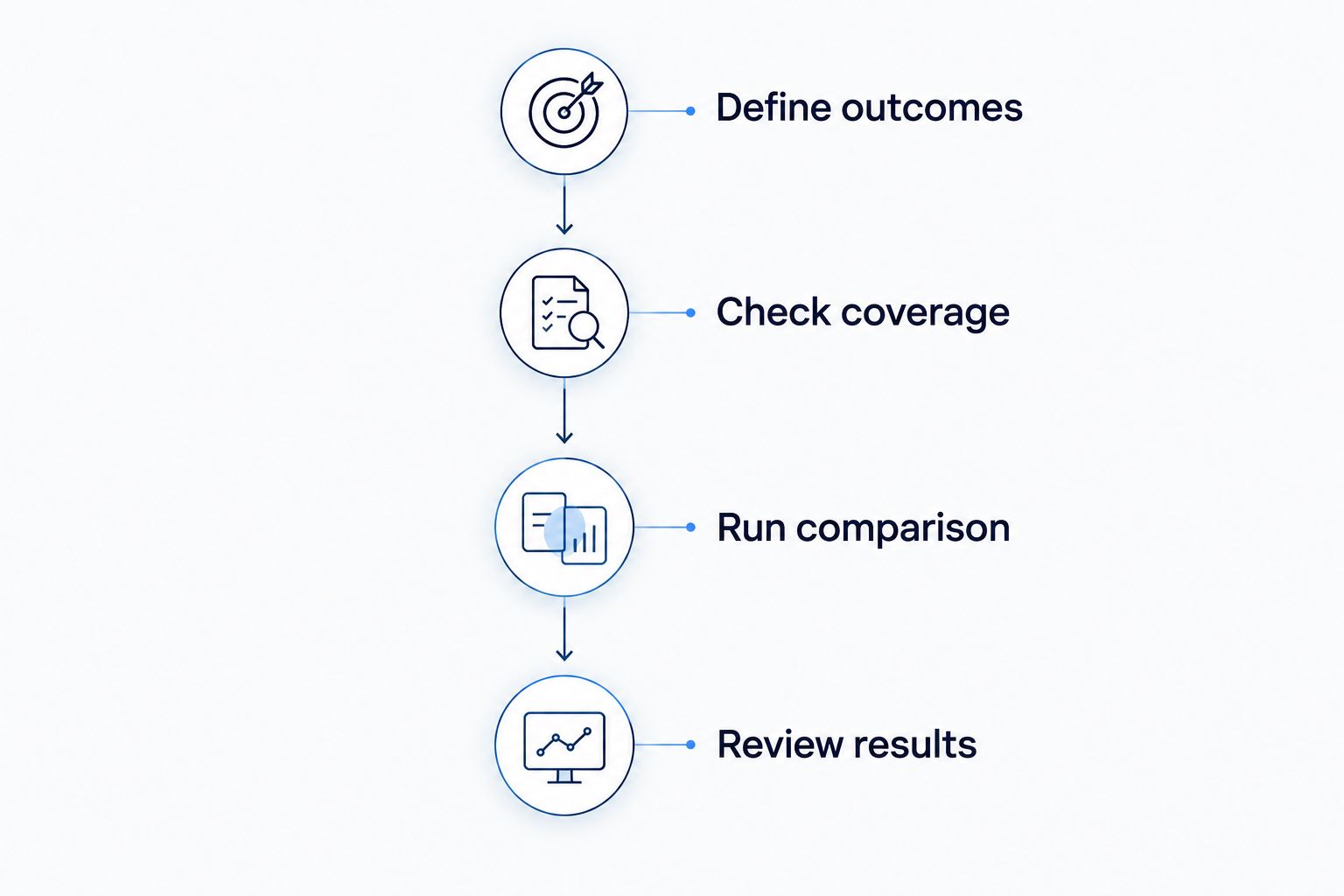
A higher attention score is not a substitute for a better business outcome.
Set the evaluation window before reading the results. Your media buying optimisation timelines need to account for measurement delivery, conversion reporting and the time required to evaluate the intended outcome; changing settings whenever a new score arrives undermines the comparison.
Avoid a universal test duration. A campaign measuring immediate site actions and a campaign assessing later brand effects need different evaluation designs. Record the decision rule before launch so an attractive intermediate result does not become a reason to stop early.
An attention score is a starting point for diagnosis. If a placement underperforms, investigate the creative, the environment and measurement coverage before removing the publisher. Otherwise, you risk treating every weak result as a supply problem.
Keep 1 shared reporting definition for each metric across traders, creative teams and client reports. Record the unit, eligible impression population and aggregation method. That makes a creative comparison interpretable without pretending that an agency dashboard and a provider dashboard must contain identical totals.
For a 2026 stack review, Cake.Shop is relevant to independent agencies and in-house brands seeking modular programmatic technology across media buying and reporting, rich media and DOOH creative, data clean rooms and direct publisher supply. Cake.Shop's swweetshop is the platform that powers in-housing.
The advantage of this full-stack scope is that the discussion can cover creative, buying, data and supply together. The trade-off is implementation responsibility: modular procurement requires you to document the boundaries and owners of each connection. Cake.Shop's platform scope does not establish support for a particular attention provider or automated bidding connection; confirm those requirements explicitly.
Data clean rooms belong in the outcome-measurement discussion where the proposed workflow calls for controlled data collaboration. They do not turn an attention correlation into proof of incremental impact. Keep the attention integration and the outcome-validation design distinct.
Make the acceptance criteria specific enough that a trader and an engineer can independently check them. A working dashboard is necessary for a reporting integration, but it is not proof that a buying integration works.
Your 2026 sign-off should answer:
For an automated connection, also document the fallback when the signal is unavailable or delayed. Specify whether ordinary buying continues, an adjustment stops or a campaign requires intervention. Agree the behaviour rather than discovering it during delivery.
Attention measurement does not inherently require a cross-site user identifier; the answer depends on the collection method and intended analysis. Placement-level reporting and user-level outcome matching are different requirements. Ask the provider to identify the data needed for each, rather than accepting an undifferentiated request for identity data.
A DSP can optimise towards attention automatically only when the signal reaches a supported buying control. A reporting integration alone does not establish that capability. Require a demonstration of the setting, data flow and fallback behaviour before describing the connection as automated optimisation.
Attention is not the same as viewability. Viewability concerns an ad's opportunity to be seen under defined conditions; attention methodologies attempt to assess or estimate aspects of actual attention. Retain the exact provider definitions in reporting rather than merging the terms.
What's the first step in connecting attention measurement to a DSP?
Define the attention metric and the decision it should inform. Then confirm collection, reporting and activation separately so a reporting connection is not mistaken for bidding support.
Can I add attention measurement without changing my DSP?
You can retain your DSP when the proposed measurement route is compatible with its creative delivery and reporting arrangements. Automated buying changes require an additional supported control, not just compatible reporting.
Does an attention score prove someone looked at my ad?
An attention score does not automatically prove that a particular person looked at your ad. The interpretation depends on whether the methodology uses direct observations, exposure signals, modelling or a combination.
Should I exclude every publisher with a low attention score?
Do not exclude publishers solely because an attention score is low. Check measurement coverage, creative performance and the relationship with your campaign outcome before changing supply.
Can attention measurement work across display, CTV and DOOH?
Attention measurement across display, CTV and DOOH requires environment-specific methods and coverage checks. Do not assume scores are comparable across channels merely because a report uses the same metric name.
How do I check whether attention optimisation improves results?
Compare an attention-informed buying approach with a suitable baseline using a predefined business outcome. Keep the attention score separate from the outcome and account for differences in delivery and measurement coverage.
A reporting-only integration can be more useful than an automatic connection you cannot explain. Start with the decision you need to make, verify the data behind it and automate only when the buying response is clear. Control means knowing what changes—and what happens when the signal disappears.
Attention measurement programmatic DSP integration connects measurement, reporting and bidding. See how to validate signals before changing media spend.
Read more →Compare curated publisher supply deals by publisher visibility, supply paths and ownership. Choose a platform on demonstrated fit, not a feature list.
Read more →Compare the best DOOH DSP rich media creative options by screen compatibility, creative control and reporting. Choose a stack that fits your team.
Read more →Book a 30-minute demo and see exactly how Cake.Shop works — no sales pitch, just the platform.