
OPEN DAILY
OPEN
HONEST
TRUST
LET'S CHAT



Yes, DOOH ads can be measured for attribution by connecting verified screen delivery with subsequent visits, purchases or other business outcomes using a defined measurement method. The caveat is that a nearby device is not proof that its owner saw an ad, and an attributed conversion is not proof that advertising caused it. For your 2026 measurement plan, separate delivery evidence, exposure estimates and incremental results before judging performance.
TL;DR
DOOH attribution connects advertising exposure estimates to later outcomes; incrementality tests whether advertising changed those outcomes. Digital out-of-home advertising does not require a click to be measured, but its evidence needs more explanation than a conversion total.
Build the measurement chain in this order:
For privacy-controlled analysis, read Can a data clean room measure incrementality safely?. A clean room governs data access and analysis; the study design still determines what the result proves.
A screen can deliver an ad correctly while the measurement report overstates its contribution. Someone recorded near a retail screen might already have planned to visit the advertised store. Counting that visit as attributed does not resolve the causal question.
Your 2026 brief should therefore name the business decision the measurement must support. Creative selection, location planning and budget allocation require different evidence; a delivery report alone cannot answer all of them.
Independent agencies also need a result they can explain to clients without hiding behind a platform score. In-house teams need the same clarity when finance asks whether a reported sale was additional or simply associated with exposure.
Choose the method around the outcome and available evidence, not around whichever dashboard looks most complete. Each approach below answers a different question and carries a different limitation.
Matched exposure analysis
Geographic experiment
Brand lift survey
QR or dedicated response route
Marketing mix modelling
Do not add the outputs of these methods together as if they were separate conversions. A QR response, an attributed purchase and a modelled contribution can describe overlapping activity.
Matched exposure analysis connects a defined exposure signal with a later outcome using an eligible identifier or controlled matching process. For a store-visit study, the methodology must define both the advertising exposure area and the destination visit criteria.
The benefit is an outcome-level view beyond screen delivery. The limitation is selection: people travelling through a location can differ from people who do not, including in their existing likelihood of visiting a nearby business.
Ask whether the report covers only matched observations or projects them onto a wider audience. Those are different reporting scopes and should remain visibly separate.
A geographic experiment assigns advertising treatment across areas and compares outcomes against controls. Random assignment, where feasible, helps reduce systematic differences; a non-random comparison needs explicit justification and checks.
The benefit is a design aimed at estimating additional outcomes rather than assigning credit. The trade-off is operational: your team must coordinate media delivery, outcome data and other marketing activity so the comparison remains interpretable.
For a 2026 regional campaign, agree the treatment boundaries before activation. Travel between areas, national promotions and changes to distribution belong in the analysis plan, not in a footnote added after results arrive.
A brand lift survey addresses what people remember or think. A QR code or dedicated response route records an action through that route. Both can support a campaign evaluation without pretending to measure every sale.
Their limits differ. Survey design and respondent selection affect survey evidence; response routes miss people who search, visit directly or buy later through another channel. Report the measured behaviour by its actual name.
Start with the commercial question and work backwards to the data. Buying screens first and choosing an attribution method afterwards creates avoidable gaps between what ran and what you can evaluate.
Write the decision in plain language: expand the campaign, change the creative, revise the location mix or stop an ineffective placement. Choose an outcome that directly informs that decision.
For a retailer, a recorded visit and a completed sale are different outcomes. For an agency generating enquiries, a form submission and a qualified opportunity are different outcomes too. Keep the distinction intact throughout reporting.
Require enough delivery detail to connect the buying record to the study. Screen location, creative identity and timestamps should describe the same campaign activity across the relevant records.
Ask how the supplier handles missing playback records, cancellations and creative changes. A study built around planned delivery must not be presented as if every planned play was confirmed.
Document the exposure model in language your client can understand. Being near a screen, having an opportunity to see it and paying attention to it are not interchangeable events.
Ask how location accuracy, screen orientation and dwell assumptions enter the method. If the study cannot distinguish those concepts, narrow the claim rather than widening the certainty.
Specify the control or baseline before the campaign starts. Describe why it is a credible comparison and what would invalidate it.
For a 2026 test, record overlapping promotions and other media activity across treatment and control areas. Those records help explain whether a measured difference belongs to the DOOH treatment or to something else changing at the same time.
Keep delivery totals, estimated exposure, observed outcomes and estimated incremental effects in separate fields. Include the eligible population, exclusions and uncertainty alongside the headline finding.
A result without a clear denominator is hard to use. Ask whether the reported conversion rate describes matched devices, estimated exposed people, households or another population before comparing campaigns.
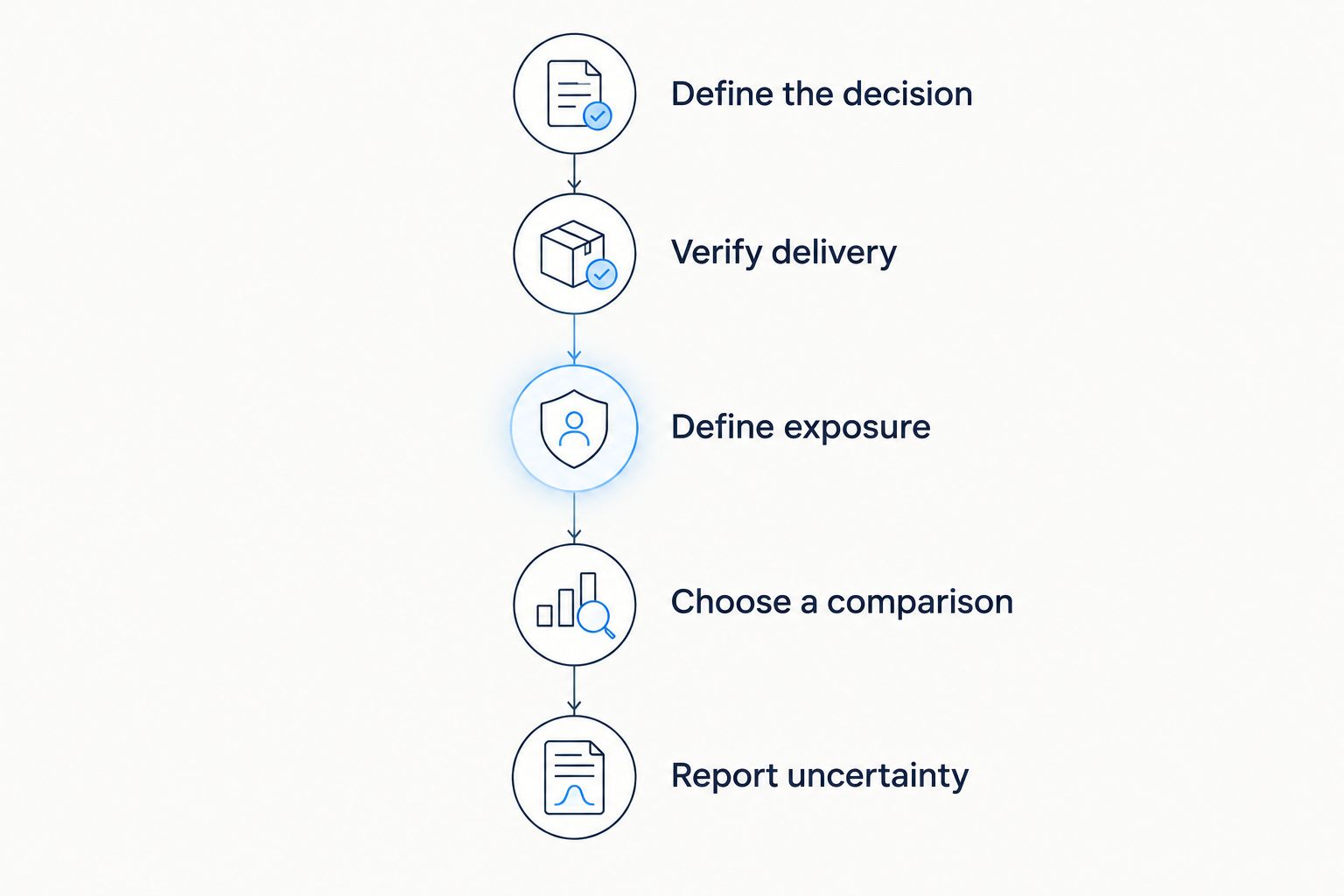
Set the measurement rules before the campaign starts, not after the results arrive.
A DOOH attribution figure is the output of a method, not a universal property of the campaign. Compare the following settings before treating different reports as equivalent:
Your 2026 reporting template should retain these definitions next to the results. A conversion figure detached from its eligibility rules is not a sound basis for moving budget.
DOOH attribution generally estimates exposure; it does not establish individual attention. Proof-of-play confirms that advertising ran on a screen, while audience and location methods estimate who had an opportunity to see it.
Use those labels consistently in client presentations. Replacing “estimated exposure” with “verified viewer” changes the claim without improving the evidence.
DOOH sales attribution requires eligible sales data and a defensible connection or comparison. A matched study can associate exposure with purchases, while a geographic experiment can evaluate changes in aggregated sales without asserting that every purchaser saw a screen.
Keep refunds, purchase eligibility and reporting coverage consistent across the comparison. Store visits remain a separate outcome, not a substitute label for sales.
A data clean room controls how data is accessed and analysed; it does not make an attribution model correct. Exposure quality, matching rules, outcome definitions and experimental design still determine the strength of the conclusion.
For cross-market programmes, assess the applicable privacy requirements and permissions before joining datasets. Restricted access is a technical control, not automatic legal approval.
Cake.Shop provides modular programmatic advertising technology across media buying and reporting, rich media and DOOH creative, data clean rooms, and publisher supply. Its swweetshop platform powers in-housing for brands and independent agencies.
For your measurement brief, map the buying record, creative version, supply record and permitted outcome analysis across that stack. Ask which records are available and which measurement responsibilities sit with your team or another provider; do not assume that buying DOOH automatically includes a particular attribution service.
The practical benefit of evaluating Cake.Shop as a full stack is that the discussion covers creative, buying, supply and data together. The boundary remains explicit: a modular platform does not, by itself, prove incremental performance. Require evidence for the measurement method separately from the platform proposition.
Can DOOH ads be measured for attribution without clicks?
Yes, DOOH attribution can connect estimated exposure with later outcomes without requiring a click. The method must explain the exposure signal, eligible outcome and attribution rule.
What is the difference between DOOH attribution and incrementality?
DOOH attribution assigns credit or identifies an association; incrementality estimates what changed because of the advertising. An attributed purchase is not automatically an additional purchase.
Does proof-of-play show that someone watched my DOOH ad?
No, proof-of-play confirms that an ad played on a screen, not that someone watched it. Audience exposure and attention require separate evidence.
Can I measure DOOH performance without matching individual devices?
Yes, geographic experiments and aggregate modelling can evaluate outcomes without individual device matching. Their conclusions depend on the comparison design, available data and stated assumptions.
Is a QR code enough to measure a DOOH campaign?
A QR code measures responses through that route, not the campaign's total contribution. It misses responses through other routes and does not establish whether the resulting outcomes were incremental.
What should I ask a DOOH measurement provider before launch?
Ask for the exposure definition, outcome definition, attribution window, comparison design and reporting population. Also require clear treatment of missing data, repeat observations and uncertainty.
Does Cake.Shop automatically prove DOOH attribution?
Cake.Shop's stated modular advertising stack does not itself establish a specific attribution result. Confirm the available campaign records, measurement arrangements and study design for your brief.
A customer can be correctly counted as attributed without being an incremental customer. That is not a contradiction; it is the difference between an attribution rule and a causal finding.
Before approving your 2026 report, ask the analyst to finish this sentence: “This result shows ___, but it does not show ___.” If the second half disappears from the presentation, the evidence has not become stronger.
Is publisher supply consolidation worth it? Test redundant routes before cutting partners. Protect publisher access, reporting ownership and campaign outcomes.
Read more →Is contextual advertising cheaper than behavioural targeting? Not always. Compare targeting fees, media quality and acquisition costs before you buy.
Read more →Can DOOH ads be measured for attribution? Yes. Compare exposure matching, geographic tests and sales measurement, with clear limits on what each proves.
Read more →Book a 30-minute demo and see exactly how Cake.Shop works — no sales pitch, just the platform.