
OPEN DAILY
OPEN
HONEST
TRUST
LET'S CHAT



Publisher supply consolidation is worth it when removing redundant buying routes improves your control without sacrificing valuable inventory or campaign outcomes. It is not worth it when fewer partners leave you dependent on a route you cannot inspect or replace. For 2026, treat consolidation as a controlled supply-path test, not a target to reduce your supplier count.
TL;DR
An independent agency needs to explain where its clients' media runs. An in-house brand team needs the same visibility, plus clear ownership of buying decisions and reporting. Neither requirement disappears when several supply relationships sit behind a single interface.
A shorter partner list is an administrative change. A better supply setup gives you evidence about the inventory, intermediaries and outcomes behind your spend. Use programmatic platform transparency as a procurement criterion before deciding which relationships to remove.
The goal is fewer unnecessary routes, not fewer routes at any cost. A specialist relationship deserves to stay when you can explain what it adds and verify that contribution.
Yes, if a controlled comparison shows that the retained routes meet your campaign requirements and improve visibility or operational control. No, if consolidation removes distinct supply, weakens reporting or concentrates access without a workable alternative.
For buyers, publisher supply consolidation means reducing the routes used to reach publisher inventory. Supply-path optimisation means evaluating those routes; consolidation is one possible result, not the objective itself.
Consolidated buying routes
Broad supply access
Core routes plus specialists
This table is a decision framework, not evidence that one model performs better. Your campaign results and access requirements decide which structure earns its place.
Consolidation makes sense when multiple routes appear to serve the same campaign need. Before removing one, establish whether they actually provide interchangeable access. Seeing the same publisher domain in reports does not establish that the placements, formats, audience opportunities or commercial arrangements are identical.
Best for: teams that can document overlap and compare retained access. Ask the remaining partner to explain the route to the publisher and the reporting you will receive. Keep that explanation specific to the inventory you intend to buy.
The downside is dependence. If the retained route changes its terms, reporting or access, your team needs a practical response. Consolidation without an exit plan trades visible complexity for a less visible dependency.
Broad access gives you more relationships to assess, but every additional route needs a purpose. Keeping a partner because it has always been present is not a supply strategy. Neither is removing it solely because its share of spend looks small.
Best for: teams investigating coverage gaps or distinct publisher relationships. Record what each route contributes, then test whether another route provides an acceptable substitute.
The trade-off is operational work. Your team must reconcile reporting, apply buying rules and resolve discrepancies across more relationships. Broad access is defensible when that work protects something valuable, not when it merely preserves an inherited setup.
A core-plus-specialist setup separates routine buying from relationships that serve a defined requirement. A specialist route might support a particular publisher arrangement, placement or creative specification. Treat these as requirements to verify, not automatic reasons to retain every partner.
Best for: teams that need central control without treating all inventory as interchangeable. Give each exception an owner and a documented reason to remain.
The downside is governance. Exceptions become clutter when nobody reviews them. Apply the same reporting and outcome standards to specialist routes as you apply to the core, while recognising that their purpose may differ.
For your 2026 review, separate the factors that change the decision. A route can be redundant for one campaign and necessary for another.
Do not turn these factors into an unsupported score. Write down the evidence for each and identify which requirements are non-negotiable for your business.
A 2026 consolidation test should isolate the supply decision as far as your buying setup allows. Changing audiences, creative and measurement at the same time leaves you without a clear explanation for the result.
List the publishers, supply partners, deals, formats and buying platforms involved in the campaign scope. Mark which relationships are contractual and which sit inside another provider's service. Record any gaps in visibility as questions to resolve before the test.
Use publisher identifiers alongside domain names where available. The aim is to understand the route, not to create a longer spreadsheet that nobody maintains.
Write down what must survive consolidation: required publishers, placements, formats, reporting fields and exclusions. Give specialist relationships a specific justification. If you cannot explain what would be lost by removing a route, investigate before assuming it is either essential or redundant.
This requirement list becomes your acceptance criteria. It also gives procurement and campaign teams the same definition of a successful change.
Use 2 test groups where your setup permits a valid comparison: the existing supply arrangement and the proposed consolidated arrangement. Keep targeting, creative, measurement and campaign objectives aligned. Avoid splitting activity so thinly that neither group can answer the business question.
Do not assume separate groups are automatically independent. Ask how overlapping audiences, auctions and delivery constraints affect interpretation, and document any limitations.
Choose 1 primary outcome before launch, aligned with the campaign's purpose. Review delivery and inventory quality alongside it rather than allowing a convenient secondary metric to decide the result afterwards.
A favourable headline result does not excuse missing publisher visibility or broken creative delivery. Equally, a cleaner reporting interface does not establish that the media itself improved.
Document 3 decision rules before changing the production setup: when to retain consolidation, when to investigate, and when to restore access. Base the thresholds on your own campaign requirements rather than a generic benchmark.
Assign responsibility for acting on those rules. A fallback that nobody can execute is not meaningful protection.
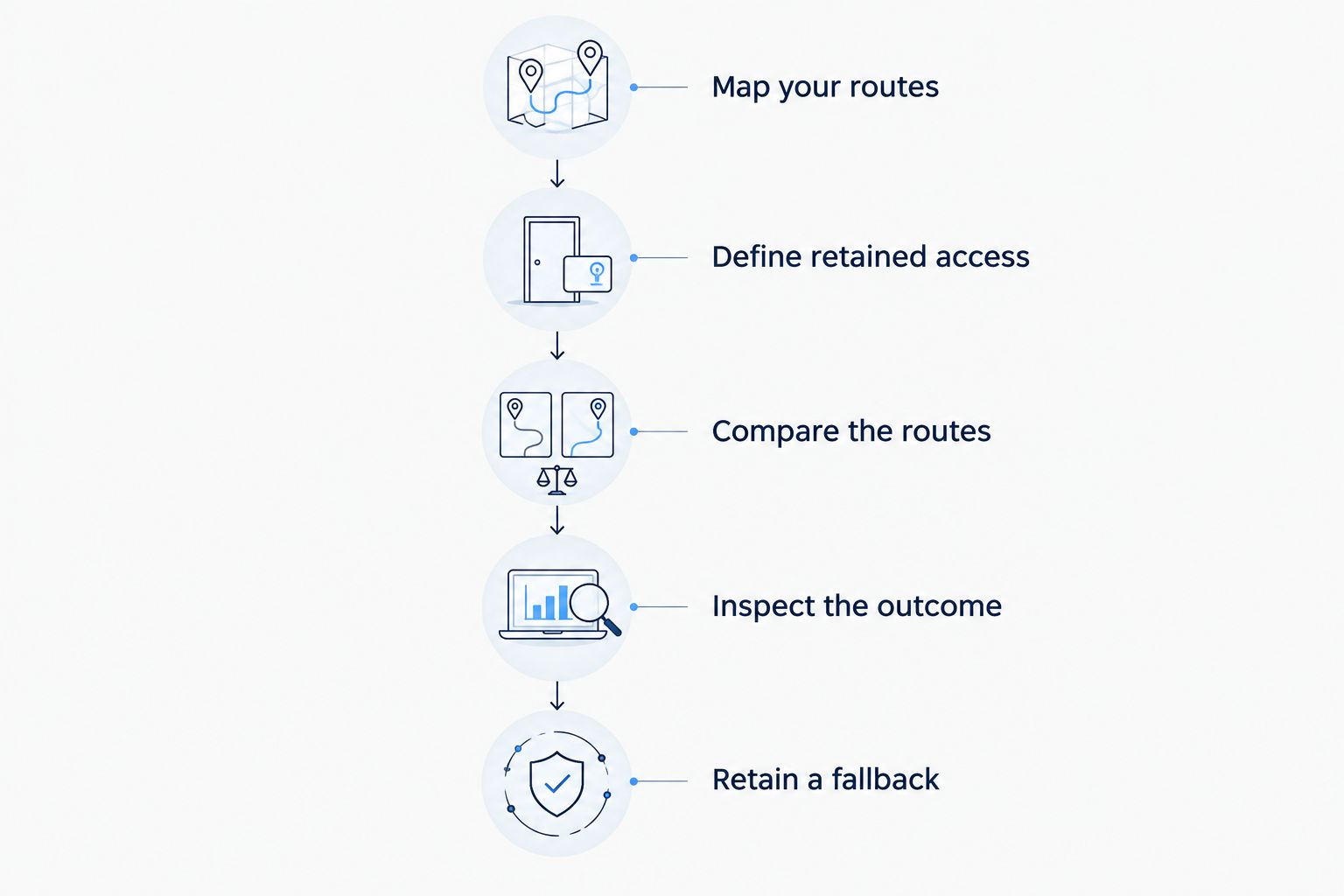
Define required access before comparing consolidated and existing supply routes.
A buyer's simpler workflow does not establish that the publisher receives a better outcome. These are different questions. Ask which intermediaries remain, what role each performs and how the commercial relationship is disclosed.
That distinction matters when assessing video monetisation platforms for publishers: the publisher-side question is how monetisation is managed, while the buyer-side question is which inventory and buying route the campaign receives. A platform category alone answers neither question.
For your consolidation decision, request an explanation of the supply chain rather than accepting the word direct as sufficient evidence. Clarify who contracts with whom and who controls the inventory offered. Do not assume every route described as direct has the same structure.
For 2026 procurement, require a sample report before accepting reporting consolidation as a benefit. Check whether it answers your actual questions: where delivery occurred, which supply relationship served it, which creative ran and how the outcome was measured.
A combined dashboard is convenient, but convenience is not the same as transparency. If the underlying detail disappears, the team loses the ability to investigate changes in performance or delivery.
Agree on report definitions before migration. Confirm who can export campaign records, which fields are available and how discrepancies are handled. These are acceptance questions for every provider, not capabilities to assume from a product description.
Keep ownership of the evidence behind your buying decisions. Otherwise, the consolidation case depends on information you cannot independently inspect.
Cake.Shop provides a modular programmatic advertising platform spanning media buying and reporting, rich media and DOOH creative, data clean rooms, and publisher supply. swweetshop is the platform that powers in-housing. Assess that full stack against your operating requirements, rather than treating it only as a standalone buying tool.
For an independent agency, the enquiry should connect client buying requirements with creative delivery, publisher access and reporting ownership. For a brand bringing programmatic in-house, it should also establish which responsibilities the internal team will own.
The trade-off is scope: a modular stack still needs decisions about modules, responsibilities and measurement. Do not assume that selecting connected services removes this work. Ask Cake.Shop to demonstrate the relevant workflow and explain the supply relationships involved before committing to consolidation.
No. Consolidation means removing unnecessary relationships or routes, not imposing a single-partner rule. Keep a specialist route when evidence shows it serves a requirement the retained core does not meet.
A single partner is a procurement structure, not proof of efficient buying. Judge the structure against access, visibility and campaign requirements.
No. A direct commercial relationship does not by itself describe every technology provider involved in delivery. Ask for both the contractual relationship and the technical supply path.
The practical question is whether each intermediary has an understood role. Removing a necessary function without replacing it is not simplification.
Not automatically. First define who owns campaign setup, creative approval, supply selection and measurement. Then decide which relationships support that operating model.
Consolidating first risks designing the team around a supplier arrangement instead of the brand's requirements. Use the 2026 in-housing plan to define the supply brief, not the other way round.
Is publisher supply consolidation worth it for an independent agency?
Publisher supply consolidation is worth testing when an agency can document overlap and verify retained access. Keep client-specific publisher, creative and reporting requirements in the acceptance criteria.
What's the difference between supply consolidation and supply-path optimisation?
Supply consolidation reduces relationships or buying routes; supply-path optimisation evaluates those routes. Optimisation can justify retaining a specialist route as well as removing a redundant one.
Will fewer supply partners improve campaign performance?
Fewer supply partners do not guarantee better campaign performance. Compare the proposed arrangement against the existing setup using consistent objectives, creative and measurement.
How do I know whether two supply routes are duplicates?
Compare the actual inventory, placements, formats and access arrangements, not just publisher domain names. Matching publisher names alone do not establish interchangeable supply.
Should I remove a partner that receives little spend?
Low spend alone is not a reason to remove a partner. Establish whether the relationship provides distinct access or fulfils a requirement that another route cannot meet.
Can Cake.Shop support a broader in-housing discussion?
Cake.Shop provides a modular programmatic advertising platform covering media buying, creative, data clean rooms and publisher supply. Evaluate those areas together when defining your in-house operating requirements.
What should I ask before signing a consolidated supply agreement?
Ask for the supply relationships, reporting definitions, required creative support and exit arrangements. Confirm which requirements are included in the agreement rather than relying on a demonstration alone.
Your exception list is an important part of the consolidation plan. It records the publisher relationships, creative requirements and measurement needs that a simpler setup must preserve. Without it, the team can remove something valuable and only discover the loss after delivery changes.
Before approving the change, ask the campaign owner to explain every retained exception and every removed route. If the reason is only that the supplier list looks cleaner, the business case is unfinished. Approve consolidation when you can explain what improves, what stays protected and how you will reverse the decision if the evidence changes.
Is publisher supply consolidation worth it? Test redundant routes before cutting partners. Protect publisher access, reporting ownership and campaign outcomes.
Read more →Is contextual advertising cheaper than behavioural targeting? Not always. Compare targeting fees, media quality and acquisition costs before you buy.
Read more →Can DOOH ads be measured for attribution? Yes. Compare exposure matching, geographic tests and sales measurement, with clear limits on what each proves.
Read more →Book a 30-minute demo and see exactly how Cake.Shop works — no sales pitch, just the platform.