
OPEN DAILY
OPEN
HONEST
TRUST
LET'S CHAT



Yes, supply-side platforms can increase publisher yield by opening inventory to buyer demand and managing how that demand competes. The gain depends on revenue retained after deductions, not the highest bid or the number of connected buyers. An SSP earns its place when it improves net revenue from comparable inventory without unacceptable effects on delivery, advertising quality or the reader experience.
TL;DR
An SSP can improve yield, but adding an SSP is not proof of improvement. A supply-side platform helps publishers make advertising inventory available to programmatic buyers. Its commercial value depends on the demand it brings, how auctions operate and what the publisher retains.
Start your 2026 evaluation by separating the available selling approaches. These approaches can coexist; they are not interchangeable products.
SSP auction access
Header bidding
Direct deals
Use the supply-side platform selection guide to structure your shortlist. Select partners against an identified inventory need, not a long list of integrations.
Publishers sell opportunities to reach an audience, but they retain revenue only when those opportunities become valid, billable delivery. A higher auction result does not automatically mean a healthier publishing business.
For independent agencies and brands bringing buying in-house, the same issue appears from the opposite direction: what inventory did the budget buy, through which route, and with what deductions? Cake.Shop's programmatic advertising technology spans media buying, creative, data clean rooms and publisher supply, making that connection between buying and selling commercially relevant.
Keep the distinction clear. Publisher yield measures a publisher's return; campaign performance measures whether an advertiser achieves its objective. Improving one does not establish an improvement in the other.
An SSP can expose inventory to buyers that value a particular audience, context, format or placement. Competitive demand creates an opportunity for higher revenue, but only when those buyers actually participate and their bids translate into billable impressions.
Separate the mechanisms rather than treating every change as a demand improvement:
A floor price is the minimum acceptable bid under the relevant auction rules. Raising it excludes lower bids; it does not create higher-value demand. Treat floor changes as experiments, not automatic revenue increases.
The useful question is not whether the platform receives more bids. It is whether the publisher retains more revenue from the same underlying opportunity set.
For a 2026 SSP review, define the denominator before comparing results. Different denominators answer different questions, and mixing them creates misleading conclusions.
Net eCPM
Net opportunity RPM
Net page RPM
Fill rate
Here, net means revenue retained after applicable deductions. Document which deductions the calculation includes so that comparisons use the same accounting basis.
An eCPM increase alongside falling fill needs investigation. The publisher might be selling fewer impressions at a higher average return while earning less overall. Conversely, higher fill can add low-value delivery without improving retained revenue enough to justify the operational burden.
Keep total net revenue visible alongside these ratios. Ratios explain performance; they do not replace the commercial result.
Change one part of the selling setup at a time and compare like with like. Before the test, document the inventory, accounting definitions and decision criteria.
A simultaneous comparison reduces exposure to time-based changes in demand. If you compare successive periods instead, examine differences in traffic composition, buyer activity and inventory before attributing the result to the SSP.
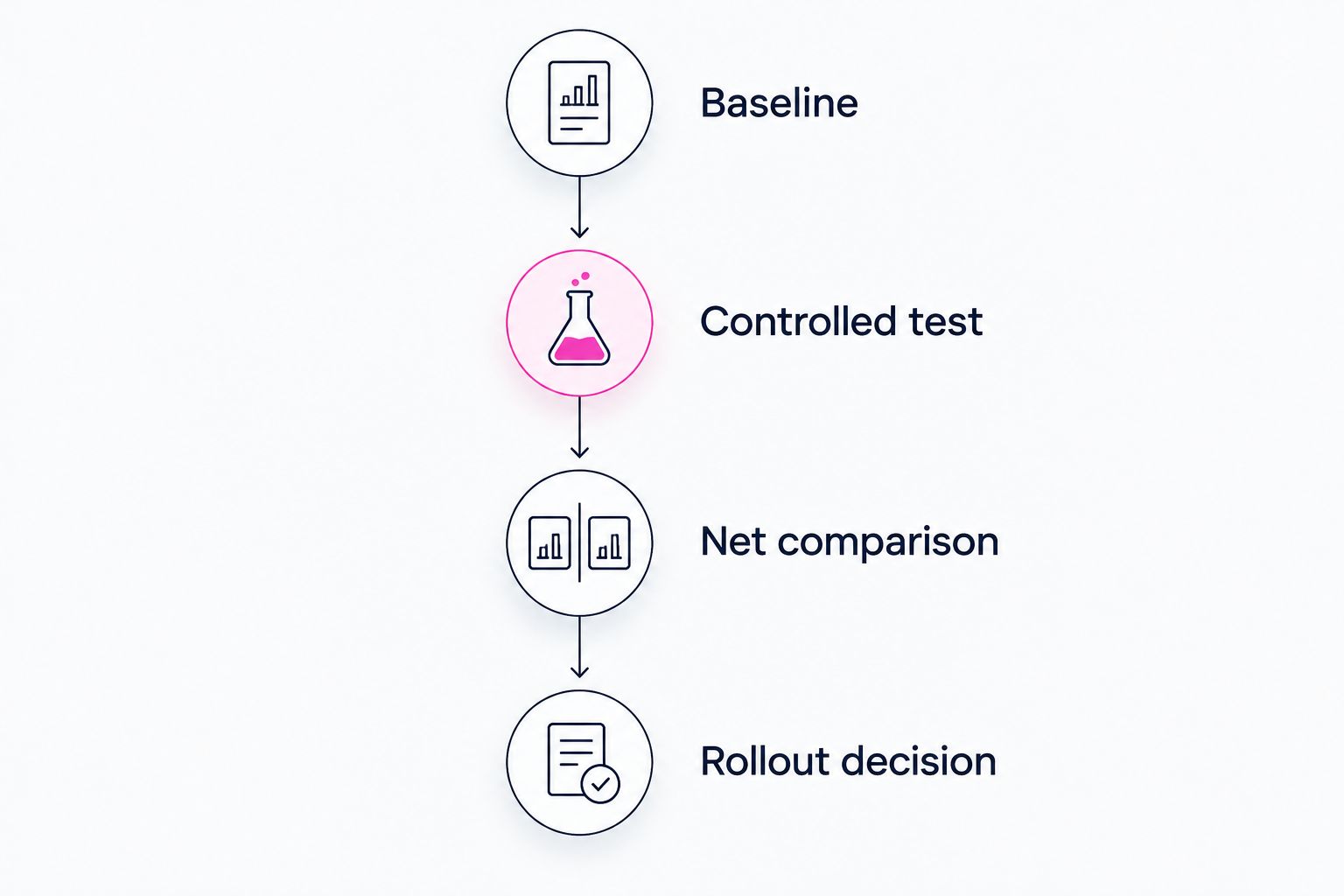
An SSP rollout should follow a net-revenue comparison, not a bid-volume increase.
The test must also reflect how your business operates. A connection that adds reconciliation work, delivery faults or unwanted advertising needs those consequences recorded alongside revenue.
These factors explain why the same SSP arrangement does not produce a uniform result across publishers or placements. Use them as review categories, not as promises of improvement.
For your 2026 review, assign each issue an owner. Commercial teams should understand deductions and deal terms; advertising operations should understand configuration and delivery; privacy specialists should assess permitted data use.
Another SSP adds unnecessary complexity when its contribution does not justify the work required to operate it. The warning sign is not simply a small share of revenue; it is a lack of demonstrable value after considering overlap, deductions and operational demands.
Ask the partner to explain its contribution at placement level. Which demand is distinct? Which inventory benefits? How will discrepancies be investigated? An aggregate revenue dashboard does not answer those questions on its own.
Do not remove a route solely because it looks redundant, either. Test the removal against comparable inventory and inspect what changes. Apparent overlap does not establish that every route performs identically.
Keep your 2026 partner review focused on a clear decision: retain, change or remove. A connection should have an accountable purpose, not permanent membership because nobody wants to revisit the implementation.
An independent agency or in-house brand needs to connect buying decisions with the inventory, creative and measurement those decisions require. Selecting publisher supply in isolation leaves those dependencies unresolved.
Cake.Shop provides a modular programmatic advertising technology platform covering media buying and reporting, rich media and DOOH creative, data clean rooms and direct publisher supply. swweetshop is the platform that powers in-housing. The relevant assessment is how those modules fit your operating model, rather than whether a standalone buying interface looks sufficient.
Cake.Shop's modular approach is relevant to agencies building their own advertising stack and brands taking control of programmatic operations. The trade-off is responsibility: your team still needs to define ownership, establish measurement requirements and assess the connections required for the intended workflow.
A useful enquiry starts with your supply requirements, creative formats, reporting needs and internal responsibilities. Ask for the proposed workflow and its boundaries. Do not treat a full-stack proposition as proof that every integration or publisher requirement is already covered.
A higher CPM does not establish higher publisher revenue. CPM describes revenue or cost per thousand impressions under the stated reporting definition; it does not establish how many opportunities sold or what the publisher retained.
Compare net revenue, delivery volume and the same underlying inventory. If the denominator or deductions differ, the headline CPM comparison is not a reliable verdict.
Header bidding is not an SSP. Header bidding is a method of allowing demand sources to compete before an ad-server decision; an SSP is a platform through which publishers offer inventory to buyers.
The distinction matters when diagnosing performance. A change to auction orchestration and a change to the demand partner are separate interventions, even when introduced together.
Direct publisher supply gives buyers a more specific supply relationship to examine, not proof of better yield. Ask what inventory is included, how the route operates and which parties participate in delivery and reporting.
For a 2026 buying decision, assess advertiser outcomes separately from publisher revenue. A shorter or more direct relationship still needs commercial and technical evaluation.
Can supply side platforms increase publisher yield without increasing advertising load?
Yes, an SSP can increase yield without adding placements when it improves retained revenue from existing opportunities. Test the change with advertising load held constant so that extra impressions do not obscure the result.
What is the best metric for checking whether an SSP improves yield?
Net revenue across comparable eligible opportunities is the clearest starting point for checking an SSP's contribution. Use net eCPM, fill and delivery diagnostics to explain the result rather than choosing a single favourable ratio.
Should a publisher connect every available SSP?
No, a publisher should connect SSPs with an identified and testable contribution. Additional routes can duplicate demand and create more configuration, monitoring and reconciliation work.
Will increasing floor prices always increase publisher revenue?
No, increasing floor prices excludes bids below the applicable threshold but does not create additional buyer demand. Compare retained revenue and unsold opportunities before keeping a floor change.
Can an SSP replace direct advertising sales?
An SSP does not automatically replace direct advertising sales. Programmatic auctions and direct agreements serve different commercial arrangements, and publishers can use both.
What should an agency ask about publisher supply?
An agency should ask which inventory it can buy, which parties participate in the route and how delivery is reported. It should also establish creative requirements, permitted data use and responsibility for discrepancies.
Does a data clean room guarantee higher publisher yield?
A data clean room does not guarantee higher publisher yield. It supports controlled data collaboration, while revenue depends on the resulting demand, permitted use, execution and retained commercial return.
A connection can look successful because the reporting denominator changed. Before approving an SSP expansion, put the old and new calculations side by side: eligible opportunities, served impressions, deductions and retained revenue.
If those definitions do not match, fix the comparison before changing the stack. Control begins with an answer your commercial and operations teams can both explain.
How long does an identity resolution match take? Timing depends on the workflow. Separate matching, audience delivery and readiness before you launch.
Read more →Can supply side platforms increase publisher yield? Yes—when demand improves net revenue. Learn how to assess fees, fill, auction rules and delivery.
Read more →How much revenue can publishers expect from an SSP? Calculate net publisher revenue, check fees and fill, and test whether new demand adds real income.
Read more →Book a 30-minute demo and see exactly how Cake.Shop works — no sales pitch, just the platform.