
OPEN DAILY
OPEN
HONEST
TRUST
LET'S CHAT



An identity resolution match takes as long as its processing workflow requires; there is no universal duration that applies across providers, datasets and destinations. The matching job is only part of the wait: data preparation, scheduled processing and audience delivery also determine when you can actually use the result.
TL;DR
A completed match is not necessarily a campaign-ready audience. If you build your launch plan around the wrong completion event, your media team inherits a deadline the data workflow cannot support.
For your 2026 campaign plan, define the finish line before requesting a turnaround estimate. The first-party data activation workflow connects identity work to the practical question: when can the buying team use the audience?
Measure time to usable output, not just time to a successful job status. That distinction matters whether you are matching customer records for analysis or preparing an audience for advertising.
The duration depends on where you start the clock and what counts as finished. An estimate for processing an accepted file does not cover the work required to make that file acceptable, or the work needed after matching.
Use these stages to request a meaningful estimate:
Data preparation
Ingestion
Identity matching
Output delivery
Activation readiness
For analysis, completion might mean an approved aggregate result is available. For media activation, completion means the destination can use the audience under its applicable rules. These are different endpoints.
Ask the provider to identify which stages its estimate includes. An end-to-end commitment must name both the start event and the completion event. Otherwise, two teams can report different turnaround times while describing the same workflow accurately.
For an activation workflow, record at least 3 timestamps: accepted input, completed match and destination readiness. Keep the source extraction time separately if you also need to measure data freshness.
Those timestamps expose whether the delay sits before matching, inside matching or after delivery. A single elapsed-time figure cannot tell you which team needs to act.
Batch matching processes a defined set of records together. It suits workflows where you can prepare a customer segment, submit it and wait for an agreed processing window.
The elapsed time includes any wait before the batch starts. A quick matching operation does not make a scheduled workflow immediate.
Best for: planned audience refreshes, reconciliation and analysis that can follow a defined schedule. The advantage is a clear input set that you can reconcile against the output; the trade-off is that records arriving after the cut-off wait for a later run.
Ask about submission cut-offs, failed-file handling and whether a corrected submission returns to the queue. Your 2026 operating plan should include those events rather than assuming every file succeeds on its first attempt.
An event-driven workflow processes incoming records or events without waiting for a complete batch. It suits use cases where newly available information needs prompt processing.
A fast response does not establish that every related record has arrived or that a downstream audience has updated. The response might describe one event rather than a fully reconciled customer profile.
Best for: workflows that need to react to incoming events. The advantage is avoiding a batch cut-off for each event; the trade-off is the need to handle late arrivals, retries and changing identity relationships explicitly.
Batch matching
Event-driven matching
Neither approach is automatically more accurate. Matching rules, identifier quality and the intended use determine whether the result is suitable.
The useful question is not simply whether the matching engine is fast. It is which parts of your workflow determine the elapsed time and which team controls each part.
Do not accept “large dataset” as the entire explanation for a delay. Ask which stage is waiting, processing or failing, and request evidence for that status.
Use a controlled rehearsal with representative data and the destination you intend to use. Testing only the matching component leaves the delivery and activation steps untested.
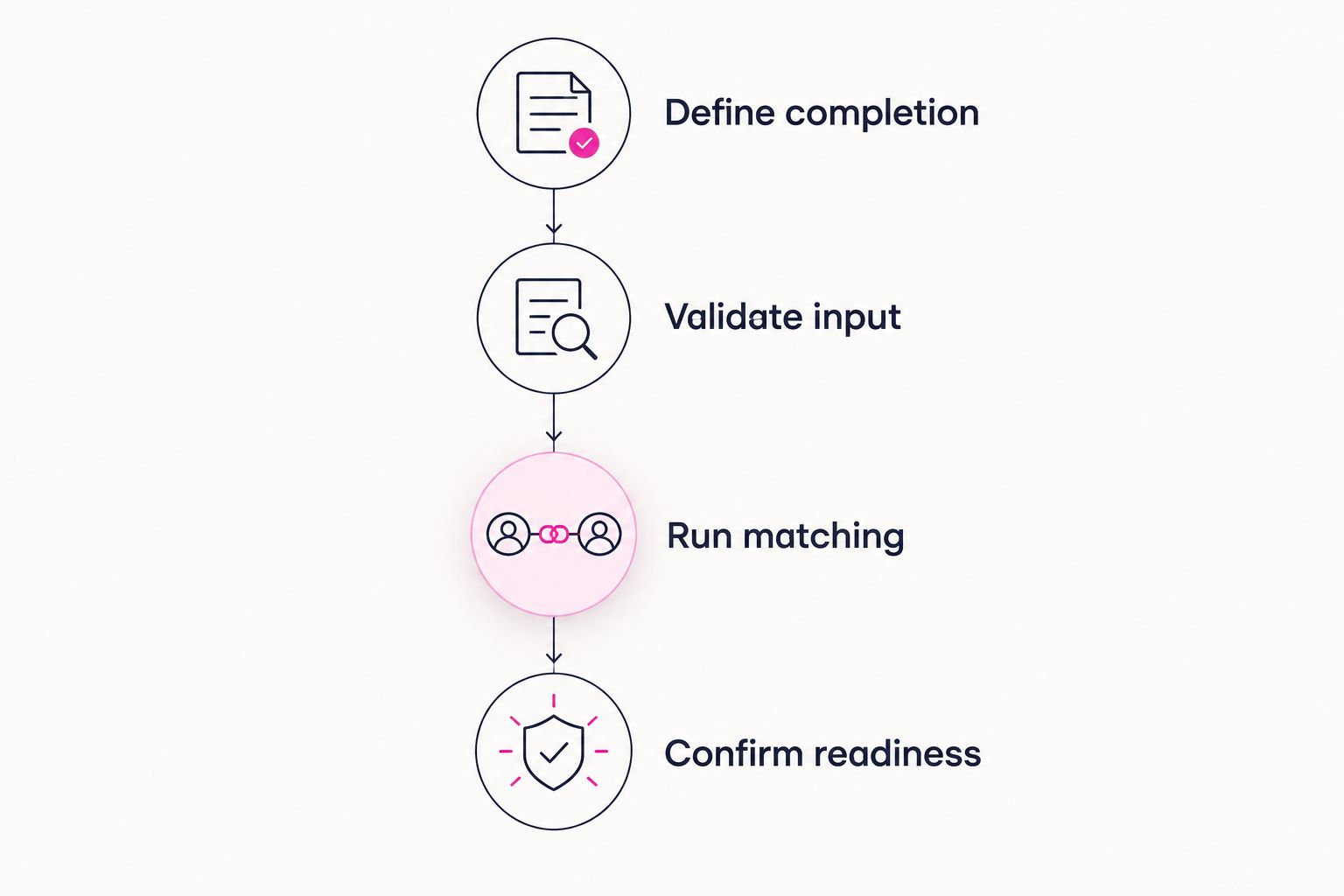
The workflow ends at the agreed usable result, not automatically when matching finishes.
Keep 2 measures separate: processing duration and end-to-end elapsed time. The first helps diagnose the matching service; the second determines whether your campaign deadline is realistic.
For your 2026 supplier evaluation, request results from the same agreed workflow rather than comparing unrelated turnaround claims. Record the data conditions and whether the run needed intervention. A clean run and a recovered failure describe different operating conditions.
No. Identity resolution links records or identifiers associated with an entity; ID verification checks evidence about a claimed identity. Completing either process does not establish that the other process has happened.
That distinction prevents a misleading comparison: ID verification processing times concern a different completion event from linking customer records for advertising. Neither process's turnaround establishes when a matched advertising audience becomes usable.
For an agency brief, use the actual task name. “Match consented customer records for audience activation” tells the delivery team more than “verify the audience”, which leaves both the method and the finish line unclear.
No. Match rate describes a proportion of records or identifiers that meet a defined matching condition; processing duration describes elapsed time. Neither measure substitutes for the other.
Before comparing results, agree on the denominator. Submitted records, valid records and eligible identifiers are different populations, so percentages based on them answer different questions.
Also separate 3 checks: coverage, correctness and usability. Coverage asks how much of the eligible input matched; correctness asks whether the links meet your rules; usability asks whether the output supports the intended task.
A rapid job with unsuitable links is not a successful activation workflow. Nor does a lower match rate prove the matching service is slow. Keep the diagnosis specific.
No. You can launch against the audience only after the destination confirms it is usable and the campaign's other requirements are satisfied. Matching does not approve creative, configure buying rules or establish measurement permissions.
Keep the identity workflow and campaign workflow connected without confusing them. A media buyer needs to know the audience's destination status, while the data team needs a clear definition of the audience the campaign actually requires.
For a 2026 launch, make audience readiness a named dependency rather than an informal message between teams. Record who confirms it and what evidence they use. That makes a delayed hand-off visible before it becomes a missed campaign deadline.
Cake.Shop is for brands and independent agencies building a modular programmatic advertising stack. Its scope includes media buying and reporting, rich media and digital out-of-home creative, data clean rooms and direct publisher supply—not just a standalone buying interface.
Cake.Shop introduces swweetshop as the platform that powers in-housing. When discussing identity resolution, keep the enquiry concrete: describe your source data, required output, destination and completion criteria rather than requesting an undefined “real-time” connection.
The commercial benefit of evaluating the full workflow is clearer ownership across data, creative, buying and reporting. The trade-off is coordination: a modular stack still needs agreed responsibilities and verified hand-offs between components.
Do not infer an identity-resolution turnaround or integration capability from the broader platform scope. Ask how your proposed workflow would operate, which party owns each stage and what would demonstrate readiness.
For Cake.Shop programmatic advertising enquiries, bring the workflow and the decision you need to make. That gives the conversation a technical starting point without turning a general platform description into a performance promise.
How long does an identity resolution match take in 2026?
An identity resolution match has no universal completion time. Define whether the estimate covers matching alone or the full workflow through usable output, then request measured timings for that scope.
Is identity resolution matching instant?
An instant response does not establish instant end-to-end completion. Data preparation, scheduled processing and destination readiness are separate events that need their own confirmation.
Does a completed match mean my advertising audience is ready?
A completed match does not necessarily mean your advertising audience is ready. Confirm that the destination has accepted the output and made it eligible for the intended use.
Is batch matching better than event-driven matching?
Batch matching suits scheduled refreshes and reconciliation; event-driven matching suits workflows that react to incoming events. Choose against your completion requirements, not an unsupported assumption that either approach is always faster or more accurate.
Can dirty customer data delay identity resolution?
Input problems add validation, rejection or correction work to the workflow. Agree on required fields and rejected-record handling before starting a production run.
What should I ask an identity resolution provider about turnaround?
Ask for the start event, completion event, processing schedule, failure-handling process and evidence of destination readiness. Request measured results for a representative workflow rather than an undefined real-time claim.
Does Cake.Shop publish a guaranteed identity resolution match time here?
This article does not establish a guaranteed identity resolution match time for Cake.Shop. Specify your proposed data and activation workflow when discussing requirements, and confirm any service commitment directly.
A fast match can still deliver stale data. Processing duration measures how long the workflow takes; freshness depends on when the source information was captured and how it is refreshed.
Put both on your 2026 acceptance checklist. Ask when the data was extracted, when matching completed and when the destination became ready. Those events tell you more about campaign readiness than a single speed claim.
How long does an identity resolution match take? Timing depends on the workflow. Separate matching, audience delivery and readiness before you launch.
Read more →Can supply side platforms increase publisher yield? Yes—when demand improves net revenue. Learn how to assess fees, fill, auction rules and delivery.
Read more →How much revenue can publishers expect from an SSP? Calculate net publisher revenue, check fees and fill, and test whether new demand adds real income.
Read more →Book a 30-minute demo and see exactly how Cake.Shop works — no sales pitch, just the platform.