
OPEN DAILY
OPEN
HONEST
TRUST
LET'S CHAT


Publishers cannot expect a fixed revenue amount from an SSP: your forecast depends on monetised impressions, the revenue those impressions earn and the deductions you actually pay. Gross auction revenue is not your payout, and a higher reported CPM does not prove that your total income increased. Build your 2026 forecast from your own inventory and reconciled earnings, not a generic earnings range.
TL;DR
An SSP revenue forecast is a business decision, not just an ad-operations calculation. It affects which demand relationships you maintain, how much implementation work you accept and what you can commit to your publishing business.
Judge an SSP by the net revenue it adds across your inventory, not the revenue it attributes to itself. Use the same principle when assessing supply-side platforms for publishers: access to demand matters, but access alone is not an earnings forecast.
The defensible answer is the amount supported by your own monetised inventory and net yield. Start with historical results for comparable traffic, then separate impression volume, earnings and deductions so you can see what changes the forecast.
Use this calculation when the reported CPM is gross of publisher-side deductions:
Expected net revenue = paid impressions ÷ 1,000 × gross realised CPM − applicable deductions.
CPM means revenue per 1,000 impressions. Confirm which impressions the report counts: an ad request, a winning bid and a rendered impression are not interchangeable billing events.
If your report already gives you net realised CPM, use paid impressions divided by 1,000, multiplied by that net CPM. Do not subtract the same platform fee again.
Gross realised CPM
Net realised CPM
Opportunity RPM
Page RPM
These are measurement choices, not competing revenue promises. Keep the denominator visible whenever you compare results.
Keep a low, central and high case in your 2026 forecast, but derive each from observed performance or documented commercial terms. An unsupported range is still an unsupported forecast.
SSP revenue varies because the inventory, buyers and auction conditions vary. Review these factors separately so you can identify whether a change came from demand, traffic composition or implementation.
Change one material setting at a time when you need to explain a result. If you alter floors, placements and demand connections together, the resulting revenue change will not identify which intervention caused it.
Choose the setup that matches your operational capacity and demand requirements. None of these approaches guarantees a particular revenue level, and more connections do not automatically mean more retained income.
Single-SSP setup
Multi-SSP setup
Deal-led setup
A single-SSP setup gives you a simpler starting point for reconciliation. Record what inventory enters the connection, what is monetised and what revenue is retained.
The limitation is concentration. A clean report does not tell you whether another demand relationship would add incremental earnings, so avoid treating simplicity as proof of maximum yield.
A multi-SSP setup deserves evaluation when you can manage the integrations and compare results consistently. The question is whether another connection increases total net earnings for equivalent inventory.
The limitation is attribution. A new SSP can report revenue that previously flowed through another connection, leaving your publishing business with little additional income despite an impressive new dashboard.
A deal-led setup is relevant when publishers and buyers need defined inventory and buying conditions. Evaluate actual delivery and retained earnings against those conditions.
The limitation is execution. A deal identifier does not ensure that buyer targeting, creative approval, inventory eligibility and auction conditions line up; those dependencies still require attention.
Use a controlled comparison wherever your implementation permits it. Compare equivalent inventory with and without the proposed connection, and keep the reporting definitions fixed throughout the assessment.
For a 2026 evaluation, document the baseline before enabling the new relationship. Record the traffic allocation, placement mix, consent conditions and auction settings so the final comparison has a clear basis.
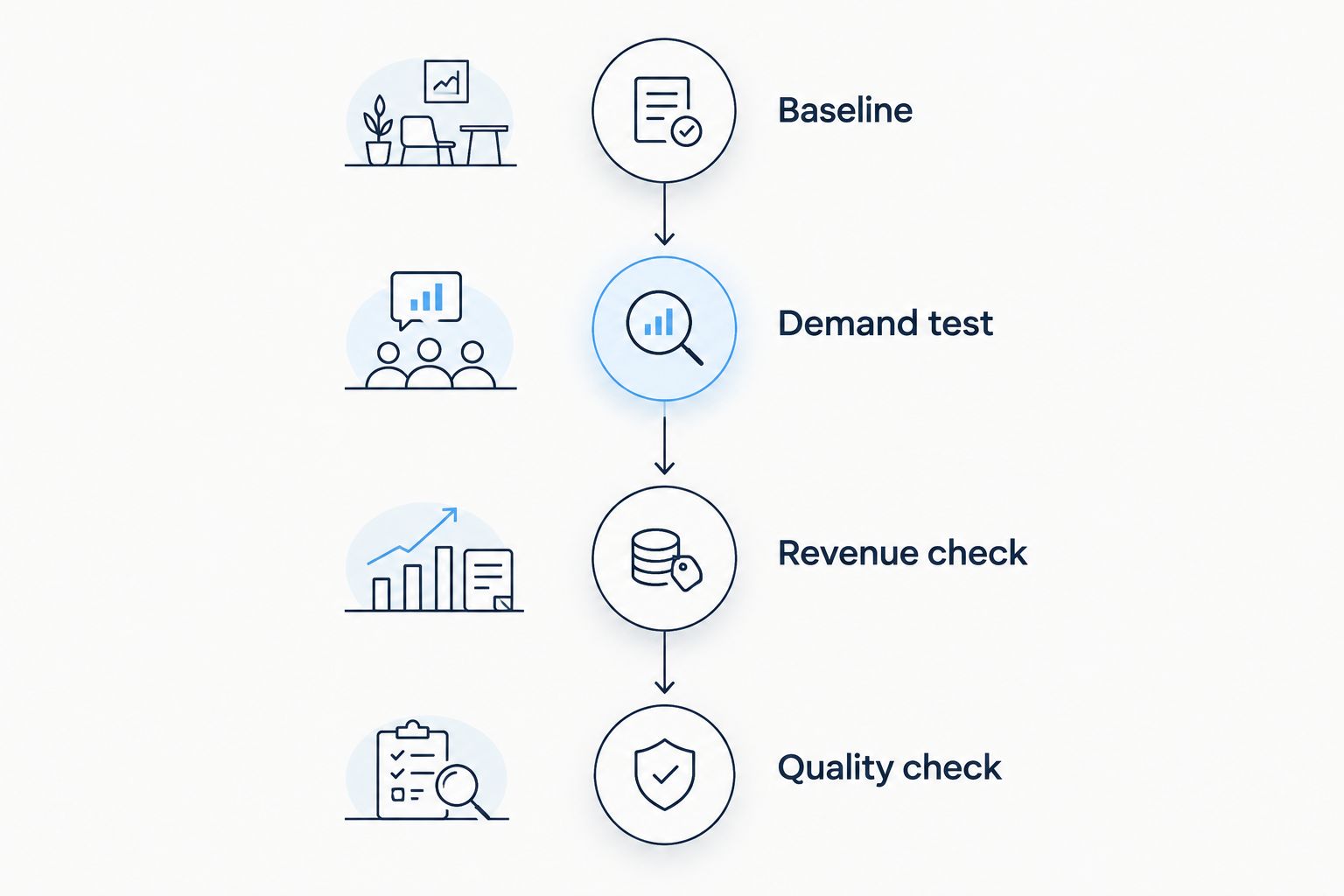
Assess the whole inventory outcome, not only the new connection’s reported revenue.
A before-and-after comparison without controlled traffic requires particular care. Changes in audience mix, advertiser demand or placement availability can explain an earnings movement independently of the new SSP.
Write the decision rule before reviewing results. Keep the connection only when its contribution justifies the associated implementation, reconciliation and maintenance work under your business requirements.
Ask for reporting and contractual definitions you can reconcile. A dashboard demonstration is not a substitute for understanding what the figures mean and how they relate to payment.
Your 2026 evaluation checklist should cover:
Ask the provider to walk through an example report and explain how it reconciles to a payment statement. Use the proposed contract to verify the explanation, particularly where dashboard terminology differs from commercial terminology.
If you cannot trace reported revenue to retained earnings, you cannot use it as a dependable forecast. Resolve that issue before expanding the implementation.
Publisher revenue and advertiser performance sit on opposite sides of the same transaction. Publishers need an intelligible route to demand; independent agencies and in-house brand teams need to understand what inventory they buy and how buying, creative and reporting fit together.
Cake.Shop is a modular programmatic option for independent agencies and brands building an in-house advertising stack. Its platform, swweetshop, powers in-housing, with media buying and reporting, rich media and DOOH creative, data clean rooms and direct publisher supply forming the broader stack.
That makes Cake.Shop relevant to an enquiry about connecting supply with buying and creative requirements, not just selecting a standalone buying tool. The trade-off is evaluation scope: buyers still need to establish which modules, inventory relationships and reporting arrangements match their requirements rather than assume every component is needed.
A higher CPM is not automatically better if it accompanies fewer paid impressions or larger deductions. Compare net earnings across the same inventory denominator before calling the change an improvement.
A connection can win fewer auctions at a higher reported CPM while total publisher income falls. The CPM describes the impressions it monetised, not every opportunity you offered.
Adding another SSP does not guarantee additional revenue because demand can overlap across connections. Evaluate the change in total retained earnings rather than adding each platform’s headline figures together without reconciliation.
Keep the operational consequence visible too. A small revenue contribution still requires assessment against integration and reporting work.
Publishers can build a conditional forecast from comparable historical inventory, documented deductions and an explicit set of assumptions. That forecast is a planning model, not a commitment from the SSP.
For a 2026 business case, label assumptions separately from observed results. Replace them with reconciled performance as the integration produces usable evidence.
How much revenue can publishers expect from an SSP in 2026?
Publishers should forecast SSP revenue from their own paid impressions, realised yield and applicable deductions, not a universal earnings range. Compare the forecast with reconciled net earnings once the connection is operating.
How do I calculate SSP revenue from CPM?
Multiply paid impressions divided by 1,000 by the realised CPM. If that CPM is gross, subtract applicable deductions; if it already reflects those deductions, do not subtract them again.
Should I compare SSPs using fill rate or CPM?
Compare total net earnings on a consistent inventory basis, with fill rate and CPM as supporting measures. Neither measure alone establishes the revenue you retain.
Will header bidding guarantee more publisher revenue?
Header bidding does not guarantee more publisher revenue. Assess whether the additional demand increases total net earnings after the associated implementation and operating requirements.
Why does my SSP dashboard differ from my payment statement?
Different reporting periods, currencies, counting definitions and applicable adjustments can produce differences. Reconcile the specific fields and contractual terms rather than assuming the dashboard figure is the final payout.
Is Cake.Shop only a media-buying tool?
Cake.Shop provides a modular programmatic stack covering media buying and reporting, rich media and DOOH creative, data clean rooms and publisher supply. Assess the relevant modules against your agency or in-house brand requirements.
What should a small publisher ask an SSP first?
Ask how net revenue is calculated, which inventory is eligible and how reporting reconciles to payment. Establish the implementation and maintenance requirements before making a revenue commitment.
An SSP’s share of your revenue can grow without your total revenue growing. It can simply capture auctions that another connection previously monetised.
Make total retained earnings the acceptance criterion. Keep the denominator, deductions and comparison conditions attached to that number, and the decision becomes clearer than any headline CPM.
How long does an identity resolution match take? Timing depends on the workflow. Separate matching, audience delivery and readiness before you launch.
Read more →Can supply side platforms increase publisher yield? Yes—when demand improves net revenue. Learn how to assess fees, fill, auction rules and delivery.
Read more →How much revenue can publishers expect from an SSP? Calculate net publisher revenue, check fees and fill, and test whether new demand adds real income.
Read more →Book a 30-minute demo and see exactly how Cake.Shop works — no sales pitch, just the platform.