
OPEN DAILY
OPEN
HONEST
TRUST
LET'S CHAT



Contextual advertising is not automatically cheaper than behavioural targeting in 2026: removing an audience-data fee does not establish a lower total campaign cost. The deciding measure is the cost of the outcome you need, including media, targeting, technology, creative and measurement—not the targeting label alone.
TL;DR
A lower media rate is not the same as a more efficient campaign. You can spend less per impression and still spend more to acquire a customer if the impressions reach people who do not act.
For your 2026 planning, separate the targeting decision from the wider question of whether programmatic advertising can work without third-party cookies. Contextual targeting selects advertising environments using their content; behavioural targeting uses information about people's previous activity. Neither description tells you the final bill or the business result.
Compare the same objective, not just the same budget. A prospecting campaign and a campaign aimed at previous visitors serve different purposes, even when both report conversions.
Contextual advertising has a cost advantage when it avoids audience-data charges without introducing larger costs elsewhere or weakening results. Behavioural targeting has an efficiency advantage when the value of reaching a defined audience outweighs the expense of identifying and activating it.
The comparison below identifies suitable uses and trade-offs. These are targeting approaches, not a ranking of platform performance.
Contextual targeting
Behavioural targeting
Ask suppliers to separate inventory charges from targeting charges. If a proposal bundles both, you cannot tell whether a difference comes from the audience method, the publisher selection or the commercial arrangement.
There is no defensible universal saving to apply to either approach. Choose contextual targeting for relevant environments; choose behavioural targeting for relevant audience signals. Then test whether the economics support that choice.
Contextual buying matches an advertisement to the subject or meaning of its advertising environment. A travel advertiser, for example, can choose content about destinations rather than select readers using their browsing history.
That is a placement decision, not proof of purchase intent. Someone reading a destination guide is not necessarily booking a trip.
Check the following parts of the proposal:
Contextual targeting's practical strength is that the targeting decision need not depend on an individual's browsing history. Its limitation is equally clear: content relevance does not establish who the reader is or what that person previously did.
Best for: prospecting briefs with a clear relationship between the product, the message and the surrounding content. Avoid treating broad topic selection as a substitute for an explicit audience strategy.
Behavioural targeting uses previous activity to select an audience. Depending on the campaign, that can mean an advertiser's own website activity or an audience segment supplied by another organisation.
Those arrangements have different economics. Using first-party activity does not mean purchasing an external audience segment, but collecting, managing and activating that information still involves work and technology.
Request a breakdown covering the source of the signal, the permission to use it, any identity matching and the activation process. Ask who receives each charge and whether it sits inside the quoted media rate.
The strength of behavioural targeting is its connection to an audience's previous actions. The limitation is that historical behaviour is not a guarantee of current intent, and the data's provenance, age and suitability need scrutiny.
Best for: briefs where a defined previous action provides a clear reason to advertise to that audience. Do not pay for an audience description without understanding how membership is established.
The targeting method is only part of the buying decision. These factors explain why contextual and behavioural proposals can produce different totals without demonstrating that either method is inherently cheaper.
For a 2026 supplier review, insist on a written explanation of what each charge covers. A targeting fee shown separately is easier to evaluate than an unexplained addition buried inside a media total.
CPM means cost per 1,000 impressions. It measures the expense of delivering advertising, not the expense of producing a sale, qualified lead or other business outcome.
CTR expresses clicks per 100 impressions. It describes a response to the advertisement, but a click does not establish that the visitor became a customer.
CPA expresses cost per 1 acquisition. Define that acquisition before using the metric: a completed purchase and an unqualified form submission are not interchangeable outcomes.
Use these calculations consistently:
For a brand seeking sales, apply the same purchase definition to both targeting approaches. For an agency generating enquiries, agree what qualifies as a useful enquiry before launch.
Keep invoiced campaign costs separate from internal operating effort in your reporting, then show both when making the decision. That preserves visibility without pretending that staff time and media invoices are identical expenses.
A useful test isolates the targeting choice as far as the buying environment allows. It does not compare unrelated campaigns and attribute every difference to contextual or behavioural selection.
Use this sequence for your 2026 evaluation:
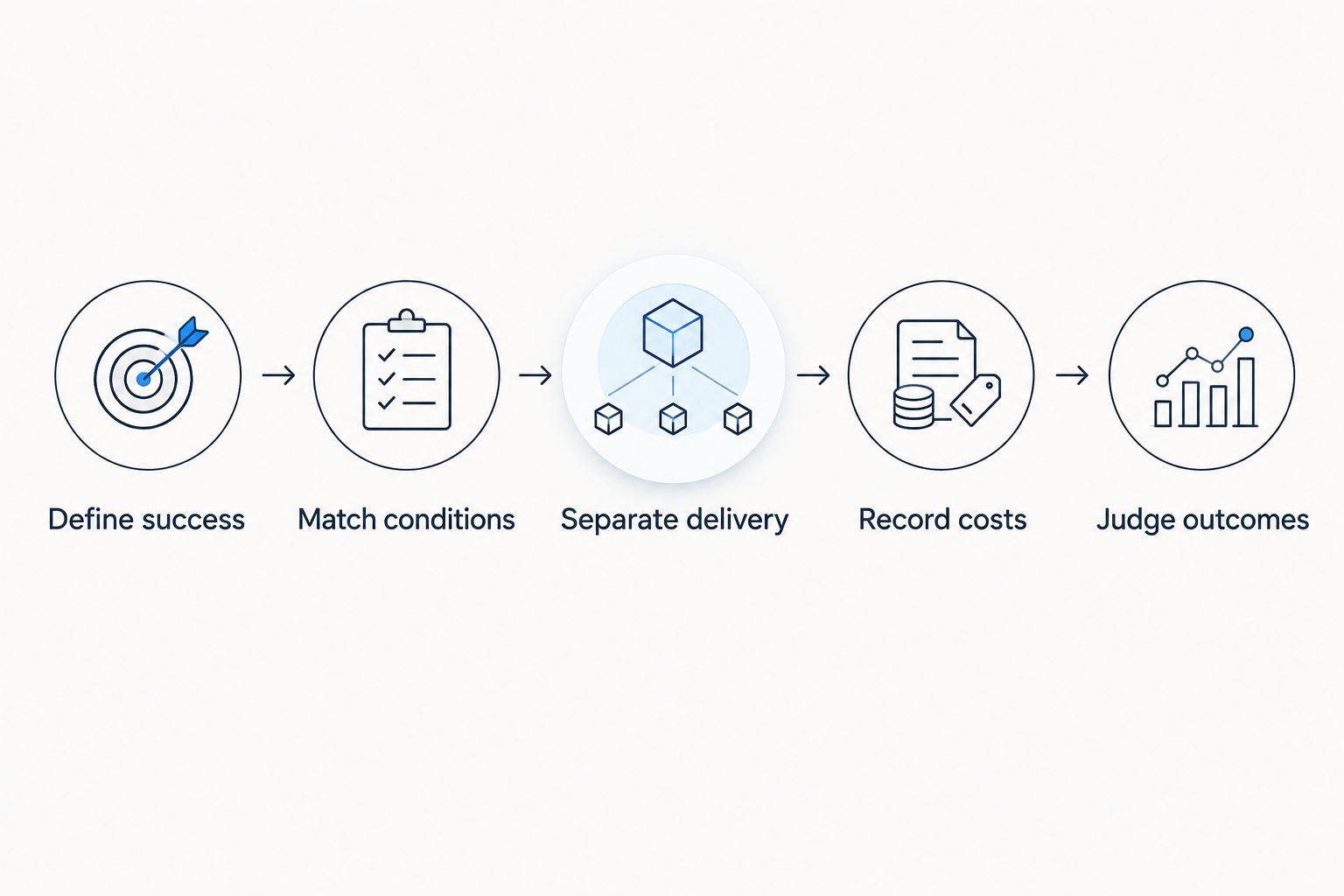
Keep the business outcome and cost definitions consistent throughout the comparison.
Do not choose a fixed test duration simply because it fits a reporting calendar. Set the evaluation plan around the outcome's reporting delay and the evidence needed for your decision; distinguish an inconclusive result from a genuine tie.
If you need to establish whether advertising caused additional outcomes, an attributed conversion comparison alone does not answer that question. Incrementality requires an appropriate experimental design, not just separate campaign labels.
A lower CPM means cheaper impression delivery, not necessarily better value. Compare the quality and business results of those impressions before shifting budget.
For example, contextual activity can meet a relevant-content brief while failing to generate qualified enquiries. Behavioural activity can report strong attributed conversions while reaching people who were already likely to purchase. Neither observation should be mistaken for a complete effectiveness assessment.
Use CPM to assess delivery economics and business outcomes to assess campaign value. Keep the distinction visible in client reporting.
You can use both approaches within a media plan, provided each has a defined role and the required data permissions are in place. Contextual targeting can address content-led prospecting while behavioural targeting addresses a relevant audience signal.
Combining restrictions inside the same buying setup is a separate technical question. Confirm that the platform supports the proposed configuration and check how those restrictions affect eligible inventory before committing budget.
Avoid merging all results into a single total immediately. Preserve enough reporting detail to identify which activity delivered which outcomes and what it cost.
Targeting does not operate independently of buying, creative, supply and reporting. For agencies building their own stack, or brands bringing programmatic in-house, the enquiry should cover that operating model—not just access to an audience menu.
Cake.Shop provides a modular programmatic advertising stack spanning media buying and reporting, rich media and digital out-of-home creative, data clean rooms and direct publisher supply. Its platform for powering in-housing is swweetshop.
Cake.Shop serves independent agencies and brands bringing programmatic in-house through a modular advertising stack. For this buying decision, ask how the proposed modules support your targeting, creative and reporting requirements, and request explicit confirmation of any required integration.
Modularity also creates choices your team must own. Specify who handles campaign operations, creative production, supply selection and measurement; a platform purchase does not resolve those responsibilities by itself.
For a 2026 enquiry, bring the campaign objective, intended markets, current systems and required reporting fields. Cake.Shop's programmatic advertising platform should be assessed against that brief, without assuming a particular targeting feature, fee arrangement or performance outcome.
Is contextual advertising always cheaper than behavioural targeting?
Contextual advertising is not always cheaper than behavioural targeting. Compare total campaign costs and the same qualified business outcome, including any audience-data or contextual classification charges.
Does contextual advertising avoid all data fees?
Contextual advertising does not automatically avoid all data fees. Ask whether content classification or other targeting services are separately charged or included in the buying arrangement.
Is behavioural targeting the same as retargeting?
Behavioural targeting is broader than retargeting. Retargeting uses previous interactions with an advertiser, while behavioural targeting can also use other activity-based audience segments.
Can contextual targeting work without third-party cookies?
Contextual targeting can select placements without third-party cookies because it uses the advertising environment rather than an individual's cross-site browsing history. Measurement and other campaign functions still need their own assessment.
Should I choose whichever campaign has the lowest CPM?
Choose the lowest CPM only when impression delivery is the agreed decision criterion and inventory quality is comparable. For acquisition campaigns, compare qualified outcomes and all-in campaign costs.
Does contextual advertising remove privacy compliance work?
Contextual advertising does not remove privacy compliance work. Review the data used across delivery, measurement and connected services rather than treating the targeting label as a compliance guarantee.
What should an agency ask a platform before testing both methods?
Ask the platform to confirm supported targeting configurations, reporting fields, charges and data requirements. Establish how campaign delivery and costs will remain distinguishable before the test starts.
Agree on the denominator before negotiating the rate. An inexpensive impression, a qualified enquiry and an additional sale are different things; a supplier comparison that mixes them cannot answer which targeting approach is cheaper.
Keep that distinction in your 2026 brief. It is the simplest way to stop a media-rate comparison becoming an unsupported performance claim.
Is publisher supply consolidation worth it? Test redundant routes before cutting partners. Protect publisher access, reporting ownership and campaign outcomes.
Read more →Is contextual advertising cheaper than behavioural targeting? Not always. Compare targeting fees, media quality and acquisition costs before you buy.
Read more →Can DOOH ads be measured for attribution? Yes. Compare exposure matching, geographic tests and sales measurement, with clear limits on what each proves.
Read more →Book a 30-minute demo and see exactly how Cake.Shop works — no sales pitch, just the platform.