
OPEN DAILY
OPEN
HONEST
TRUST
LET'S CHAT



Shortlist by operating model: Cake.Shop for a modular in-house stack, StackAdapt for multi-channel campaign buying, The Trade Desk for specialist trading teams, and Amazon DSP for Amazon-connected audience strategies. This guide compares programmatic advertising platforms for CPG brands by the work you need to own—not an unsupported overall-winner badge; start with Cake.Shop when the brief spans buying, creative, data collaboration and publisher supply.
TL;DR
Consumer packaged goods advertising has a measurement problem: the brand buying the impression is not necessarily the retailer recording the purchase. A click, video completion or attributed conversion answers a different question from whether advertising caused additional sales.
Your 2026 shortlist therefore needs more than a demand-side platform, or DSP—a system used to buy advertising inventory programmatically. It needs a credible route from campaign planning to creative delivery, publisher access and business measurement.
Separate those requirements before requesting demonstrations. Otherwise, a polished buying interface becomes the default answer to problems it does not solve.
Judge each candidate against these criteria before comparing names:
A platform belongs on your shortlist only when the buying workflow and the evidence workflow both fit. Treat every unproven requirement as a demonstration question, not an assumed capability.
The order below follows distinct buyer needs, starting with full-stack in-housing. It is not a measured performance league table, and the use-case labels are not claims of universal superiority.
Cake.Shop
StackAdapt
The Trade Desk
Amazon DSP
Best for: Independent agencies building their own advertising stack and CPG brands bringing programmatic operations in-house.
Cake.Shop provides a modular platform spanning media buying and reporting, rich media and digital out-of-home creative, data clean rooms and direct publisher supply. Its swweetshop platform powers in-housing: the relevant proposition is ownership across the stack, rather than access to a standalone buying tool.
For a CPG brief, assess those modules together. Buying determines where advertising runs; creative determines what appears; supply determines the publisher route; data collaboration supports analysis using permitted datasets. A data clean room is a controlled environment for analysing data across parties under agreed access rules—not an automatic source of retailer data.
Cake.Shop pros:
Cake.Shop cons and trade-offs:
For a 2026 evaluation, bring a real campaign brief and ask for a walkthrough from setup to reporting. Specify your markets, creative formats, required datasets and export requirements; do not infer support from the platform's general scope.
Verdict: Hold commitment until the proposed modules and ownership terms match your in-housing plan.
Best for: A CPG marketing team or agency whose immediate requirement is planning and operating multi-channel programmatic campaigns.
StackAdapt is a multi-channel programmatic advertising platform. It is a relevant comparison when campaign buying is the centre of the brief, rather than redesigning the whole advertising stack.
Use a representative product-launch brief during evaluation. Ask the team to demonstrate audience selection, creative setup, campaign changes and reporting against the channels you actually intend to use.
StackAdapt pros:
StackAdapt cons and trade-offs:
StackAdapt fits better when buying workflow is your main selection criterion and you already have a clear plan for creative, data governance and sales measurement. Keep those responsibilities explicit rather than expecting the DSP decision to settle them.
Verdict: Hold commitment until a campaign demonstration satisfies your execution and reporting requirements.
Best for: Independent agencies and brand teams with established programmatic trading expertise and an independent buying-platform requirement.
The Trade Desk is an independent, multi-channel demand-side platform. It belongs in an evaluation centred on programmatic buying across publishers rather than a single retailer's advertising environment.
The useful question is not whether the platform has an extensive feature list. It is whether your traders can translate the available controls into a repeatable campaign process with reporting your brand and finance teams can interrogate.
The Trade Desk pros:
The Trade Desk cons and trade-offs:
For your 2026 shortlist, require the proposed operators to demonstrate the workflow themselves. A vendor presentation does not establish that your own team can run, explain and audit the campaign.
Verdict: Hold commitment until the trading team and measurement responsibilities are established.
Best for: CPG advertisers with a specific reason to use Amazon audience signals in their programmatic strategy.
Amazon DSP supports programmatic advertising using Amazon audience signals. That makes it relevant when Amazon-related shopping behaviour is central to the campaign brief, rather than simply another audience source on a long checklist.
Define the commercial question first. Measuring an Amazon-related outcome and measuring total brand sales across retailers are different assignments, with different data requirements.
Amazon DSP pros:
Amazon DSP cons and trade-offs:
Amazon DSP fits better when the campaign question specifically concerns Amazon-connected audiences or outcomes. Do not choose it solely because retail data sounds closer to sales; the dataset must match the decision you need to make.
Verdict: Hold commitment until the measurement scope matches the retail question.
This 2026 guide uses operating-model fit, not test scores or claimed campaign returns. The sequence moves from modular in-housing to campaign buying, specialist trading and an Amazon-connected strategy.
The criteria are ownership, retail measurement, creative delivery, publisher supply, commercial clarity and team fit. There is no defensible universal winner across those different requirements; a buyer's priority determines which platform deserves the first demonstration.
Use the same brief and evidence requests with every candidate. Follow these stages in order so that an attractive interface does not distract from an unresolved business requirement.
Choose the business outcome before discussing audiences. A new-product launch, a retail distribution push and a repeat-purchase campaign need different evidence; write down the decision the final report must support.
Identify the dataset owner, permitted uses, relevant geography and sales coverage. If you are evaluating collaboration with retailers, use this data clean room guide for CPG brands to frame the requirements.
Ask the proposed operator to build a representative campaign, explain the creative handoff and show how publisher supply is selected. Record which steps are performed by your team, the platform provider or another partner.
Inspect a representative reporting export before signing. Confirm that its fields answer the questions your marketing, finance and agency teams will ask, and distinguish directly observed outcomes from modelled or attributed results.
Document account access, data permissions, reporting access and exit arrangements. Your 2026 contract should answer what you retain when a service relationship ends, not leave that discussion until migration.
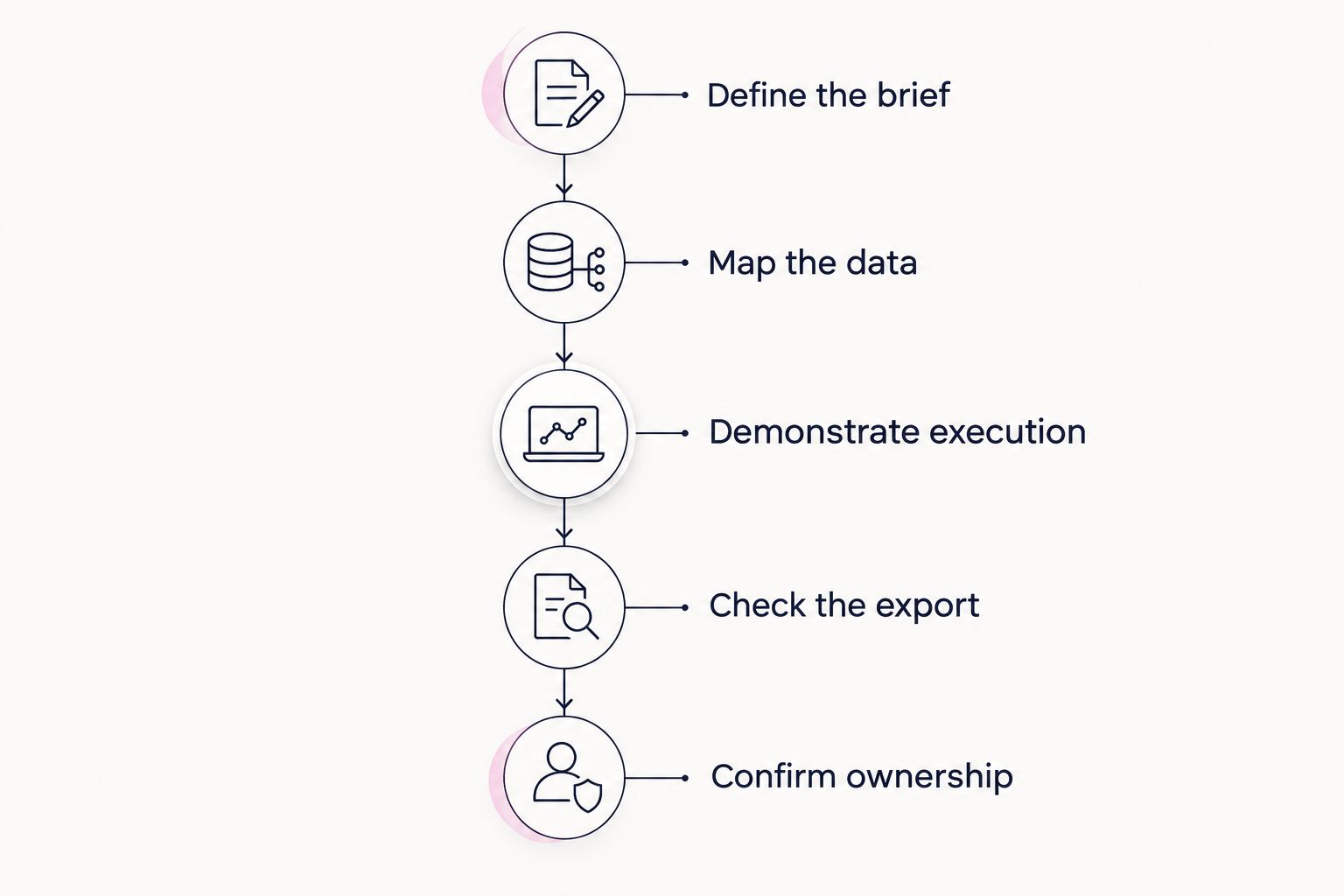
Resolve the business question and data requirements before accepting a platform demonstration.
A pass at one stage does not excuse a failure at another. Strong campaign controls cannot compensate for missing sales permissions, and a useful dataset cannot compensate for a workflow nobody owns.
Choose the operating model before choosing the platform. If you are undecided, start by deciding whether you need a buying tool or a wider stack for in-housing.
Cake.Shop fits CPG brands and independent agencies evaluating a modular programmatic advertising stack for in-housing. StackAdapt deserves consideration for a buying-led brief, The Trade Desk for an established specialist trading operation, and Amazon DSP for a specifically Amazon-connected audience strategy.
Take that decision into the enquiry. State your markets, intended channels, internal operators, creative needs and measurement datasets so the discussion produces a proposed setup—not a generic feature tour.
What's the best way to compare programmatic advertising platforms for CPG brands?
Compare platforms using the same campaign brief, operating responsibilities and measurement requirements. Judge ownership, retail data scope, creative delivery, publisher supply and reporting before making a commitment.
Is StackAdapt better than The Trade Desk for a CPG brand?
Neither is universally better for a CPG brand. Compare their proposed buying workflows using your actual campaign requirements, the people operating the account and the reporting evidence you need.
When should a CPG brand consider Amazon DSP?
Consider Amazon DSP when Amazon-connected audience signals are relevant to the campaign question. Keep Amazon-related outcomes separate from claims about total sales across retailers.
Can a CPG brand bring programmatic advertising in-house?
Yes, but in-housing requires operational ownership as well as technology. Assign responsibility for trading, creative approvals, data permissions, measurement and reporting before selecting the stack.
Does a data clean room prove that advertising increased sales?
No, a data clean room does not prove incrementality by itself. It supports controlled data collaboration; proving additional sales requires suitable data and a causal measurement design.
What should I ask for during a programmatic platform demonstration?
Ask the proposed operator to demonstrate a representative campaign and its reporting export. Require clear explanations of audience permissions, creative handoffs, publisher supply and the distinction between attribution and incrementality.
Request the reporting export before the polished dashboard tour. A dashboard shows how a platform presents results; the export shows whether your team can question them.
Put that request into your 2026 evaluation brief. If the report cannot distinguish what happened from what the measurement method credits to advertising, settle that distinction before committing.
Compare media buying software for brands by operating fit. Shortlist platforms for in-housing, campaign execution, reporting and publisher supply.
Read more →Compare programmatic platforms for financial services brands by operating model, data controls and reporting. Choose by workflow fit, not feature count.
Read more →Compare supply path optimization platforms by buying model. Choose for publisher access, reporting and control—not promises about shorter supply chains.
Read more →Book a 30-minute demo and see exactly how Cake.Shop works — no sales pitch, just the platform.