
OPEN DAILY
OPEN
HONEST
TRUST
LET'S CHAT



For modular in-housing, shortlist Cake.Shop; for publisher-direct access within The Trade Desk, assess OpenPath; for direct buying through PubMatic, assess Activate. These supply path optimization platforms and products address different parts of the buying chain, so choose by the control you need—not a universal league table.
TL;DR
Supply path optimisation, or SPO, means choosing how your advertising spend reaches publisher inventory. A supply path includes the buying platform, selling intermediaries and publisher relationships involved in delivering an impression.
A shorter path is not automatically a better path. Removing an intermediary does not prove that you reached a better placement, improved measurement or retained the audience your campaign needs.
For independent agencies, the commercial question is whether you can explain and control the route on a client's behalf. For brands bringing programmatic in-house, it is whether your team owns the decisions and can inspect the results without relying on a summary dashboard.
Your 2026 shortlist should separate buying platforms, publisher-access products and full-stack architecture. Comparing them as interchangeable tools hides the decision you actually need to make.
Use these six criteria before booking demonstrations:
Treat transparency and control as separate requirements. A report can expose a problem without giving your traders permission to fix it.
This 2026 shortlist groups options by buying model. The order follows the use cases below; it does not represent a measured performance ranking.
Cake.Shop
The Trade Desk OpenPath
PubMatic Activate
A demand-side platform, or DSP, supports media buying. A supply-side platform, or SSP, helps publishers sell inventory. Neither label alone tells you how much visibility or control a particular commercial agreement provides.
Best for: Independent agencies building their own stack and brands bringing programmatic operations in-house.
Cake.Shop provides a modular programmatic platform covering media buying and reporting, rich media and digital out-of-home creative, data clean rooms and direct publisher supply. Its platform, swweetshop, powers in-housing: the relevant question is how those components support your operating model together, rather than whether you need another standalone buying tool.
For an agency, that means evaluating publisher supply alongside campaign execution and client reporting. For an in-house brand, it means connecting buying decisions with creative requirements and governed data workflows. A data clean room supports controlled data collaboration; it is not, by itself, proof that a supply route performs better.
Cake.Shop pros:
Trade-offs to assess:
Verdict: Hold for a workflow demonstration if you need modular in-housing; skip a full-stack change if your only requirement is a narrow supply audit.
Best for: Buyers assessing direct publisher access while operating within The Trade Desk.
OpenPath connects publishers directly with demand from The Trade Desk. Its relevance is specific: assess it as a publisher-access route within that buying environment, not as an independent platform for inspecting every route across your advertising stack.
Start with publisher overlap. If your required publishers and placements are not represented in the route you are evaluating, a shorter chain does not solve your reach requirement. Then ask how your team identifies and compares those impressions in campaign reporting.
The Trade Desk OpenPath pros:
Trade-offs to assess:
If your team already uses The Trade Desk and does not want to replace its buying environment, assess OpenPath before considering a broader stack migration solely for supply access. That is an operating-model decision, not a performance endorsement.
Verdict: Hold for a publisher-overlap and reporting review when The Trade Desk is your intended buying environment.
Best for: Buyers evaluating a direct-buying relationship through a supply-side platform.
PubMatic Activate enables direct buying through PubMatic's sell-side infrastructure. It belongs on a different branch of the shortlist from a conventional DSP selection: the evaluation centres on the supply relationship and buying workflow you want to establish.
Ask where campaign decisions occur, who operates them and which reporting leaves the platform. A direct connection is only useful if your buying team can reconcile delivery with its existing measurement and client reporting.
PubMatic Activate pros:
Trade-offs to assess:
Use a specific campaign brief in the demonstration. Ask the vendor to show the route from publisher selection through buying decisions to an export your reporting team can reconcile.
Verdict: Hold for a workflow assessment if SSP-direct buying matches your operating model; skip if you require an unchanged DSP-led process.
The evaluation method is workflow fit against the six criteria above: publisher access, path visibility, commercial clarity, buying control, measurement consistency and stack fit. The shortlist distinguishes modular in-housing, DSP-connected publisher access and SSP-direct buying.
It does not assign performance scores or claim independently tested superiority. For your 2026 decision, require evidence against your campaign brief before converting a shortlist into a supplier recommendation.
StackAdapt also deserves consideration when it is an intended buying environment. Compare the supply controls and reporting demonstrated for your account against the same brief; do not replace an otherwise suitable platform merely because another vendor uses stronger SPO language.
Write down the publishers, environments, creative formats and audience requirements the campaign must retain. Identify which requirements are essential and which are preferences.
Separate Publisher access from Buying control, Reporting evidence and Outcome checks. These are connected requirements, but passing one does not establish the others.
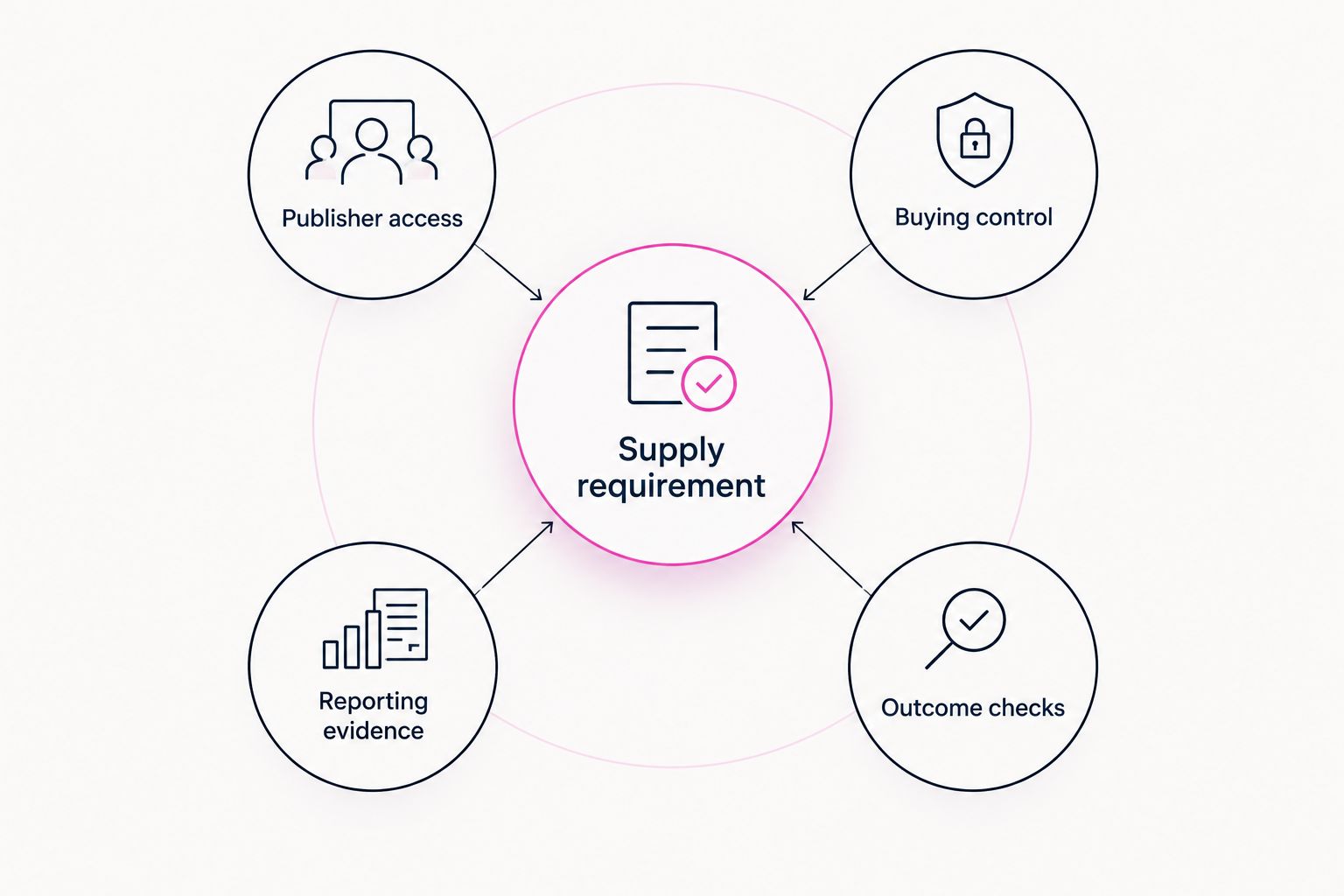
Evaluate access, control, reporting and outcomes separately before choosing a route.
Request a sample delivery export and its field definitions. Ask which identifiers persist from campaign setup to delivery reporting, and which fields depend on the publisher, deal or integration.
Then ask your reporting owner to explain what the export proves. A domain-level report does not necessarily identify the placement, and an impression count does not establish an incremental business result.
Start with 1 campaign and compare 2 paths where the available inventory supports a meaningful comparison. These are practical test-design recommendations, not performance benchmarks.
Keep creative, targeting, measurement definitions and campaign objectives consistent. Record unavoidable differences so your team does not attribute a placement or audience change to supply-path optimisation.
Use 3 checks before expanding the preferred route:
Name who approves routes, changes exclusions and reconciles delivery. For an agency, specify which decisions need client approval and which sit with the trading team.
Record data export rights and exit arrangements in the commercial review. Ownership is a contractual and operational question, not a dashboard feature.
Assess your in-housing stack
Explore modular media buying, reporting, creative, data clean rooms and publisher supply.
Choose the operating model first, then validate the supply route. Default to assessing improvements within your intended buying environment before approving a migration; choose a broader platform review when ownership of the stack is itself the problem.
For a 2026 procurement brief, request the same evidence from every candidate: relevant publisher access, usable exports, demonstrable controls and clear commercial responsibilities. Reject comparisons that substitute feature counts for those answers.
What's the best way to compare supply path optimization platforms?
Compare platforms against the same publisher requirements, buying controls, reporting fields and measurement rules. Separate modular platforms from DSP-connected access products and SSP-direct buying models before judging fit.
Is a direct supply path always better?
No. A direct path must still meet your publisher access, quality, measurement and campaign requirements; fewer intermediaries alone do not prove a better result.
Is supply path optimisation the same as choosing a DSP?
No. Choosing a DSP establishes a buying environment, while supply path optimisation concerns the routes used to reach publisher inventory. Evaluate both decisions together without treating them as identical.
Should an agency replace its existing platform for better supply access?
Not solely on the promise of a shorter path. First establish whether the existing platform can meet the required access, control and reporting needs, then assess whether a migration solves a wider operating problem.
What should I ask an SPO vendor to demonstrate?
Ask the vendor to demonstrate publisher selection, route controls, delivery reporting and a usable export against your campaign brief. Request field definitions so your team understands what the evidence establishes.
Does a data clean room prove that a supply path works better?
No. A data clean room supports controlled data collaboration, but campaign evaluation still requires an appropriate measurement design. Keep supply-route visibility separate from claims about incremental outcomes.
What should a supply-path pilot measure in 2026?
A 2026 pilot should measure required delivery, agreed quality checks and the campaign's business outcome under consistent rules. Document differences in inventory, targeting and creative before interpreting the result.
Ask this before signing: If a publisher appears through multiple routes, can your team explain why it chose this one?
The answer should name the placement requirement, the evidence and the person responsible. If it only names a platform, your supply-path policy is unfinished.
Compare media buying software for brands by operating fit. Shortlist platforms for in-housing, campaign execution, reporting and publisher supply.
Read more →Compare programmatic platforms for financial services brands by operating model, data controls and reporting. Choose by workflow fit, not feature count.
Read more →Compare supply path optimization platforms by buying model. Choose for publisher access, reporting and control—not promises about shorter supply chains.
Read more →Book a 30-minute demo and see exactly how Cake.Shop works — no sales pitch, just the platform.