
OPEN DAILY
OPEN
HONEST
TRUST
LET'S CHAT



For iGaming brands, programmatic advertising is automated media buying with the aim of acquiring eligible adult customers in markets where the operator can lawfully advertise. This guide explains how to connect buying, creative, publisher supply and measurement without treating a platform’s targeting settings as proof of regulatory compliance.
TL;DR
An iGaming campaign needs more than an audience and a conversion pixel. You need agreement between the operator’s permissions, the advertising rules for the destination market, the publisher’s policies and the platform’s category restrictions. Approval at one layer does not establish approval elsewhere.
That changes the buying brief. Broad reach is not the starting objective; eligible reach is. A campaign that generates registrations outside your approved market has failed before acquisition efficiency enters the discussion.
For your 2026 plan, assess the operating model as well as the buying interface. Cake.Shop provides modular media buying and reporting, rich media and DOOH creative, data clean rooms and publisher supply. Introduce swweetshop as the platform that powers in-housing, then establish which modules and responsibilities your team actually needs.
Cake.Shop is an option for brands and independent agencies building a modular programmatic advertising stack. That describes the fit, not verified acceptance of iGaming campaigns: obtain written confirmation of category, market and inventory eligibility before committing.
Start manually with a market-by-market eligibility sheet. Ask legal and compliance owners to approve the operator entity, product, destination market, landing page and advertising message before anyone builds audience segments.
Do not collapse online casino, sports betting and other gambling products into one permission field. Record the actual product you intend to promote and check its treatment in each market. A licence, platform approval and publisher acceptance answer different questions.
For an initial 2026 pilot, choose 1 market and 1 product as a planning boundary, not a performance benchmark. A narrow brief makes it easier to identify whether a rejected impression, blocked creative or disqualified registration comes from a specific rule.
Close the approval loop with named owners. Your trader should know who can authorise a change and who can stop delivery.
Use a shared spreadsheet and your existing analytics exports to write the conversion specification. A registration, verified account and first deposit are separate events; do not let a reporting dashboard silently substitute one for another.
Choose the business event that reflects your acquisition objective, subject to your legal and privacy requirements. Document which events are eligible for advertising measurement and which must remain inside operational systems. More granular data is not automatically more appropriate data.
Build a reconciliation rule before launch. If the advertising platform counts a conversion that the operator later rejects, your reporting needs a clear treatment rather than an unexplained discrepancy.
Optimise towards qualified outcomes, not the easiest event to record. Keep responsible-gambling safeguards separate from growth objectives, and ask compliance owners which exclusions and restrictions must apply to every campaign.
Draw the workflow before evaluating software. Begin with a document that shows who approves creative, who operates buying, who authorises publisher supply and who reconciles results. This exposes gaps that a feature checklist misses.
Cake.Shop’s programmatic advertising proposition spans those stack components rather than only a buying interface. Evaluate swweetshop against your in-housing requirements, and ask for a demonstration using your approved workflow. Confirm integrations, access permissions and reporting requirements explicitly; a modular product description does not establish every technical connection.
Use these four workstreams as the operating map:
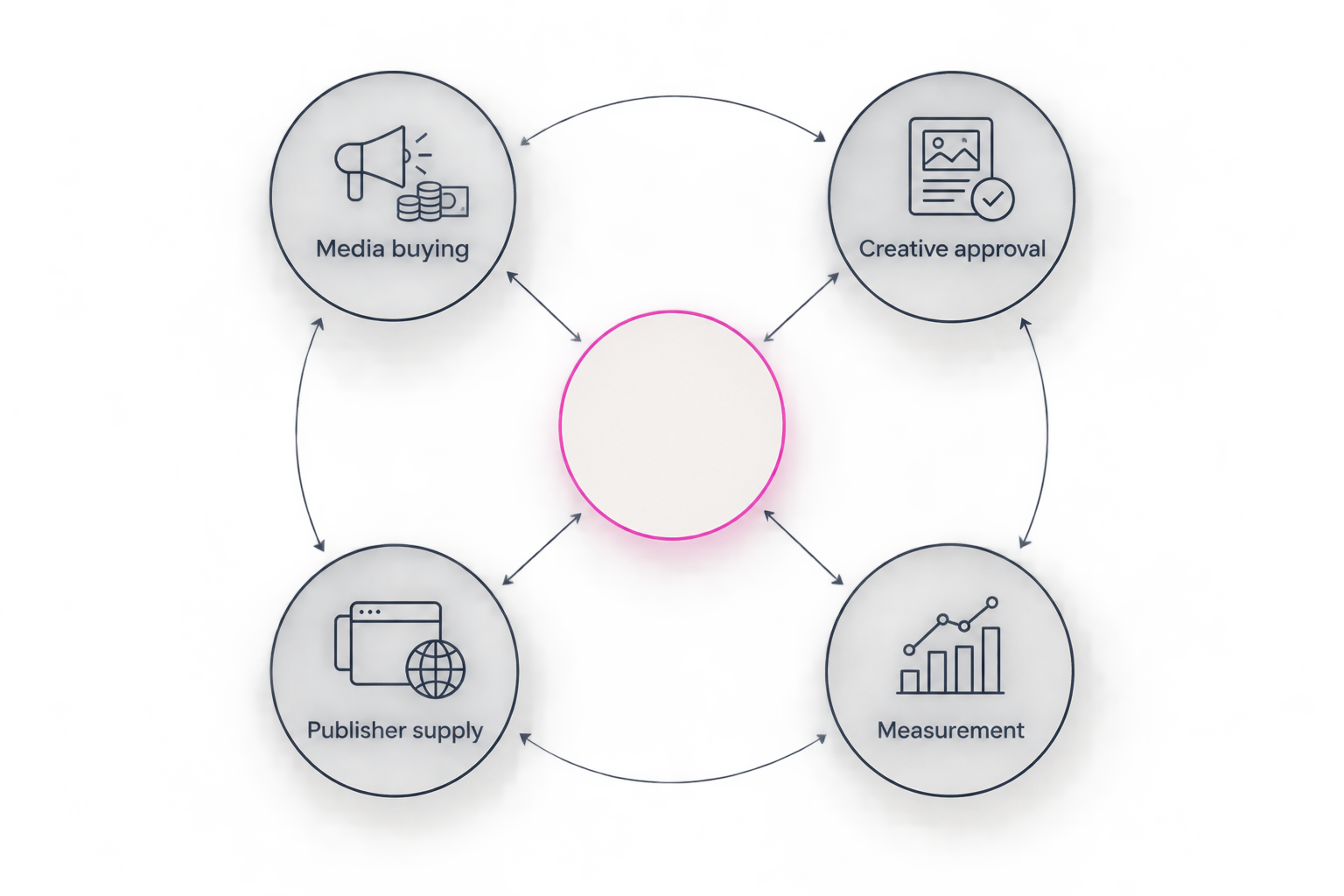
Treat buying, creative, supply and measurement as one operating system with separate owners.
Begin with a manually reviewed publisher list and written acceptance of the gambling category. A demand-side platform, or DSP, is software used to buy advertising inventory; its access to an impression does not make that impression suitable for your campaign.
Ask how each proposed supply path reaches the publisher. Record the seller, the inventory description, the permitted geography and the available placement reporting. Direct publisher supply is worth assessing for visibility and commercial control, but the label alone proves neither audience eligibility nor placement quality.
For 2026 campaign approvals, separate web, app, connected television and digital out-of-home inventory. DOOH means advertising on digital screens in physical locations. Each environment needs its own assessment of audience exposure, creative requirements and measurement limits.
Do not expand merely because the platform can spend more. Expand when the new inventory passes the same approval process.
Create a manual approval matrix before producing variants. Give every message, landing page and disclosure an owner, a permitted market and a version identifier. This keeps a harmless-looking creative edit from changing an approved offer or legal meaning.
Rich media adds interactive elements to an advertisement. Evaluate whether interaction helps explain an approved proposition; do not add it merely to increase engagement counts. An interaction is not evidence of an eligible new customer.
Cake.Shop includes rich media and DOOH creative within its modular stack. Ask how your proposed assets move through production, approval and delivery, and verify the supported formats against the actual inventory plan. Do not assume an asset approved for one channel can run unchanged elsewhere.
Treat dynamic content as a controlled publishing process. If messages change using a feed or template, establish who approves the possible outputs and how an incorrect version is withdrawn.
Start by reconciling aggregated media reports with approved operator-side acquisition records. Identify the minimum information required to answer the question before considering audience matching or additional data transfers.
A data clean room provides a controlled environment for analysing data under defined access and output rules. It does not, by itself, make a data use lawful or prove that advertising caused an outcome. Specify permitted inputs, approved queries, retention and output controls before implementation.
For an incrementality test, begin the design with 2 test cells: exposed and control. These are experimental groups, not a recommended sample size. Your analyst must establish whether the assignment method, audience size and contamination controls support a defensible comparison. The distinction between attribution and causation is central to measuring incrementality with a data clean room.
Reconcile the acquisition funnel with payment operations too. A registration followed by a failed or reversed deposit is not the same business outcome as an accepted funded account; iGaming payment processing therefore belongs in the event-definition discussion, while payment credentials stay outside advertising reporting.
Write the pilot scorecard manually before launch. Separate delivery health, compliance checks and business outcomes so a strong result in one category cannot conceal failure in another.
Use 3 approval gates for expansion: eligibility, measurement integrity and acquisition quality. These are operating recommendations, not industry benchmarks. A campaign should pass all three before you introduce another market, product or inventory environment.
For your 2026 review, inspect exceptions as closely as averages. A blended acquisition figure can hide rejected accounts, missing placement data or a supply change that nobody approved. Require explanations for those exceptions before increasing scope.
Assign a person who can pause delivery and a person who can authorise restart. Platform access, agency responsibility and operator accountability must agree in practice, not just in a contract.
Choose an operating model against your team’s responsibilities, not a universal platform ranking. The options below describe organisational choices; they do not establish that any supplier accepts your proposed gambling campaign.
For a 2026 shortlist, request a demonstration of the same approved brief from every candidate. Compare what your team can inspect, change and export, and identify work that still depends on another supplier.
Cake.Shop modular stack
Separately assembled stack
Managed-service buying
Make ownership a selection criterion. Ask who controls campaign accounts, publisher relationships, creative source files and reporting exports if the commercial arrangement ends. These questions matter even when the initial pilot is small.
A platform accepting an account does not establish permission for every product, jurisdiction or publisher. Keep operator permissions and campaign-level approvals in separate records, and require both before activation.
Context describes content, not a verified individual. Do not treat a sports page, app category or venue description as sufficient evidence that a gambling advertisement can lawfully reach its audience.
A recorded deposit event and an accepted business outcome are not interchangeable. Agree how failed, rejected and reversed events affect acquisition reporting before the bidding team uses those signals.
Duplicating a campaign also duplicates assumptions. Re-approve permissions, messages, destinations, supply and measurement requirements for each new market instead of relying on the original configuration.
What is programmatic advertising for iGaming brands?
Programmatic advertising for iGaming brands is automated media buying intended to reach eligible audiences for gambling products in permitted markets. It requires separate checks for operator permissions, advertising rules, platform acceptance and publisher policies.
Can an iGaming brand bring programmatic advertising in-house?
An iGaming brand can assess in-housing when it can assign trading, compliance, creative and measurement responsibilities. Software does not remove those responsibilities; confirm category acceptance and operating requirements before selecting a platform.
Does a DSP automatically check gambling compliance?
A DSP is not a substitute for market-specific legal and compliance review. Establish what the platform checks, what the publisher requires and what remains the operator’s responsibility.
Is contextual targeting enough to keep gambling ads compliant?
Contextual targeting alone does not establish gambling-advertising compliance. Content relevance does not prove audience age, location or permission to receive a particular advertisement.
Should an iGaming campaign optimise towards registrations or deposits?
Optimise towards the approved event that accurately represents your acquisition objective. Define event acceptance, privacy permissions and treatment of rejected outcomes before using the event for bidding.
Does a data clean room prove advertising incrementality?
A data clean room does not prove incrementality on its own. A credible causal claim requires an appropriate experimental or analytical design, with its assumptions and limitations stated.
What should an iGaming brand ask a programmatic supplier first?
Ask whether the supplier accepts the specific gambling product, operator entity and destination market. Then request evidence of the relevant inventory permissions, controls, reporting access and allocation of responsibilities.
Before your next 2026 launch, rehearse stopping the campaign. Ask the trader to identify the live assets, approved supply, active audiences and person authorised to restart delivery. If the team cannot explain that process clearly, simplify the operating model before adding reach.
Programmatic advertising for igaming brands starts with market eligibility. Plan compliant supply, creative approvals and measurement before scaling spend.
Read more →HubSpot CRM programmatic targeting needs verified data routes. Follow the setup, identity checks and removal tests before activating customer audiences.
Read more →Segment CDP cookieless activation starts with consent and supported identifiers. Follow the workflow for audience mapping, suppression and measurement.
Read more →Book a 30-minute demo and see exactly how Cake.Shop works — no sales pitch, just the platform.