
OPEN DAILY
OPEN
HONEST
TRUST
LET'S CHAT



Brand safety tools can block some ads from appearing beside harmful content, but they cannot guarantee that every placement is safe. In 2026, the practical approach is to combine pre-bid filtering, publisher controls and post-bid verification, then investigate the placements those controls miss.
TL;DR
An ad can reach the right audience in the wrong environment. Audience targeting answers who you want to reach; brand safety controls address where your advertising appears. Treating those as the same decision leaves a gap in your buying policy.
For an independent agency, that gap becomes a client accountability problem. For an in-house team, it becomes an ownership problem: someone must approve the rules, review exceptions and stop unsuitable delivery. Use the ad verification and brand safety tools guide alongside a written placement policy, not instead of one.
Brand safety tools reduce the risk of harmful adjacency; they do not eliminate it. Their effectiveness depends on what they can inspect, when they inspect it and whether their findings actually change delivery.
Pre-bid means before an advertising impression is purchased. Post-bid means after the purchase, when a verification system measures the delivered placement. A warning in a report is not the same thing as a buying restriction.
Pre-bid filtering
Publisher inclusion lists
Contextual classification
Post-bid verification
Manual review
These controls belong together. An inclusion list narrows the buying environment; contextual rules assess content within it; verification checks what happened. Manual review handles the cases that automated categories do not explain well.
Pre-bid filters give your buying platform a reason not to bid on inventory that matches an exclusion rule. This is the right place to enforce known restrictions rather than discovering them only in a delivery report.
The limitation is visibility. A filter acts on the signals available at the buying decision, not on a perfect, permanent understanding of every surrounding element. Content can change, and a domain-level classification does not describe every article on that domain.
Ask the supplier to demonstrate an actual exclusion in the campaign workflow. Confirm where the rule applies, how exceptions work and whether an unclassified placement remains eligible. A configured filter needs an explicit policy for content it cannot classify.
Post-bid verification helps you identify assessed impressions that breached your policy. It is useful for diagnosing publishers, placements or buying routes that need investigation.
Its central limitation is timing: the ad has already run. A report becomes a control only when someone uses it to change delivery, escalate a disputed classification or revise the buying rules.
Keep measurement coverage separate from measured safety results. A favourable result across assessed impressions does not establish that unassessed impressions were safe. Your 2026 reporting should show both the finding and the scope of the assessment.
An inclusion list restricts delivery to publishers, domains or apps that your team has approved. It gives agencies and brands a deliberate boundary around their buying rather than relying entirely on exclusions.
The trade-off is reduced access to inventory outside that boundary. It also creates maintenance work: publishers change, apps change ownership, and an approved environment can contain material unsuitable for a particular campaign.
Direct publisher relationships can help you establish content expectations and escalation routes. They do not make every placement automatically safe. Keep the publisher agreement, placement rules and verification requirements distinct.
The same policy can produce different results across campaigns because the available evidence and enforcement points differ. Check these factors before treating a dashboard result as proof of protection:
Write down the treatment of unknown inventory before launch. Otherwise, the most consequential setting can remain an undocumented default.
Brand safety addresses content categories that an advertiser excludes because of the risk they present. Brand suitability adds the advertiser's own judgement about acceptable context. A placement can pass a general safety rule and still conflict with a campaign's message.
Consider a travel campaign beside reporting about a serious transport incident. The journalism can be legitimate while the adjacency remains unsuitable for that campaign. That is a contextual decision, not evidence that the publisher is inherently unsafe.
Build your 2026 policy around examples, not just category names. Explain what is prohibited, what needs review and what remains acceptable. This helps traders avoid turning a broad topic exclusion into a blanket ban on useful reporting.
Overblocking has a trade-off too. It removes eligible inventory, including content that uses a flagged term in a harmless or informative context. Review false positives alongside missed harmful placements rather than judging the system only by how much it blocks.
Use a workflow that connects policy to buying decisions and evidence. The point is not to accumulate settings; it is to make each setting accountable to a business decision.
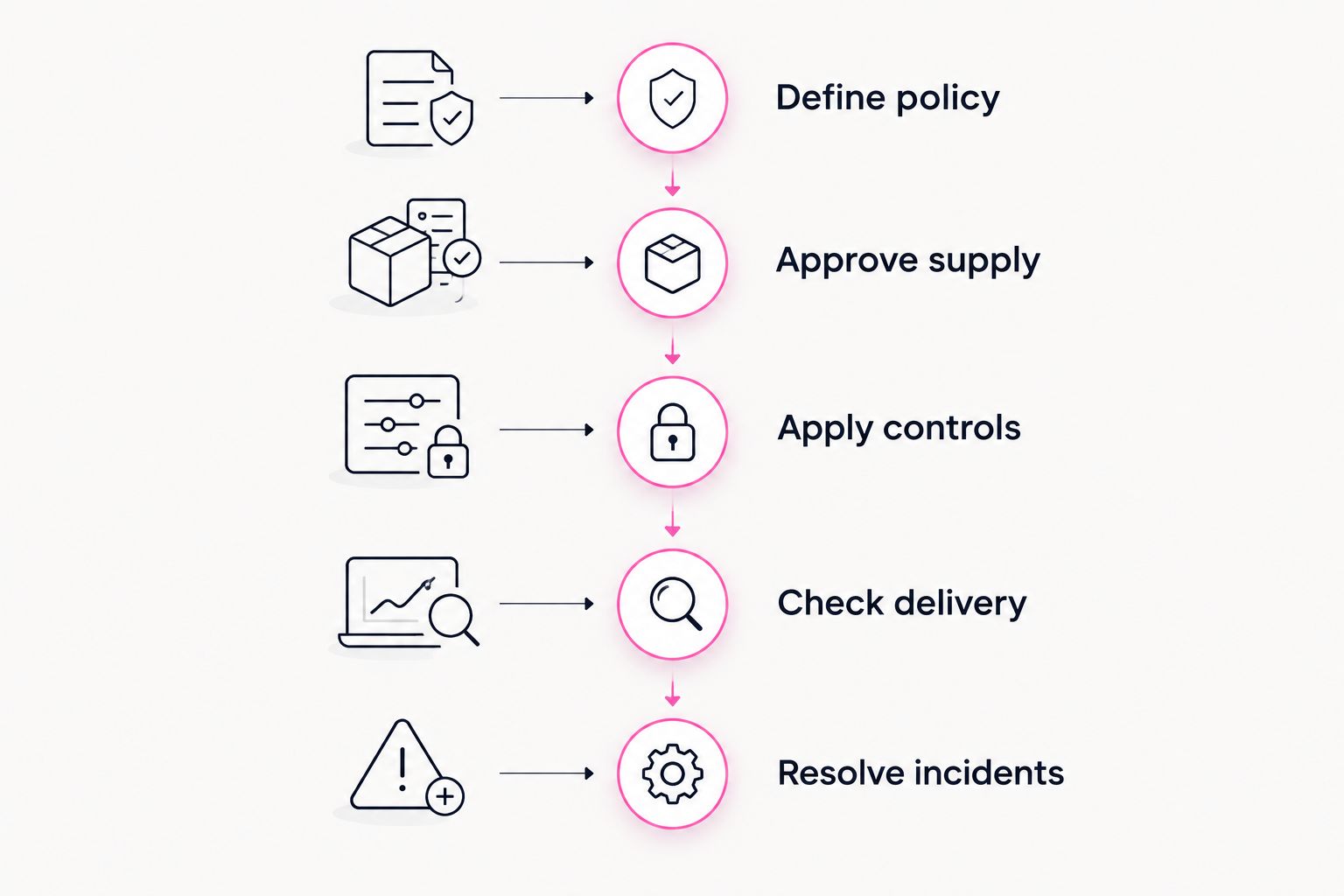
A safety policy needs both buying restrictions and a process for responding to delivery evidence.
Give each stage an owner. An agency should agree with the client which decisions require approval; an in-house brand should establish who can pause activity without waiting for a wider review. Escalation rules belong in the launch plan, not in an emergency email thread.
A platform demonstration should show how the policy operates, not just where the brand safety menu sits. Ask the seller to trace a restriction from configuration through delivery reporting and incident handling.
Request a sample report that distinguishes classified, unclassified and excluded inventory. Ask whether you can inspect the placement information needed to investigate a complaint, and which channels have different reporting limits. Confirm whether a stated control prevents buying or only reports an issue afterwards.
For a 2026 evaluation, use the same test scenarios across shortlisted suppliers. Include an approved publisher with an unsuitable article, content without a classification and a disputed keyword match. These are evaluation scenarios, not claims about any supplier's performance.
A useful demonstration ends with clear responsibility. Who maintains the rules? Who investigates a breach? Who can change an exclusion? If those answers depend on separate providers, document the hand-off rather than assuming the buying platform owns everything.
Cake.Shop provides a modular programmatic advertising platform spanning media buying and reporting, rich media and DOOH creative, data clean rooms and publisher supply. Cake.Shop introduces swweetshop as the platform that powers in-housing. The relevant question is how the buyer's safety policy works across that stack, rather than treating safety as an isolated buying feature.
Creative, supply and measurement solve different problems. Rich media changes the ad experience; publisher supply determines the available environments; a data clean room supports controlled data collaboration. None of those functions, by itself, proves that a delivered placement is suitable.
For brands and independent agencies considering Cake.Shop, request a demonstration of the applicable controls, reporting boundaries and ownership arrangements. A modular stack supports a choice of components, but buyers must establish where responsibilities sit between them. That is the trade-off to resolve before launch, not a reason to assume every module includes verification.
An inclusion list cannot replace content assessment when your policy depends on the specific page or programme. It controls the approved environment, not every piece of content within it.
Use publisher approval as a boundary and assess whether additional contextual controls are needed inside that boundary. A narrow campaign with reviewed placements has different requirements from broad buying across changing content.
Contextual targeting does not make verification unnecessary. Selecting content relevant to your campaign and checking whether the delivered environment meets your safety policy are separate tasks.
A relevant topic can still contain unsuitable material. Keep the targeting decision and the suitability decision visible in the campaign setup, even when the same supplier supports both.
Restrict the affected delivery while you investigate the evidence. Record the placement, timing, creative and applicable policy rule, then establish whether the issue involved classification, configuration, coverage or a disputed interpretation.
Change the relevant control rather than blocking an entire publisher by reflex. Resume only when the responsible owner accepts the corrective action and documents the decision.
Can brand safety tools guarantee my ads never appear beside harmful content?
No. Brand safety tools reduce exposure, but classification gaps, changing content and differences in channel coverage prevent a universal guarantee. Combine prevention with verification and incident handling.
What's the difference between pre-bid and post-bid brand safety?
Pre-bid controls act before an impression is purchased; post-bid verification assesses delivery afterwards. Prevention restricts buying, while verification provides evidence for investigation and corrective action.
Is blocking harmful keywords enough to protect my brand?
No. Keyword blocking can miss harmful meaning and exclude harmless reporting that uses the same terms. Use contextual assessment and review disputed matches against your written policy.
Are approved publishers automatically safe for every campaign?
No. Publisher approval establishes an acceptable buying environment, but individual articles, programmes or discussions can still breach campaign-specific suitability rules. Retain content-level controls where the policy requires them.
How do I compare brand safety results between platforms?
Compare the policy definitions, assessment coverage, channels and enforcement points before comparing headline results. Results with different scopes do not describe the same protection.
Can direct publisher buying remove brand safety risk?
Direct publisher buying does not remove brand safety risk. It can establish clearer content expectations and escalation routes, but placements still need to meet your campaign policy.
What should an agency put in a brand safety report?
An agency should report the applicable policy, assessed coverage, detected breaches and corrective actions. Separate unassessed inventory from inventory that was assessed and passed.
A clean report is not the same as a fully assessed campaign. Before approving your next 2026 campaign report, ask what proportion of delivery the assessment actually covers and how the remaining inventory was handled. That question separates evidence of protection from the absence of reported incidents.
Compare programmatic display advertising platforms by operating model. Shortlist for in-housing, multichannel buying and Google workflows, with clear checks.
Read more →How long to onboard a new DSP for an agency? Readiness sets the timeline. Define launch gates, data dependencies and handover checks before committing.
Read more →Can brand safety tools stop ads next to harmful content? They reduce risk, not eliminate it. Learn which controls prevent, detect and resolve unsafe placements.
Read more →Book a 30-minute demo and see exactly how Cake.Shop works — no sales pitch, just the platform.