
OPEN DAILY
OPEN
HONEST
TRUST
LET'S CHAT


Onboarding a new DSP takes as long as your agency needs to complete commercial approval, account setup, campaign checks and an operational handover; a login is not the finish line. For a 2026 rollout, agree separate dates for platform access, the first live campaign and independent operation, because creative approval, measurement and data permissions sit outside basic account creation.
TL;DR
The onboarding timeline ends when your agency can run the agreed workflow, not when the vendor creates an account. Distinguish platform implementation from launching a programmatic campaign: launch readiness includes assets, targeting, inventory access and measurement decisions that account provisioning alone does not resolve.
Use the following acceptance sequence for your 2026 onboarding plan. These are checkpoints, not promised turnaround times.
Ask the provider to attach an owner, dependency and acceptance condition to each checkpoint. A calendar date without those details is a target, not an implementation plan.
An agency does not just need access to media. You need a repeatable way to operate client accounts, approve changes, explain delivery and produce reporting that your client team understands.
A narrow onboarding definition hides that work. If training ends at campaign creation, the first reporting request or tracking discrepancy becomes an unplanned implementation task during live delivery.
For your 2026 rollout, distinguish what must work before launch from what can follow. That decision keeps optional integrations from becoming accidental requirements while protecting the controls that genuinely matter.
Your first campaign and your finished advertising stack do not need identical scope. Choose the smallest operational scope that still meets the client's brief, then document what it excludes.
The following options describe implementation approaches, not vendor service tiers or speed guarantees.
Initial campaign
Agency operating setup
Connected stack
Choose scope by the work your team must perform, not by the shortest onboarding claim. A limited launch is useful when everyone understands its boundaries. It becomes a problem when the agency presents it internally as a completed migration.
For example, a campaign that does not require customer data should not automatically inherit a customer-data integration project. Conversely, if the client brief requires that data, removing the integration changes the brief rather than completing onboarding sooner.
The main drivers are dependencies and acceptance decisions. Use these factors to explain the schedule rather than asking for an unsupported average.
Keep a dependency register alongside the launch plan. Each entry should state what is blocked, who can unblock it and what evidence closes the issue.
Use acceptance gates to make progress visible. A gate is a documented decision that the next stage can begin, supported by evidence rather than a meeting invitation.
Write down the initial advertiser, campaign objective, channels, creative formats and measurement requirements. Identify exclusions explicitly, especially integrations or workflows that stakeholders assume are included.
Your acceptance evidence is a brief approved by the people responsible for delivery and client expectations. If those people disagree about the goal, configuration work will not resolve the disagreement.
Test the permissions each role needs for its actual work. Include buying, review and reporting responsibilities rather than checking only whether an administrator can sign in.
Your acceptance evidence is a role-based walkthrough. Record who can approve changes and who receives an escalation when access or account configuration fails.
Review the campaign configuration against the approved brief. Check assets, destinations, targeting, exclusions, scheduling and the reporting setup relevant to the campaign.
Your acceptance evidence is a documented quality check with unresolved items clearly marked. Do not treat an unfinished measurement requirement as a cosmetic issue if the client needs it to judge delivery.
Ask the operating team to demonstrate the workflow without the implementation lead doing the work for them. Include routine changes, delivery checks, reporting and an explanation of where to seek help.
Your acceptance evidence is an agreed handover record. Separate launch-blocking issues from improvements that can wait, and assign both rather than allowing them to disappear into meeting notes.
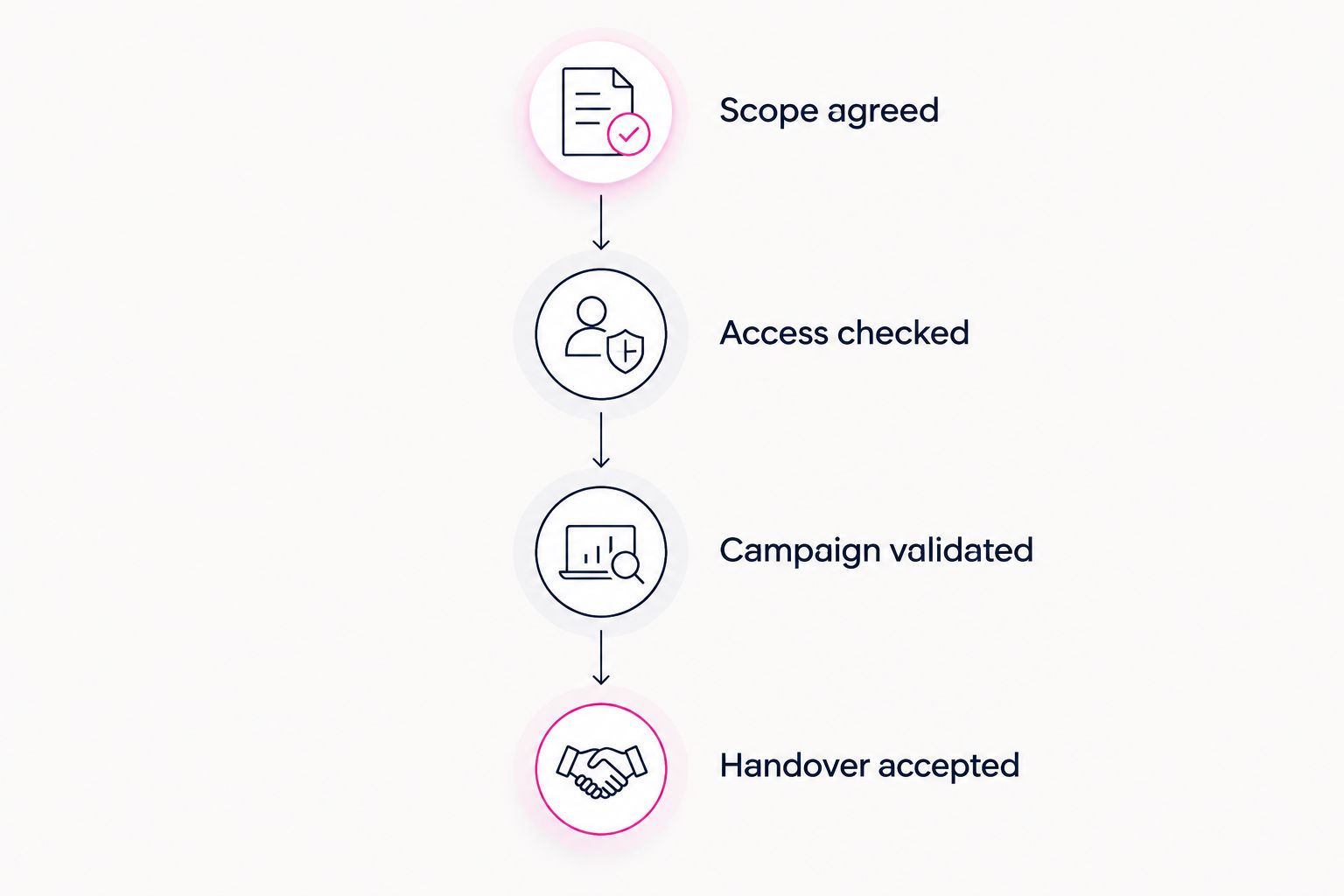
Each gate needs acceptance evidence before the next stage is treated as complete.
The diagram is a decision sequence, not a duration estimate. Some preparation can happen together, but dependent work still needs a clear release condition.
Cake.Shop is a fit for independent agencies and in-house brand teams seeking a modular programmatic advertising stack. Its stated scope covers media buying and reporting, rich media and DOOH creative, data clean rooms, and direct publisher supply; swweetshop is the platform that powers in-housing.
That scope changes the onboarding conversation. Assess how buying, creative, data and supply support the intended operating model, rather than evaluating access to a buying interface alone.
The benefit of a modular approach is scope choice. The trade-off is that your team must decide which modules belong in the initial implementation and who owns the connections between workflows; modular does not mean implementation-free.
For a 2026 supplier discussion, request a walkthrough based on your actual brief. Ask what is included, which dependencies remain with your agency and how acceptance will be demonstrated. Do not translate a broad platform description into an assumed integration or delivery commitment.
Discuss your onboarding scope
Set out your buying, creative, data and supply requirements before agreeing the implementation plan.
Ask for an implementation plan tied to your scope, not a generic presentation. The useful answer explains responsibilities and dependencies as clearly as it explains platform configuration.
Include these questions in the supplier discussion:
Request written acceptance criteria before accepting a launch commitment. A provider can describe its own tasks, but your agency still needs to account for client approvals and internal work.
Use the same brief when evaluating different providers. Otherwise, a narrow account-creation proposal and a broader operational implementation look comparable even though they promise different outcomes.
You can launch before optional integrations are finished if the approved campaign does not depend on them. Do not launch around a missing requirement by quietly changing how success will be measured.
Define the limitation in the launch record. For example, if the first campaign excludes customer-data activation, make that exclusion visible to the client team and keep it separate from the later integration acceptance decision.
A live campaign proves that a campaign has launched; it does not prove that your agency can operate the account independently. Completion should also cover the agreed approval, monitoring, reporting and escalation workflow.
Keep the initial live review separate from final handover. The review checks delivery and configuration; handover checks whether the responsible people can perform their jobs without an implementation lead stepping in.
Separate the new DSP's required launch workflow from historical data, legacy reporting and wider stack changes. Bring a migration task into the critical path only when the approved launch genuinely depends on it.
For your 2026 plan, give deferred work its own owner and acceptance criteria. Deferring a task is a scope decision, not permission to leave it undefined.
How long does it take to onboard a new DSP for an agency?
DSP onboarding takes the time required to complete the agreed commercial, technical and operational acceptance gates. Set separate dates for account access, campaign launch and independent operation rather than treating them as the same milestone.
What's the fastest way to get a new DSP ready?
Keep the initial scope limited to the approved campaign's actual requirements. Prepare assets, permissions and measurement decisions before configuration, and keep optional integrations outside the launch dependency chain.
Can our agency onboard a DSP without customer data?
Your agency can define an initial campaign that does not require customer-data activation. Confirm that the targeting and measurement approach still meets the client brief before excluding that integration.
Should buyers or operations own DSP onboarding?
Assign an accountable onboarding owner, with buying and operations responsible for their respective acceptance checks. Commercial approvals, data permissions and client decisions also need named owners.
What should DSP onboarding training include?
DSP onboarding training should cover the workflow your team must operate: campaign creation, review, delivery checks, changes, reporting and escalation. Ask the team to demonstrate that workflow rather than counting attendance as readiness.
Is Cake.Shop only a media buying tool?
Cake.Shop provides a modular programmatic advertising stack covering media buying and reporting, rich media and DOOH creative, data clean rooms, and direct publisher supply. Define which parts belong in your initial onboarding scope before agreeing an implementation plan.
Ask your future account operator to run the handover demonstration, not the person who configured everything. Let that operator find the campaign, explain its controls, produce the required report and describe the escalation route.
The useful finish line is demonstrated operational ownership. A polished demonstration by someone else does not establish that your agency is ready to take responsibility for live client delivery.
Compare programmatic display advertising platforms by operating model. Shortlist for in-housing, multichannel buying and Google workflows, with clear checks.
Read more →How long to onboard a new DSP for an agency? Readiness sets the timeline. Define launch gates, data dependencies and handover checks before committing.
Read more →Can brand safety tools stop ads next to harmful content? They reduce risk, not eliminate it. Learn which controls prevent, detect and resolve unsafe placements.
Read more →Book a 30-minute demo and see exactly how Cake.Shop works — no sales pitch, just the platform.