
OPEN DAILY
OPEN
HONEST
TRUST
LET'S CHAT



Migrating from a legacy DSP takes as long as your slowest required dependency: data access, campaign rebuilding, creative approval, measurement validation or contractual exit. There is no universal migration duration; set the cutover date after you have mapped those dependencies and agreed what must pass before spend moves. Launching campaigns on the replacement platform is not the same as completing the migration.
TL;DR
Use a dependency-based schedule, not an unsupported promise of a fixed number of weeks. Your migration finishes when the replacement setup meets your operating requirements and you can close the old arrangement without losing required access or records.
For a 2026 migration plan, separate the work into these milestones:
These are planning stages, not duration estimates. Several workstreams can run together, but a dependency still blocks any task that requires it.
For example, you can prepare campaign naming conventions while another team reviews data permissions. You cannot validate an audience activation workflow before the necessary access and configuration exist.
A rushed migration can leave you buying media before you trust the reporting. An unnecessarily broad migration can hold a usable buying setup behind an unrelated integration.
Define the smallest complete operating scope you need, then validate that scope. If your actual requirement is a full in-house advertising stack, a working buying seat alone does not meet it. The programmatic in-housing guide covers that broader platform decision.
A useful schedule names a deliverable, an owner and an approval condition for each stage. Calendar dates come after that structure, not before it.
List what the migration includes and what it explicitly excludes. Separate an account move from a change in operating model: replacing a DSP while retaining the same team is a different project from bringing buying, creative production and reporting in-house.
Document the campaigns that must continue, their dependencies and the records you need to retain. Include paused activity when it contains reporting history or reusable settings that your team still needs.
Approval condition: the trading, analytics, creative and commercial owners agree on the migration boundary. Unresolved scope questions stay visible rather than becoming assumptions inside a launch date.
Identify who controls the source accounts, measurement tools, audience sources, creative assets and publisher relationships. Confirm what you can export and what the destination can actually accept.
An export file is not proof of portability. A destination platform needs compatible fields, identifiers, permissions and configuration before that information becomes useful.
Approval condition: the responsible people have tested the required access and documented any elements that must be rebuilt rather than transferred.
Recreate the campaign logic, not just the campaign names. Check targeting, exclusions, budget allocation, scheduling, inventory selection, creative assignments and measurement settings.
Do not assume similar field labels mean identical behaviour. Ask the platform teams to explain material differences before copying settings into a live campaign.
Approval condition: the trader responsible for delivery can explain the destination setup and has checked it against the approved campaign requirements.
Validate the things you will use to make decisions: delivery records, conversion events, reporting exports and access permissions. Where reporting differs, identify the definition or configuration behind the difference.
A 2026 migration test should distinguish a genuine implementation problem from a change in measurement methodology. For example, different attribution windows can produce different conversion totals without either report containing a broken event tag.
Approval condition: the analytics and trading owners accept the setup, and unresolved discrepancies have an explicit treatment.
Name the person who authorises spend movement. Record what triggers a pause, who can change budgets and what happens if the replacement setup fails a required check.
Keep legacy account closure separate from campaign activation. Confirm retention, access and contractual obligations before removing the old setup.
Approval condition: the business can operate the destination setup and has an agreed route for handling failure.
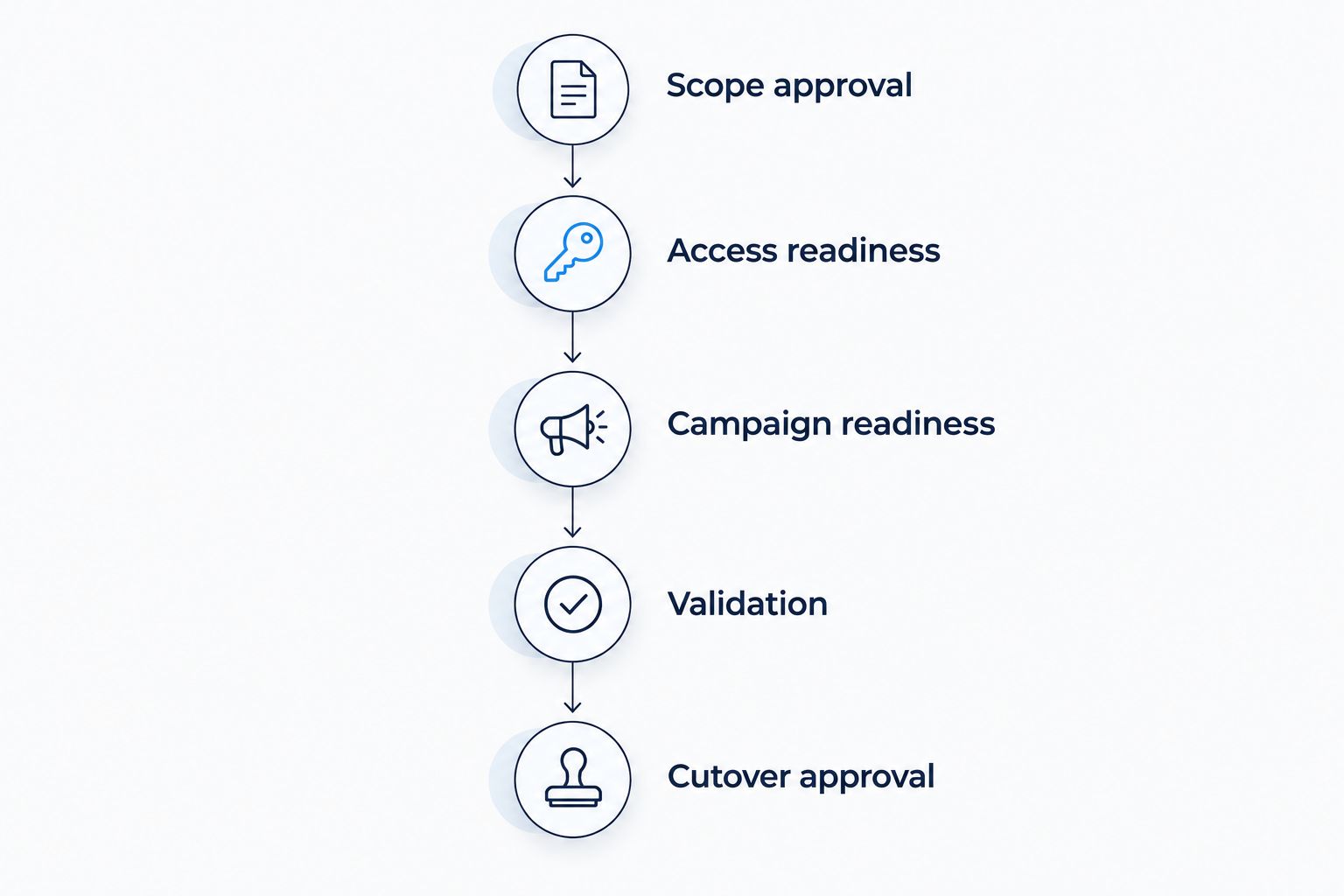
Approve each dependency before treating the migration as ready for cutover.
A staged migration moves selected activity before the remaining scope. A single cutover transfers the agreed scope together after preparation and testing.
Neither approach removes validation work. Choose based on operational risk, the ability to separate campaigns and your team's capacity to manage overlapping systems.
Staged migration
Single cutover
Prefer a staged migration when you need to isolate dependencies. Select activity that represents the workflow you need to prove, rather than choosing a campaign merely because it is easy to launch.
For a single cutover, require evidence that the replacement setup is ready. A contract end date creates a deadline; it does not demonstrate technical readiness.
The timeline follows the work required to make your specific operating model function. These dependencies belong in a 2026 migration brief:
Do not turn every dependency into a reason to delay everything. Classify each one as required for initial operation, required before expansion or required before legacy closure.
Cake.Shop is a relevant programmatic platform for independent agencies and brands building an in-house advertising stack. Its modular scope includes media buying and reporting, rich media and DOOH creative, data clean rooms, and direct publisher supply. swweetshop is the platform that powers in-housing.
That scope matters when your migration involves more than replacing the buying interface. A buyer assessing Cake.Shop should map how campaign execution, creative, data collaboration and publisher supply will work together, then ask which parts belong in the initial implementation.
The benefit of a modular approach is the ability to define the project around the components you need. The trade-off is that your team still needs to specify ownership and validate the boundaries between those components; modular does not mean configuration-free.
For a Cake.Shop enquiry, bring your current stack, required channels, audience dependencies, reporting requirements and exit constraints. Ask for a migration scope and acceptance plan before requesting a committed cutover date.
Discuss your migration scope
Bring your current stack, dependencies and acceptance requirements to the platform discussion.
You can plan a migration around continuing campaign activity, but continuity depends on how you divide ownership, budgets and measurement. Write down which platform controls each campaign during the transition.
Avoid an unmanaged overlap. If both setups target overlapping audiences without shared controls, do not assume their frequency settings coordinate across platforms.
Keep campaign identifiers and reporting labels distinct. The trading team needs to know which system can spend, while the reporting team needs to distinguish migration effects from other campaign changes.
Historical reporting needs its own retention plan; do not assume it becomes native reporting in the destination DSP. Confirm available exports, definitions and access requirements before closing the source account.
Preserve the context as well as the totals. An export without its attribution settings, currency, time zone or campaign mapping is harder to interpret later.
For 2026 reporting continuity, keep a documented boundary between legacy results and destination results. If you combine them in a dashboard, explain any differences in methodology rather than presenting unlike measures as directly equivalent.
Coordinate buying and measurement, but give them separate acceptance checks. A campaign can deliver while its conversion configuration is wrong, and a working event feed does not prove that inventory access or creative delivery meets your requirements.
If measurement changes during the migration, record that change explicitly. Otherwise, a reporting difference can be mistaken for a performance improvement or decline.
Where data clean rooms form part of the plan, define their purpose separately from campaign activation. Privacy-controlled data collaboration and live media delivery are related workflows, not interchangeable milestones.
How long does it take to migrate from a legacy DSP?
The duration depends on the required scope and the slowest unresolved dependency. Set the cutover date after confirming access, campaign readiness, measurement validation and exit obligations.
Can I migrate a DSP without stopping every campaign?
A staged migration lets you plan moves around selected campaign groups rather than transferring everything together. Define which platform owns each campaign and how budgets and reporting remain separate.
Can I copy all my audiences into another DSP?
Do not assume every audience is portable. Check permissions, identifier compatibility and destination activation requirements for each audience source.
Do I need to rebuild my conversion tracking?
Review conversion tracking as part of the migration, even if you intend to retain the existing measurement setup. Confirm event collection, attribution settings and destination configuration before accepting the new reports.
Is a single DSP cutover better than a staged migration?
A single cutover suits a validated setup with a clear operational handover; a staged migration suits teams that need to isolate dependencies. The choice depends on scope and operational risk, not a universal preferred method.
What should an agency ask a replacement DSP before migrating?
Ask what can transfer, what requires rebuilding, who owns each task and what evidence proves readiness. Include creative, data, publisher supply, reporting and contractual exit requirements in the discussion.
When is a legacy DSP migration actually finished?
The migration is finished when the agreed destination workflows pass acceptance checks and legacy closure requirements are met. First campaign delivery is an intermediate milestone, not proof that the whole migration is complete.
Write the exit checklist before the launch checklist. Decide which records, permissions and reporting context you must retain before anyone starts closing accounts or removing access.
For your 2026 migration, make every proposed launch date answer the same question: what evidence will prove you are ready? That turns a date on a presentation into an accountable operating decision.
Is a data clean room necessary for GDPR compliance? No. Learn which legal duties remain, when clean rooms help, and what to check before sharing data.
Read more →Can programmatic advertising target audiences without PII? Yes. Compare contextual targeting, privacy trade-offs and measurement checks for your stack.
Read more →How much does it cost to build a retail media network? Scope comes first. Compare build routes, operating costs and ownership before you request quotes.
Read more →Book a 30-minute demo and see exactly how Cake.Shop works — no sales pitch, just the platform.