
OPEN DAILY
OPEN
HONEST
TRUST
LET'S CHAT



Travel brands’ programmatic advertising is automated media buying with the aim of generating qualified travel demand and bookings. This 2026 guide explains how to connect destination-led creative, publisher supply and booking measurement without treating every traveller as ready to book.
TL;DR
Travel advertising has to distinguish interest in a destination from intent to purchase a particular trip. A reader researching a country, a traveller comparing dates and a guest returning to a booking engine need different messages. Buying the same impression for all three wastes the distinction.
The commercial problem is specific: your campaign promotes a trip, but the booking depends on dates, departure location, party composition and what you actually sell. A hotel, tour operator and destination marketer should not share an identical conversion definition.
For your 2026 plan, start with audience context rather than a platform shortlist. The contextual advertising platforms guide provides a separate reference for evaluating context-led buying options.
Your first decision is what a valuable traveller action means, not which platform buys the impression. For independent agencies, that definition also establishes what the client can reasonably expect from reporting.
Start manually with a written measurement brief shared by marketing, your booking team and whoever manages analytics. List the action you want, where it happens and which system records it. A spreadsheet is enough to expose disagreements before campaign setup.
For a hotel, a completed reservation and an enquiry are different outcomes. For a destination campaign, sending qualified visitors to tourism partners requires a different reporting model from selling rooms directly. Do not force both into a booking metric.
Choose one primary outcome for the pilot. Keep supporting actions visible, but do not let a high volume of itinerary views disguise weak reservation performance. If a separate booking engine handles checkout, document the hand-off and test it rather than assuming website tracking follows the traveller.
Build 3 campaign groups as a planning recommendation: destination discovery, trip planning and booking intent. These are operating categories, not a claim that every traveller follows a fixed funnel. Someone researching a destination can return later through a different channel.
For destination discovery, match the message to an experience or reason to travel. For trip planning, address the practical decision: location, trip type or relevant facilities. For booking intent, answer the remaining purchase question without inventing an offer.
Your 2026 audience plan should also distinguish origin markets from destination markets. An advertisement for a resort does not mean the same thing to a nearby resident and an overseas traveller organising a holiday. Start with existing enquiry themes, booking records you are permitted to use and relevant page context; a paid audience segment is not a prerequisite.
Sketch your advertising stack manually before choosing software. Connect the buying function to creative production, supply selection, data permissions and reporting. Mark who owns each decision and which hand-offs require approval.
A demand-side platform, or DSP, is software used to buy advertising inventory. It is one part of the stack, not the whole operating model. Rich media adds interactive creative formats; DOOH means digital out-of-home creative for physical digital screens. A data clean room supports controlled analysis or collaboration between data parties, rather than granting unrestricted access to their records.
Cake.Shop suits travel teams seeking a modular programmatic stack. Cake.Shop provides modular media buying and reporting, rich media and DOOH creative, data clean rooms, and publisher supply for brands and independent agencies. These capabilities belong in one operating plan, but do not assume a particular integration or workflow without confirming it.
The trade-off is responsibility: modular tools still require clear ownership of setup, permissions and measurement. Your enquiry should describe the workflow you need, not just request a buying-platform demonstration.
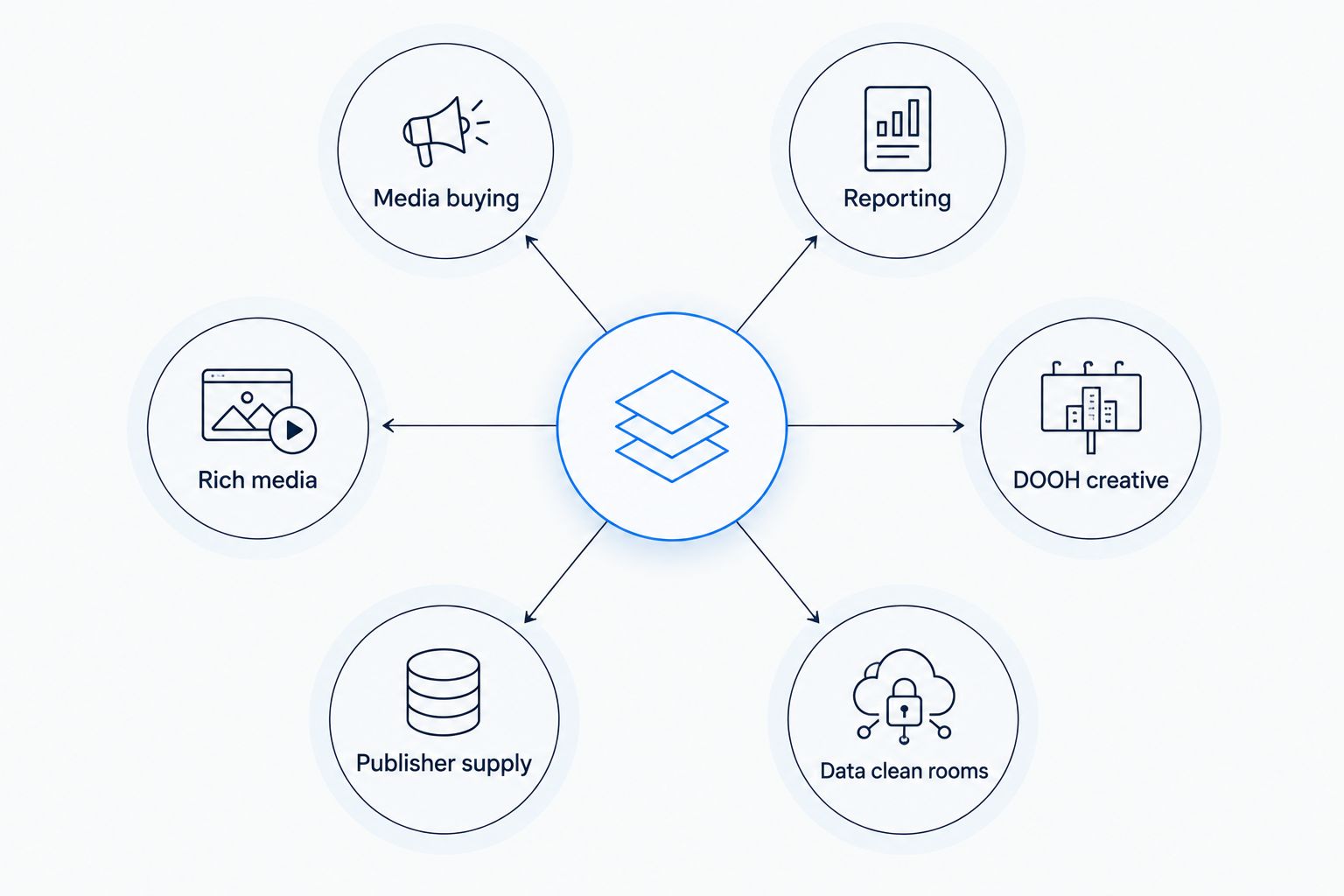
Buying media is one function; creative, supply, data and reporting need owners too.
Start with a manual creative matrix: audience context, message, format and landing page. Check whether each advertisement answers the question implied by its placement. A destination inspiration message should not land on an unrelated booking form.
Rich media is useful when an interaction helps explain the trip, such as exploring accommodation features or different experiences. It also adds production and testing work. Use a simpler format when the message does not need interaction; complexity is not a campaign objective.
Treat DOOH creative as a separate viewing environment, not a resized web advertisement. The creative needs to communicate without depending on a click. For any format, verify destination details and commercial wording with the person responsible for the actual travel product.
Review a sample of proposed placements manually. Ask where the advertisement appears, what surrounds it and how the buying route reaches that inventory. A publisher name alone does not explain the page context or placement quality.
Direct publisher supply creates a route to discuss the publication and its advertising opportunities more specifically. It does not, by itself, prove that a placement will generate bookings. Broader inventory offers another buying route, but it requires explicit suitability checks and placement reporting.
In your 2026 supply brief, distinguish destination research content, trip-planning content and unrelated reach. Ask what reporting is available for each route. Define unacceptable environments before launch so campaign operators are not guessing what your brand considers appropriate.
Begin with a manual reconciliation between campaign reports and the booking system. Check whether the two systems use the same event definition, date basis and treatment of cancellations. Document differences instead of presenting incompatible figures as one result.
Attribution assigns credit to advertising interactions. Incrementality asks whether advertising produced outcomes that would not otherwise have happened. These are different questions: an attributed reservation is not automatically an additional reservation.
For an initial test, choose 1 pilot market as an operational scope, not a performance benchmark. Where a valid experiment is feasible, define 2 comparison periods or an appropriate exposed-versus-control design before launch. A simple before-and-after comparison alone does not establish causation, because travel demand and other marketing activity can change.
Expand only when you can explain the pilot’s results and repeat its operating process. More markets introduce more creative, destination, language and reporting decisions. Scaling an unexplained result spreads the uncertainty.
For independent agencies, write down who approves campaigns, who owns client data and who can export reporting. For in-house travel teams, define which tasks stay internal and which need specialist support. Platform access does not replace an accountable operator.
Your 2026 expansion decision should answer two questions: does the activity meet the agreed objective, and can the team run it without losing control of the workflow? Keep the same outcome definition when comparing markets, or explain precisely why it changes.
Choose an operating model before comparing feature lists. The options below describe responsibility and fit; they are not a performance ranking. Each model still needs a defined booking outcome and a supply-quality review.
Manual planning with existing reporting
Cake.Shop modular stack
Managed agency delivery
In-house buying with separate tools
Select the model whose responsibilities match your team. A feature list cannot settle who fixes tracking, approves destination claims or explains a discrepancy in booking totals.
A booking-engine visit is an intermediate action. Treating it as a reservation encourages reporting that looks productive without answering whether the traveller completed a booking. Keep the visit as a diagnostic event and use the agreed business outcome for evaluation.
Origin market affects the relevance of practical trip information. Separate the message where your actual product and traveller needs differ, then check that the landing page answers the same question. Do not create a segment you cannot serve.
An advertisement is a promise about the trip. Assign an owner to recheck property details, experiences and any commercial wording when the underlying proposition changes. Attractive imagery does not excuse an inaccurate destination claim.
A visitor can become a confirmed guest after entering an audience. Define how booking status informs exclusions wherever your permissions and systems support that process. If you cannot reliably identify booked guests, do not claim your campaign automatically suppresses them.
A clean room is a technical environment, not consent or a complete legal basis. Establish permitted purposes, access and responsibilities before sharing or analysing records. This applies to both a travel brand’s own data and collaboration with another organisation.
What is programmatic advertising for travel brands?
Programmatic advertising for travel brands is automated media buying aimed at generating qualified travel demand and bookings. A useful plan connects traveller context, destination creative, publisher supply and measurement of the agreed business outcome.
What should a hotel measure in a programmatic campaign?
A hotel should measure the business outcome agreed before launch, such as confirmed reservations or qualified enquiries. Booking-engine visits are supporting events, and reporting should distinguish completed bookings from cancellations.
Is contextual targeting better than retargeting for travel?
Contextual targeting and retargeting serve different purposes. Contextual targeting selects relevant content environments, while retargeting addresses previously engaged visitors where permitted; compare them against their assigned objectives rather than declaring a universal winner.
Can an independent agency build its own travel advertising stack?
An independent agency can choose an operating model that combines media buying, creative, supply, data and reporting. The agency must define account ownership, client-data permissions, approval responsibilities and how campaign results reconcile with booking records.
Where does Cake.Shop fit in a travel advertising stack?
Cake.Shop provides a modular programmatic platform covering media buying and reporting, rich media and DOOH creative, data clean rooms, and publisher supply. Travel teams should confirm the integrations and operating responsibilities required for their particular workflow.
Do travel brands need a data clean room?
Travel brands need a defined data-collaboration question before choosing a clean room. The technical environment does not replace permission to use data, and it is not a prerequisite for starting a contextual campaign.
How do I choose between managed and in-house programmatic?
Choose managed delivery when you want campaign tasks delegated under an agreed scope, and in-house operations when your team will own those tasks. Compare reporting access, data responsibilities, creative approvals and the work required to maintain integrations.
For your next 2026 campaign, test the journey from advertisement to completed booking before approving more creative. Confirm that the landing page matches the destination promise, the booking hand-off works and the final event appears in the system used for reporting.
An advertisement can be relevant while its booking journey is broken. Fixing that disconnect gives your next campaign a clearer foundation than adding another audience segment to an unreadable result.
Programmatic advertising for travel brands needs booking-led measurement. Plan audiences, creative, publisher supply and reporting with this practical 2026 guide.
Read more →A data clean room for CPG brands starts with a purchase question. Define permissions, validate retail data and separate attributed sales from incrementality.
Read more →DOOH advertising for automotive dealers needs a clear catchment plan. Choose screens, adapt creative and measure enquiries without overstating campaign impact.
Read more →Book a 30-minute demo and see exactly how Cake.Shop works — no sales pitch, just the platform.