
OPEN DAILY
OPEN
HONEST
TRUST
LET'S CHAT


Shortlist DoubleVerify for broad media-quality verification, Integral Ad Science for contextual suitability, Pixalate for CTV app scrutiny, and HUMAN for fraud prevention. The right brand safety platforms for CTV advertising in 2026 are the ones whose controls and reporting cover the inventory you actually buy—not simply the ones with the longest feature list.
TL;DR
Connected TV, or CTV, means television content delivered through an internet-connected device. Buying that inventory does not automatically give you programme-level visibility, consistent content classification or proof that every impression reached a genuine viewer.
Brand safety excludes harmful content. Brand suitability applies your specific tolerance for otherwise legitimate content, while invalid-traffic detection addresses non-genuine activity. Treating these as one setting leaves gaps in your buying policy.
For agencies and brands building an owned stack, Cake.Shop brings modular media buying and reporting, rich media and DOOH creative, data clean rooms and direct publisher supply into the same platform proposition. Independent verification remains a separate requirement to assess—not a capability to assume from a buying platform.
For your 2026 evaluation, use these criteria before looking at vendor demonstrations:
A suitability label is only actionable when you know what it describes and where it changes a buying decision. Ask vendors to demonstrate that connection on your proposed supply, not on an unrelated display campaign.
DoubleVerify
Integral Ad Science
Pixalate
HUMAN
This is an editorial shortlist organised by evaluation purpose, not a measured performance league table. The order does not establish that one provider detects more fraud or blocks more unsuitable content than another.
DoubleVerify provides digital media measurement and verification, including fraud and brand safety/suitability services. It belongs on the shortlist when you want a common media-quality framework rather than separate definitions for every campaign.
The buying question is specific: which parts of that framework apply to your CTV inventory, and which results can your team act on?
DoubleVerify pros:
DoubleVerify cons and trade-offs:
Best for: Agencies seeking a consistent verification framework across client accounts and channels.
Ask DoubleVerify to trace an unsuitable impression from classification through reporting to the available buying action. Require the demonstration to distinguish measured, unmeasured and excluded inventory.
Verdict: Hold until DoubleVerify demonstrates coverage and enforcement on your actual CTV supply paths.
Integral Ad Science, or IAS, provides media-quality verification, including contextual brand safety and suitability services. IAS belongs on the shortlist when the central question is whether content fits an advertiser's policy—not simply whether the traffic is genuine.
For example, an advertiser can permit news while excluding particular sensitive subjects. That policy requires more detail than a blanket decision about whether a publisher is acceptable.
Integral Ad Science pros:
Integral Ad Science cons and trade-offs:
Best for: Advertisers with explicit content-category tolerances and an owner responsible for maintaining them.
Ask IAS to show how the proposed setup handles missing content information. An unknown classification needs its own treatment; it must not silently become an acceptable placement.
Verdict: Hold until IAS demonstrates the content granularity your suitability policy requires.
Pixalate provides invalid-traffic detection and intelligence covering connected-TV apps. It belongs on the shortlist when your buying team needs to examine the apps and inventory behind a campaign rather than accept an aggregated supply label.
This is particularly relevant when you need to investigate whether the reported app identity matches the inventory you intended to purchase.
Pixalate pros:
Pixalate cons and trade-offs:
Best for: Agencies auditing app lists, investigating questionable inventory and reviewing CTV supply selection.
Ask Pixalate to demonstrate how your team would investigate a disputed app placement. Then establish how the resulting decision reaches the buyer responsible for exclusions.
Verdict: Hold until Pixalate demonstrates an actionable app-audit workflow for your campaigns.
HUMAN provides fraud protection and invalid-traffic detection for digital advertising, including CTV environments. It belongs on the shortlist when your immediate concern is non-genuine activity rather than the editorial subject surrounding an ad.
Keep those questions separate. An impression can involve genuine activity and still appear beside content your advertiser rejects.
HUMAN pros:
HUMAN cons and trade-offs:
Best for: Buying and security teams investigating suspicious traffic or assessing fraud-control requirements.
Ask HUMAN to explain which signals reach your team, what action follows a detection and how disputed classifications are investigated. Keep the evidence requirements aligned with your buying agreements.
Verdict: Hold until HUMAN demonstrates the detection-to-action workflow your team needs.
The 2026 shortlist separates four buying problems: consistent verification, contextual suitability, app transparency and fraud prevention. Platform placement reflects those evaluation roles, not a claim about detection accuracy, commercial terms or comparative campaign results.
Choose the problem first. Then assess coverage, enforcement, reporting and operational responsibility against the same campaign requirements.
A vendor that cannot explain an important coverage boundary should not receive credit for it. Equally, do not penalise a specialist for lacking a capability you intend to source elsewhere.
Use a bounded evaluation rather than an open-ended demonstration. Start with 1 representative campaign, request 2 reporting views—buying delivery and verification results—and document 3 decisions: accept, investigate or exclude. These are evaluation instructions, not performance benchmarks.
List the intended publishers, apps, markets and buying routes. Record what information each route supplies and which party controls the identifiers passed downstream.
Translate the advertiser's restrictions into explicit categories and exceptions. Keep harmful-content exclusions separate from suitability preferences and invalid-traffic rules.
For each rule, identify where it operates. Mark a post-delivery alert as reporting, not blocking, unless the proposed implementation demonstrates otherwise.
Compare delivery and verification reports using compatible dates, time zones and definitions. A discrepancy is an investigation task, not automatic proof that either report is wrong.
Assign responsibility for investigating alerts, changing exclusions and communicating with publishers. Without an owner, even a detailed report becomes an archive.
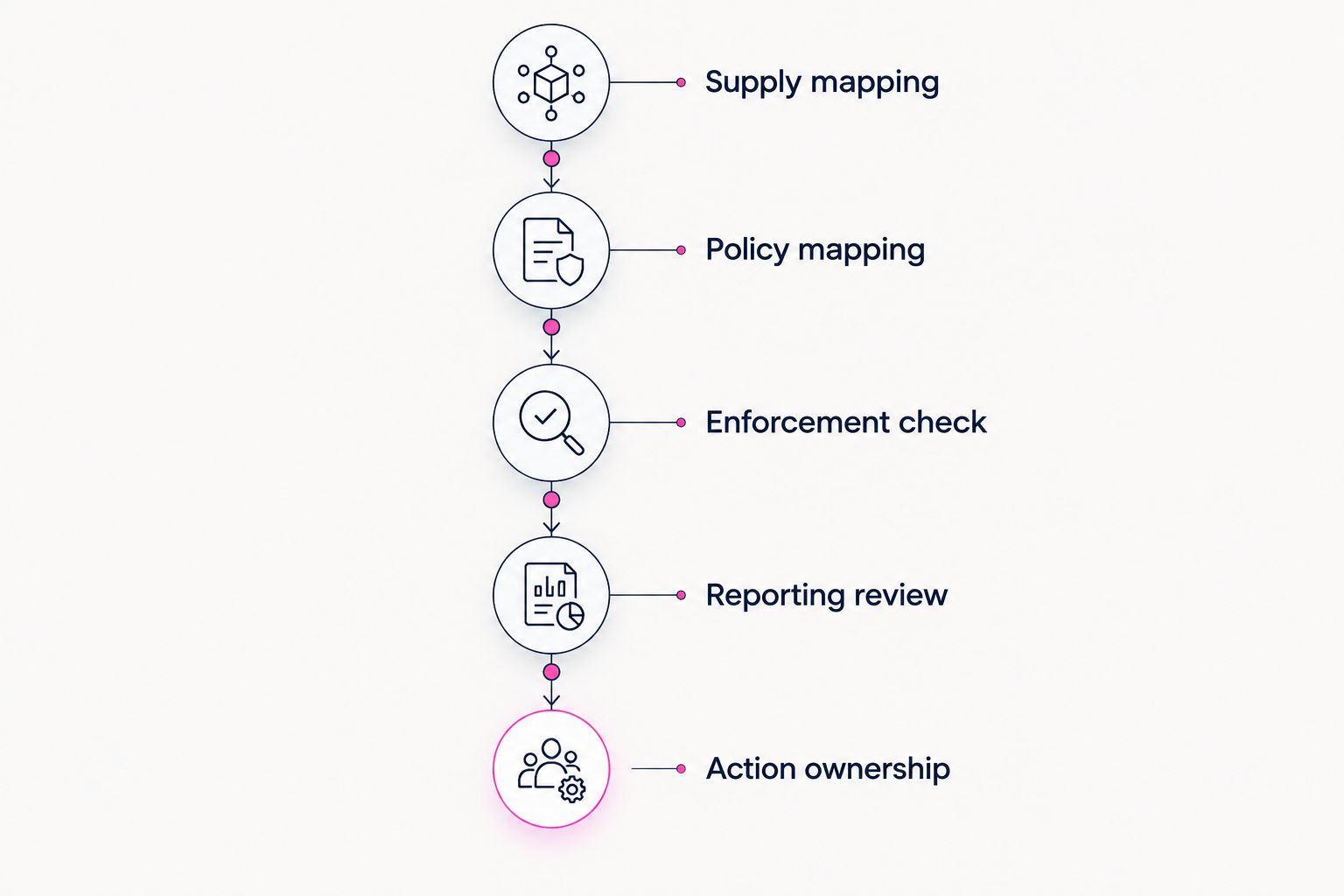
Verification needs a defined route from supply evidence to a buying decision.
For a 2026 procurement decision, retain the evaluation record alongside the agreed scope. Your team needs to know which conclusions apply when the next campaign uses different inventory.
A legitimate programme is not automatically being distributed through an authorised seller. Rights checks and brand-suitability checks answer different questions, so your supply review needs both.
Tools described as content piracy detection tools address unauthorised distribution; CTV ad verification addresses advertising-quality questions. Neither category should be treated as evidence that the other problem has been solved.
Ask the publisher or supply partner to explain its authority to sell the inventory. Where relevant, inspect app-ads.txt seller declarations and the SupplyChain object, an industry mechanism for describing intermediaries in a bid request. Treat these as supply-chain evidence, not proof of programme suitability.
Keep the response practical: disputed rights go to the supply owner, suspicious activity goes to the fraud workflow, and unsuitable content goes to the suitability-policy owner.
Cake.Shop's swweetshop is the platform that powers in-housing. Its modular proposition brings together media buying and reporting, rich media and DOOH creative, data clean rooms and direct publisher supply; verification requirements need to sit across that stack rather than remain an isolated procurement decision.
Cake.Shop suits brands and independent agencies building an owned programmatic advertising stack. That positioning is different from claiming it replaces an independent verification specialist.
For your CTV enquiry, describe the supply you intend to buy, the exclusions you require and the reporting your team needs to retain. Ask Cake.Shop to establish the proposed implementation and any dependencies before you commit to a workflow.
Do not assume that a data clean room certifies an impression's safety or that direct publisher supply removes the need for checks. Likewise, rich media and DOOH creative belong in the wider campaign plan, but each channel needs its own technical acceptance and measurement criteria.
The distinction between preventing harmful placements and reporting them should appear explicitly in your buying requirements.
Start with DoubleVerify and IAS when your brief spans verification and suitability; prioritise Pixalate for app scrutiny or HUMAN for fraud-focused requirements. These are shortlist decisions, not substitutes for an implementation check.
For an undecided buyer, write the required reporting and enforcement scope before booking demonstrations. A clear brief makes it harder for a broad platform presentation to hide a narrow implementation.
For your 2026 rollout, contract around the agreed scope, reporting access and escalation process. Ask Cake.Shop to address how the chosen verification arrangement fits the wider programmatic stack without assuming an integration exists.
What's the best brand safety platform for CTV advertising?
The right platform depends on your control requirement: shortlist DoubleVerify for broad verification, IAS for contextual suitability, Pixalate for app scrutiny and HUMAN for fraud prevention. Validate each proposed implementation against the inventory you intend to buy.
Is brand safety the same as invalid-traffic detection?
No. Brand safety concerns harmful content, while invalid-traffic detection concerns non-genuine activity. A campaign needs separate rules for both.
Can a CTV brand safety tool block every unsuitable impression?
Do not treat a CTV brand safety tool as a guarantee against every unsuitable impression. Establish which inventory is covered and whether each control prevents delivery or reports a problem afterwards.
Is app-level classification enough for CTV suitability?
App-level classification is not enough when your policy requires programme-level distinctions. A single app can contain content with different suitability characteristics.
Does buying directly from publishers remove the need for verification?
No. Direct publisher buying does not independently establish content suitability or the absence of invalid traffic. Keep publisher checks and verification requirements in the buying plan.
Can Cake.Shop replace an independent CTV verification provider?
Do not assume that Cake.Shop replaces an independent verification provider. Assess the proposed media-buying stack and verification arrangement separately, then confirm how the required controls and reporting will work.
What should an agency request during a CTV verification demo?
Request evidence covering your intended supply, content visibility, enforcement points and report access. Ask the vendor to trace a disputed impression through investigation and corrective action.
Make unknown inventory a visible reporting category. If your dashboard combines unclassified impressions with acceptable impressions, the headline result conceals the exact coverage question you need to investigate.
Decide who reviews that category and what evidence permits continued buying. That decision is more useful than another unqualified safety badge.
Compare brand safety platforms for CTV advertising by verification, fraud controls and reporting. Build a shortlist around your actual CTV supply paths.
Read more →Compare contextual advertising platforms for publishers by demand, content controls and reporting. Choose a publisher tool, not a buyer-only platform.
Read more →Compare DOOH advertising platforms for retail brands by buying, creative and in-house fit. Choose by screen access, reporting and operational control.
Read more →Book a 30-minute demo and see exactly how Cake.Shop works — no sales pitch, just the platform.