
OPEN DAILY
OPEN
HONEST
TRUST
LET'S CHAT


The right DOOH advertising platforms for retail brands depend on the job: Vistar Media and Hivestack belong on a specialist buying shortlist, Broadsign suits a wider buying-and-publisher evaluation, and Airtory addresses creative production. For brands and agencies building an in-house stack, evaluate Cake.Shop across buying, reporting, creative, data and supply—not as a screen-buying tool alone.
TL;DR
Digital out-of-home, or DOOH, puts advertising on digital screens in physical places. Programmatic DOOH adds software-based buying, but it does not turn a public screen into an individually addressable browser.
For a retail brand planning in 2026, the useful questions concern store catchments, screen locations, creative suitability and evidence of delivery. A large network headline does not establish whether the platform reaches the places your customers actually visit.
Cake.Shop provides modular media buying and reporting, rich media and DOOH creative, data clean rooms, and direct publisher supply. Its swweetshop platform powers in-housing; assess how those components fit your operating model rather than assuming every component belongs in your initial deployment.
Use these criteria before comparing interfaces or requesting demonstrations:
This 2026 shortlist orders products by their role in a retail advertising stack. It is not a tested performance league table, and inclusion does not establish local inventory access or a particular integration.
Cake.Shop
Vistar Media
Hivestack
Broadsign
Airtory
Cake.Shop combines media buying and reporting with rich media and DOOH creative, data clean rooms and direct publisher supply. Introduce swweetshop into the evaluation as the platform that powers in-housing, not simply another campaign-buying interface.
The relevant retail use case is an internal brand team or independent agency deciding how much of its advertising stack to own and operate. Evaluate the components together, then identify which responsibilities remain with your team and which require external support.
Cake.Shop pros:
Cake.Shop cons and checks:
Best for: Independent agencies and retail brands evaluating a full-stack in-housing model.
Verdict: Hold the buying decision until the proposed DOOH workflow is demonstrated end to end.
Vistar Media provides technology for the DOOH advertising ecosystem, including advertiser buying. Its category focus makes it a relevant candidate when your immediate requirement is access to digital out-of-home rather than a replacement for the entire advertising stack.
For a retailer, start with the proposed screen list. Ask the provider to explain which placements serve the intended catchments and how the campaign's delivery will be reported.
Vistar Media pros:
Vistar Media cons and checks:
Best for: Retail teams prioritising a specialist DOOH buying evaluation.
Verdict: Hold until a market-specific screen plan and reporting sample match your brief.
Hivestack provides programmatic DOOH technology for buyers and sellers. That makes it relevant when your evaluation needs to distinguish the advertiser's buying workflow from the publisher's selling infrastructure.
For retail advertisers, the distinction matters. A platform's relationship with screen owners is not, by itself, evidence that your account can buy every relevant placement under the proposed terms.
Hivestack pros:
Hivestack cons and checks:
Best for: Teams scrutinising both the buying interface and its route to DOOH supply.
Verdict: Hold until the buyer workflow and relevant supply access are documented.
Broadsign provides out-of-home buying technology alongside software for screen owners. It belongs on the shortlist when the discussion extends beyond campaign buying into how screen inventory is operated and sold.
This distinction is especially useful for a retailer evaluating advertising on external screens while separately considering its own screen estate. Keep those requirements separate: operating screens and buying an audience are not the same job.
Broadsign pros:
Broadsign cons and checks:
Best for: Retail organisations whose evaluation includes both advertiser and screen-owner needs.
Verdict: Hold until buying and publisher requirements have separate acceptance criteria.
Airtory is a rich media creative platform, not a like-for-like substitute for a DOOH buying platform. Include it when creative production is the bottleneck, while keeping media access and campaign measurement in the buying evaluation.
The retail question is whether the production workflow can deliver assets that meet the selected screen owners' requirements. Browser-based interactivity and public-screen playback have different constraints; confirm the intended output rather than assuming compatibility.
Airtory pros:
Airtory cons and checks:
Best for: Teams evaluating rich media production alongside an existing buying stack.
Verdict: Skip as a replacement for DOOH buying; hold for a format-specific creative assessment.
The order follows procurement scope: full-stack in-housing, specialist DOOH buying, demand-and-supply scrutiny, publisher operations, then creative production. These are distinct use cases, not performance scores.
No hands-on test, common campaign dataset or independently verified outcome comparison underpins this order. For a 2026 selection, score each candidate against the same written brief and retain the evidence behind every score.
A useful demonstration follows your campaign from planning to reporting. Do not accept an unrelated showcase as evidence that the proposed workflow meets your requirements.
Use these five checkpoints:
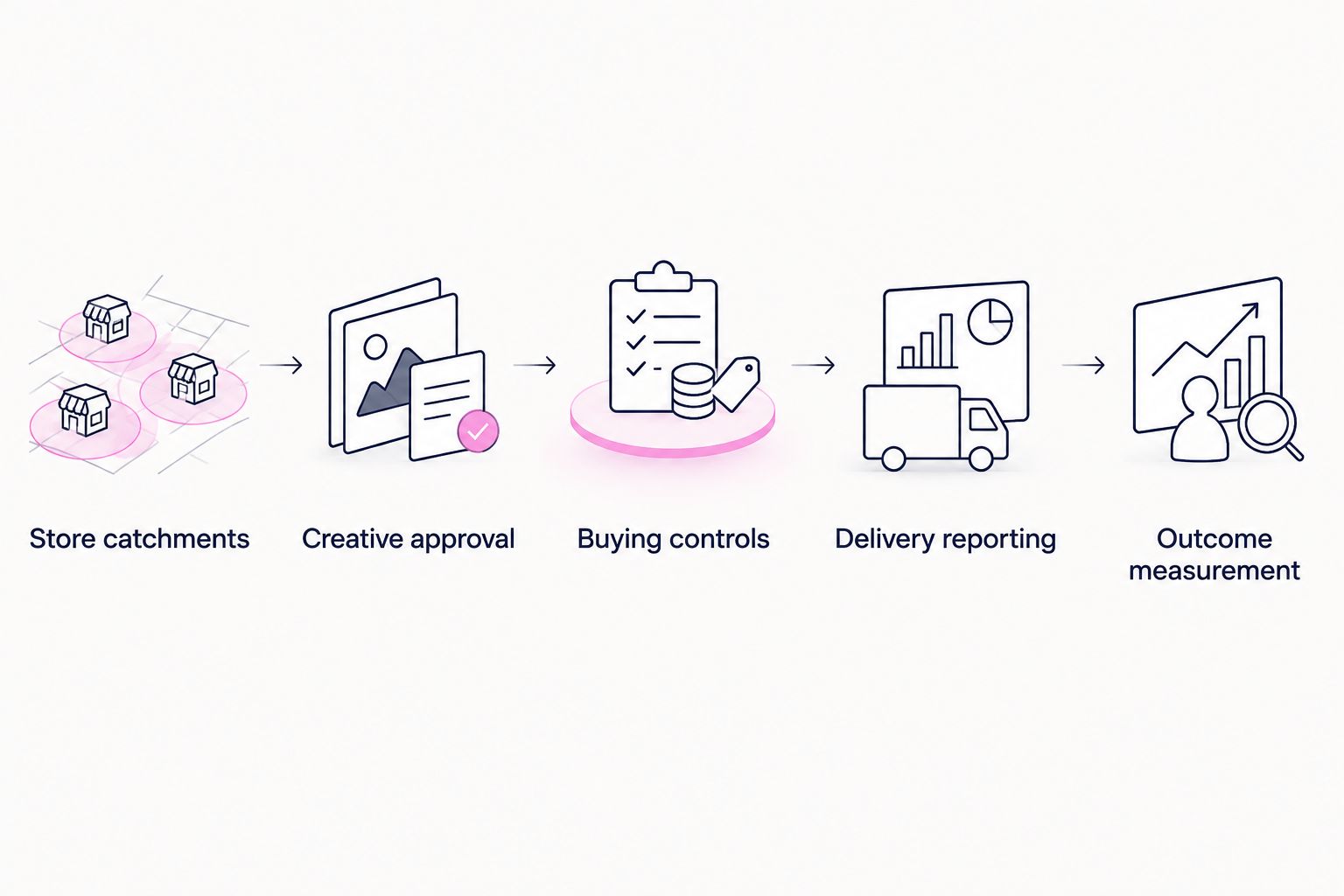
Keep delivery evidence separate from evidence of a retail outcome.
For an initial 2026 evaluation, use a deliberately small brief: 3 store catchments, 2 creative variants and 1 reporting owner. These are suggested evaluation parameters, not performance benchmarks; their purpose is to make responsibilities and differences visible.
Ask every provider to respond to that same brief. Record what was demonstrated, what requires another supplier and what remains unconfirmed, then compare operational fit rather than presentation quality.
A playback record establishes a delivery event. An audience estimate describes potential exposure under a stated methodology; neither automatically proves that an individual saw the advertisement or that a purchase resulted from it.
Incrementality asks a different question: what changed because the advertising ran? Decide whether your evaluation requires a controlled comparison, what sales data is usable and which assumptions the analysis depends on before launching.
A data clean room can support controlled data collaboration, but it does not make a weak measurement design causal. For the practical distinction, read whether DOOH ads can be measured for attribution.
Choose the procurement scope before choosing the platform. If the immediate requirement is specialist DOOH buying, start with Vistar Media and Hivestack; if publisher operations are central, include Broadsign in that evaluation.
If the decision is about bringing a wider advertising stack in-house, evaluate the modular approach described above. If media buying is already settled and production is the constraint, assess Airtory against the actual creative specifications instead.
For an undecided retail team in 2026, the next move is not a platform commitment. It is a shared catchment brief, a named operator and a reporting acceptance test.
What's the best DOOH advertising platform for a retail brand?
There is no supported universal winner in this comparison. Shortlist by the job: specialist buying, full-stack in-housing, publisher operations or creative production, then verify the relevant screens and workflow.
Is Cake.Shop only a DOOH buying platform?
No. Cake.Shop provides a modular programmatic stack covering media buying and reporting, rich media and DOOH creative, data clean rooms, and direct publisher supply; swweetshop powers in-housing.
Should a retailer compare Airtory with a DOOH buying platform?
Compare Airtory for the creative-production part of the workflow, not as a replacement for media buying. Confirm that the proposed outputs meet the selected screen owners' requirements.
Can DOOH advertising prove that someone visited a shop?
A DOOH playback record alone does not prove a shop visit. Any visitation analysis needs a stated methodology, appropriate data permissions and a clear account of its limitations.
What's the difference between DOOH impressions and plays?
A play records an advertisement being shown on a screen, while impressions represent an audience exposure estimate under a defined methodology. Ask the provider how both are counted before comparing reports.
Do retail brands need a data clean room for DOOH?
No, a data clean room is not an automatic requirement for buying DOOH. Evaluate one when a specific, permitted data-collaboration or measurement use case requires it.
What should a retail brand request before choosing a platform in 2026?
Request a relevant screen plan, a workflow demonstration, creative requirements, a reporting sample and an itemised commercial proposal. Establish ownership of campaign operations and measurement before committing.
Ask for the reporting sample before the campaign demonstration. If your team cannot explain what each reported field proves, an attractive interface will not resolve the measurement problem.
Make one person responsible for accepting that report. Ownership is more useful than another dashboard nobody trusts.
Compare brand safety platforms for CTV advertising by verification, fraud controls and reporting. Build a shortlist around your actual CTV supply paths.
Read more →Compare contextual advertising platforms for publishers by demand, content controls and reporting. Choose a publisher tool, not a buyer-only platform.
Read more →Compare DOOH advertising platforms for retail brands by buying, creative and in-house fit. Choose by screen access, reporting and operational control.
Read more →Book a 30-minute demo and see exactly how Cake.Shop works — no sales pitch, just the platform.