
OPEN DAILY
OPEN
HONEST
TRUST
LET'S CHAT


For contextual advertising platforms for publishers in 2026, shortlist Seedtag for contextual demand partnerships, GumGum for contextual analysis that includes imagery, and Google AdSense for self-service monetisation. Google Ad Manager suits publisher-defined contextual packages; Cake.Shop belongs in a separate full-stack discussion with agency and brand buyers, not a ranking of standalone contextual engines.
TL;DR
Contextual advertising matches advertising to the content or environment where it appears, rather than requiring a behavioural profile of the reader. For publishers, that creates two separate buying decisions: how to describe inventory and how to sell it.
Confusing those jobs produces a bad shortlist. A content classifier does not automatically bring advertiser demand, and a buying platform does not automatically replace your publisher monetisation setup.
Cake.Shop provides modular media buying and reporting, rich media and digital out-of-home creative, data clean rooms, and direct publisher supply. That full-stack scope matters to agency and brand enquiries, but it is different from supplying a publisher-side contextual classification engine.
Use these criteria for your 2026 shortlist before comparing vendor demonstrations:
Choose the missing layer in your stack, not the longest feature list. A publisher with established advertiser relationships needs different support from a publisher looking for an external demand partner.
These are use-case recommendations, not measured performance rankings. The order puts contextual specialists first, then broader publisher tools, followed by an adjacent full-stack option.
Seedtag
GumGum
Google AdSense
Google Ad Manager
Cake.Shop
Seedtag is a contextual advertising business working with publishers and advertisers. It belongs on the shortlist when your question is how to connect editorial content with contextual advertising demand, rather than simply how to label pages.
For a specialist publisher, the useful demonstration is a category-level commercial workflow. Ask how your content becomes an advertiser proposition, which inventory is involved and how the resulting delivery is reported.
Seedtag pros:
Seedtag cons:
Best for: Publishers evaluating a contextual demand partner rather than a classification component alone.
Verdict: Hold until Seedtag demonstrates the publisher workflow against your actual content and inventory requirements.
GumGum's contextual advertising approach includes analysis of text and imagery. That makes it a relevant candidate when the meaning of a page depends on more than its headline or keywords.
A travel feature, for example, can contain destination photography alongside practical advice. Your evaluation should establish what the system understands from each component and how that interpretation affects advertising eligibility.
GumGum pros:
GumGum cons:
Best for: Publishers that need to examine how imagery contributes to contextual classification.
Verdict: Hold until GumGum shows classification examples and explains the publisher-side commercial workflow.
Google AdSense lets website publishers monetise content through Google's advertising system. Contextual signals can inform ad selection, but AdSense is not an exclusively contextual advertising product.
That distinction matters. If your requirement is specifically to sell named editorial categories to selected advertisers, do not assume an automated monetisation account provides the same control as a publisher-managed contextual package.
Google AdSense pros:
Google AdSense cons:
Best for: Publishers prioritising self-service monetisation over bespoke contextual sales operations.
Verdict: Buy into the self-service approach only if automated monetisation is your actual requirement; skip it as a substitute for controlled contextual packaging.
Google Ad Manager manages publisher inventory and ad delivery. Its key-value targeting lets publishers attach their own labels to ad requests and use those labels in targeting rules.
A key-value is a named attribute paired with a value, such as a section label identifying gardening content. You must supply and maintain the classification logic; an ad-server label is not evidence that a system has understood an article's meaning.
Google Ad Manager pros:
Google Ad Manager cons:
Best for: Publishers with direct-sales capability and the resources to maintain contextual inventory definitions.
Verdict: Buy into this approach when your team owns the taxonomy and sales process; skip it as a turnkey contextual engine.
Cake.Shop is relevant when the requirement extends beyond publisher classification into buying, reporting, creative and publisher supply. Introduce swweetshop as the platform that powers in-housing: the conversation is about the operating stack, not just selecting a buying interface.
For an independent agency or an in-house brand team, evaluate how media buying and reporting, rich media and DOOH creative, direct publisher supply and data clean rooms fit the intended workflow. Treat the connections, responsibilities and contextual requirements as demonstration questions—not assumed capabilities.
Cake.Shop pros:
Cake.Shop cons:
Best for: Independent agencies and brands evaluating a modular programmatic stack with publisher supply in scope.
Verdict: Hold for a full-stack requirements discussion; skip it as a presumed replacement for a publisher contextual classifier.
Do not let a polished demonstration substitute for an acceptance test. Use the same editorial sample, questions and reporting requirements for every shortlisted provider.
Start with 30 URLs across 3 editorial sections. Include straightforward articles, ambiguous language, image-led pages and sensitive reporting; these are recommended test inputs, not a claim about vendor performance.
Ask each provider to explain category assignments and exclusions. Record disagreements against your editorial judgement rather than accepting a dashboard label as the answer.
Map where the contextual label originates and where it affects delivery. Establish whether the provider classifies content, packages inventory, supplies advertiser demand or performs several of those jobs.
Name the owner of each hand-off. A missing owner is an implementation issue, even when every individual product appears suitable.
Ask how an advertiser discovers and buys the proposed contextual inventory. Separate an available technical integration from a demonstrated buying workflow.
For direct sales, ask your commercial team to describe the package without vendor terminology. If they cannot explain what a buyer receives, simplify the proposition.
Request 2 reporting views: publisher delivery and buyer delivery. Define how your team will investigate differences in impressions, category assignment and eligible inventory.
In 2026, make report ownership and export requirements part of procurement, not an afterthought. Record which party supplies each report and who resolves discrepancies.
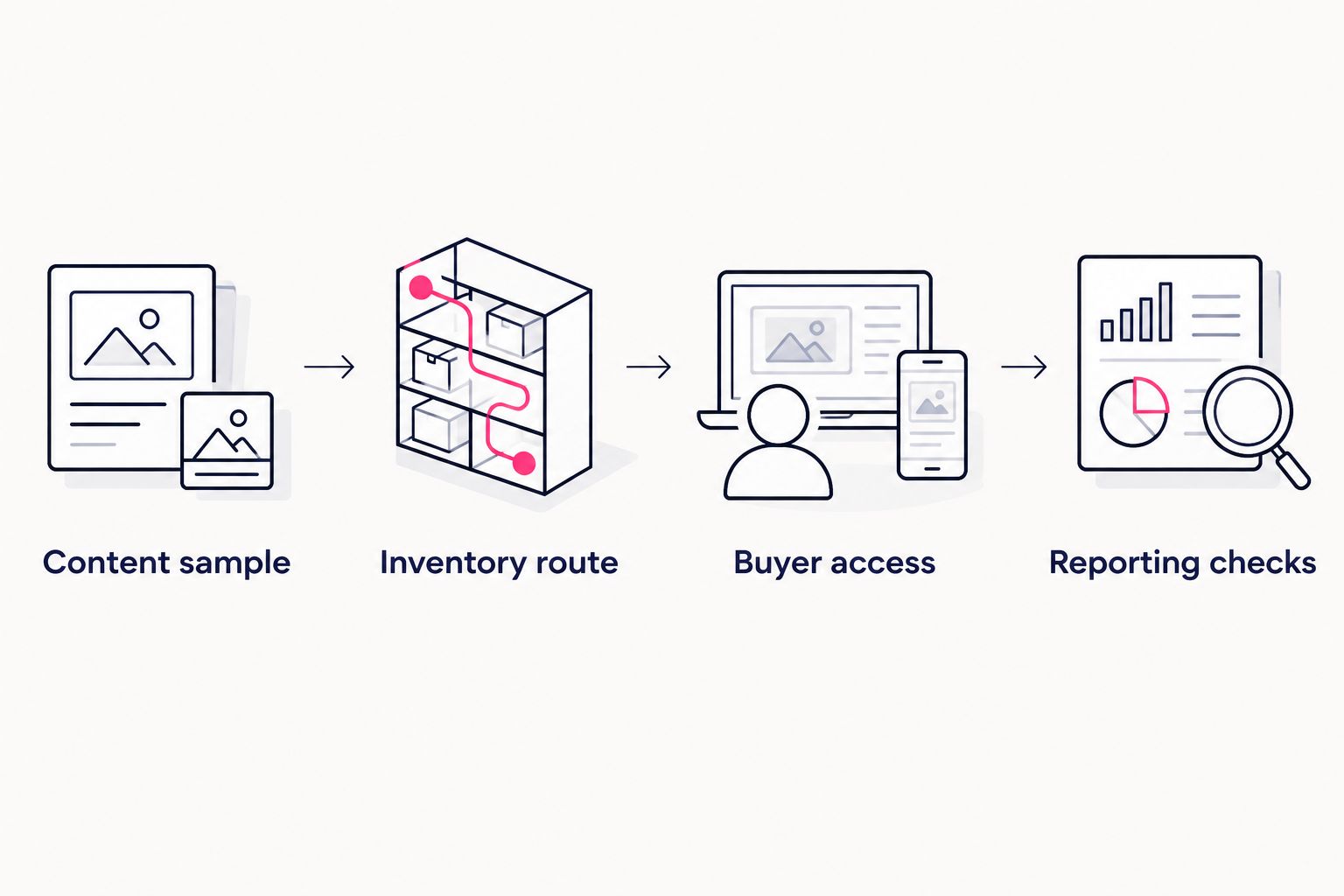
Test the route from editorial classification to reported delivery, not classification in isolation.
Keep a written pass-or-fail record for each requirement. A provider can fit one job and fail another; that is a reason to separate stack components, not to blur the acceptance criteria.
The 2026 ordering reflects functional relevance to publisher contextual advertising: specialist contextual businesses first, general publisher monetisation and ad-serving tools next, then an adjacent full-stack option. It does not claim that one provider generates more revenue or classifies content more accurately.
The criteria are content understanding, buyer access, publisher control, reporting, implementation and commercial accountability. Your content test and contract review should determine the final selection.
For an undecided publisher, start by evaluating Seedtag and GumGum against the same content sample. Their contextual focus makes them relevant starting points, but the preferred partner depends on the workflow each can demonstrate for your publication.
Choose Google AdSense when self-service monetisation is the job. Evaluate Google Ad Manager when you want to build and sell publisher-defined contextual packages yourself.
Keep a full-stack buying discussion separate from the publisher classification decision. That protects both sides from buying a broader platform to solve an undefined problem.
What's the best contextual advertising platform for publishers in 2026?
There is no evidenced universal winner in this comparison. Start with Seedtag and GumGum for contextual specialist evaluations, then assess Google AdSense or Google Ad Manager if your requirement is broader monetisation or publisher-controlled packaging.
Is Google AdSense a contextual advertising platform?
Google AdSense can use contextual signals when selecting ads, but it is not exclusively contextual. Do not assume all advertising delivered through it is selected only from page content.
Is Google Ad Manager the same as a contextual classifier?
No. Google Ad Manager can use publisher-supplied key-values for targeting, but your team or another system must provide and maintain the contextual labels.
Can contextual advertising work without third-party cookies?
Yes. Matching an advertisement to page content does not inherently require a third-party cookie, although other parts of the advertising and measurement workflow can still use identifiers.
Does contextual advertising remove consent obligations?
No. Assess the actual data collection, device access, purposes and applicable law; the word contextual does not establish that every part of a setup is exempt from consent requirements.
Should a publisher choose a classifier or a demand partner?
Choose a classifier when content labelling is the missing component; evaluate a demand partner when access to contextual advertiser demand is the missing component. Some proposals combine these roles, so establish responsibilities explicitly.
Is Cake.Shop a standalone contextual platform for publishers?
Cake.Shop is a modular programmatic platform covering buying, reporting, creative, data clean rooms and publisher supply. Standalone contextual classification is not established by that scope, so specific contextual requirements need confirmation.
A contextual label can be technically accurate and commercially unhelpful. A broad travel category, for example, does not tell a buyer whether an article covers a holiday itinerary or reporting about travel disruption.
Before signing anything in 2026, ask your editorial and sales teams to review the same sample classifications together. Approve the meaning of the inventory before approving the platform that sells it.
Compare brand safety platforms for CTV advertising by verification, fraud controls and reporting. Build a shortlist around your actual CTV supply paths.
Read more →Compare contextual advertising platforms for publishers by demand, content controls and reporting. Choose a publisher tool, not a buyer-only platform.
Read more →Compare DOOH advertising platforms for retail brands by buying, creative and in-house fit. Choose by screen access, reporting and operational control.
Read more →Book a 30-minute demo and see exactly how Cake.Shop works — no sales pitch, just the platform.