
OPEN DAILY
OPEN
HONEST
TRUST
LET'S CHAT



Yes, dynamic creative optimisation can improve conversion rates when the message, imagery or destination becomes more relevant to the person seeing the ad. It does not guarantee an uplift: you need a controlled test to separate the effect of creative changes from differences in audience, media buying and attribution.
TL;DR
Yes. Better-matched creative can help more people complete the action you want, but a higher reported conversion rate alone does not prove the creative caused it. Dynamic creative optimisation, or DCO, assembles or selects ad components using rules or performance signals. Its value depends on whether those changes address a real obstacle to conversion.
For a 2026 evaluation, use this sequence before choosing between dynamic creative optimisation tools:
These are testing instructions, not a promised performance benchmark. There is no defensible universal uplift figure for your campaign without comparable results from your own test.
A dynamic ad can display a more appropriate message and still fail commercially. The destination might be confusing, the conversion event might count low-value actions, or the campaign might reach people who would have converted anyway.
For independent agencies, the decision is whether creative variation improves client outcomes enough to justify production, checking and reporting work. For brands bringing programmatic in-house in 2026, the additional question is who owns those decisions. Automation does not remove the need for an accountable creative and measurement owner.
These approaches solve different problems. Static creative provides a fixed reference, rules-based creative applies explicit conditions, and performance-led optimisation uses observed results to influence selection. A dynamic setup is not automatically an optimisation system.
Static creative
Rules-based dynamic creative
Performance-led dynamic optimisation
Choose the simplest approach that answers your campaign question. If the hypothesis concerns a single headline, a controlled static test can answer it without introducing dynamic assembly. If the hypothesis concerns matching several approved messages to different contexts, dynamic creative addresses the actual requirement.
Avoid comparing a heavily refreshed dynamic campaign against neglected static ads. That tests the whole production process, not just dynamic optimisation.
Start with a mismatch you can describe clearly. “Make the ads more personalised” is too vague to guide a test or explain a result.
An agency promoting a service across different markets can test locally relevant wording against a generic message. The hypothesis is that clearer relevance helps eligible prospects understand the offer. Keep the underlying service proposition consistent so that localisation does not become a test of different promises.
Context does not have to mean personal identity. Page subject matter or an approved campaign condition can inform creative selection without requiring a person-level profile. Confirm which signals your chosen implementation actually supports.
An ad that highlights a particular service should lead to a destination that explains that service. Dynamic variation adds little if every variation sends people to a page that fails to carry the message through.
Review 3 creative components together: the headline, image and call to action. They should make a coherent promise that the destination fulfils. Test the combination deliberately rather than letting unrelated components produce contradictory messages.
Eligibility rules can stop inappropriate combinations from being assembled. For example, a campaign should not combine wording for one service with imagery and a destination describing another.
That is a quality-control benefit, not evidence of conversion uplift. Measure the commercial outcome separately. Fewer creative errors and a higher conversion rate are different findings, even when both matter to the campaign.
Results vary because the creative is only part of the system delivering and measuring the ad. These factors belong in your 2026 test plan:
There is no universal audience size, campaign duration or conversion count that makes every DCO test reliable. Set the test requirements using your baseline conversion rate, the effect you need to detect and the uncertainty you will accept. Do not substitute an arbitrary calendar deadline for sufficient evidence.
Treat the workflow as connected responsibilities rather than a creative tool operating in isolation. Your 2026 implementation plan should name the owner of each responsibility and document what passes between them.
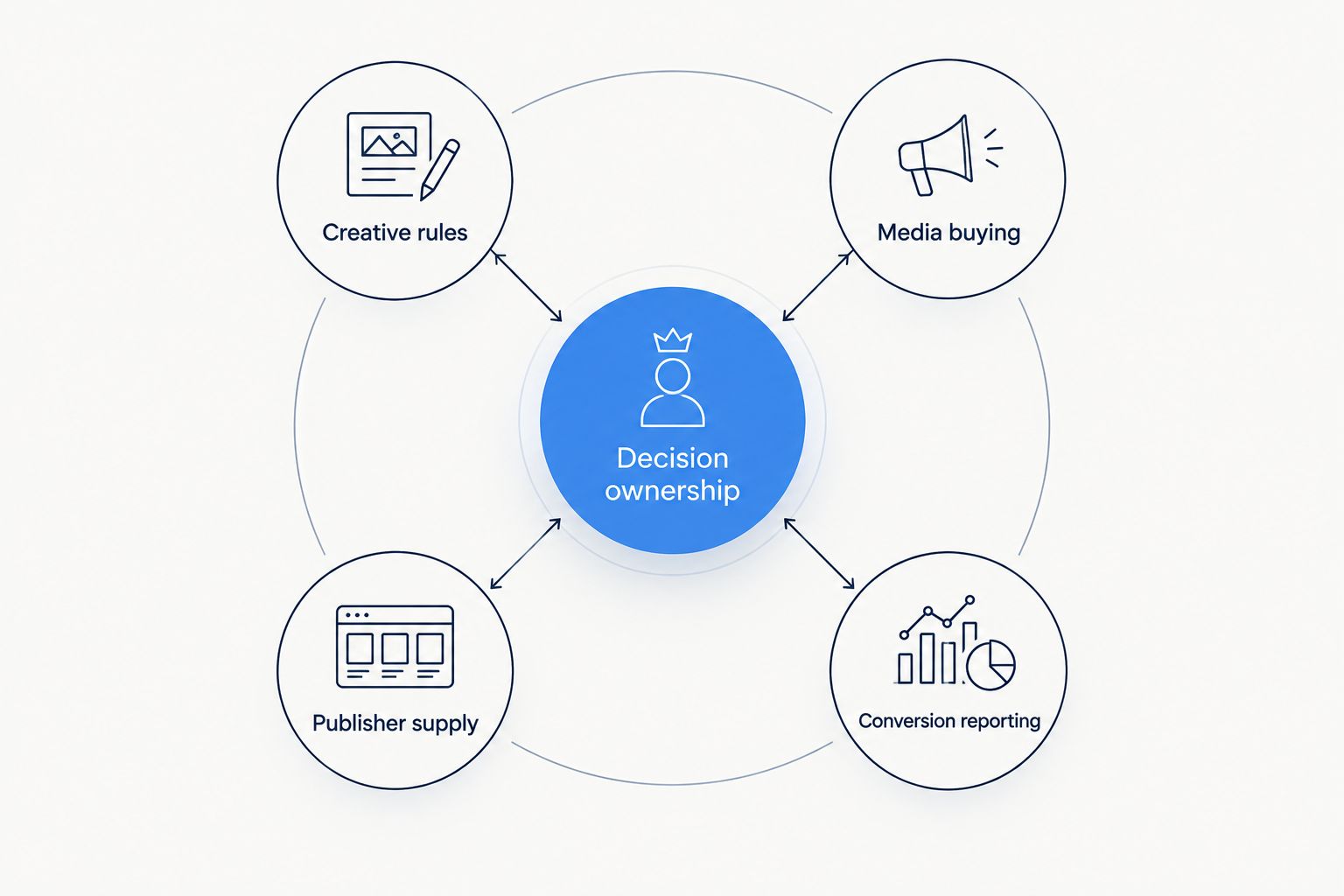
Creative optimisation needs shared rules across production, delivery and measurement.
Cake.Shop provides a modular programmatic advertising platform spanning media buying and reporting, rich media and DOOH creative, data clean rooms, and direct publisher supply. Cake.Shop introduces swweetshop as the platform that powers in-housing. The relevant enquiry is how those parts fit your existing stack, not whether a buying interface alone can fix creative performance.
The modular approach also leaves decisions with your team: which responsibilities to retain, which connections to validate and who owns campaign checking. Do not assume a particular DCO connector, automated workflow or conversion outcome; make those requirements explicit in the platform discussion.
Discuss your programmatic stack
Bring your creative, buying and reporting requirements to a discussion about in-housing.
A higher conversion rate proves that the measured ratio increased under your chosen definition; it does not, by itself, prove that DCO caused additional conversions. Write down the denominator. Conversions divided by clicks answers a different question from conversions divided by impressions or eligible users.
Compare like with like. A click-based conversion rate can rise while the campaign reaches fewer people or produces fewer valuable outcomes overall. Report the rate alongside conversion volume and quality so that an attractive percentage does not hide a weaker business result.
Attributed conversions are outcomes credited to advertising under a measurement rule. Incremental conversions are additional outcomes caused by advertising. A randomised comparison with a suitable control supports a stronger causal conclusion than a before-and-after dashboard comparison, where other conditions can change.
Optimise for completed conversions when those events accurately represent the business outcome and provide usable feedback. Clicks measure an earlier action. An ad can attract attention without attracting people who become customers or qualified prospects.
For lead generation, connect the initial enquiry to later qualification wherever your measurement and permissions allow. Otherwise, a creative variation that attracts unsuitable enquiries can look successful in the advertising report. Agree the quality check with sales before the campaign launches, not after the headline result arrives.
Yes. Dynamic creative can use contextual rules rather than person-level profiles, provided the implementation supports the signals and selection logic you need. An ad can vary according to its approved context without identifying the individual viewing it.
That does not remove privacy obligations from the wider campaign. Buying, measurement and data connections need their own assessment. A data clean room is a controlled environment for permitted data collaboration; it is not a blanket permission to use data or a guarantee of conversion uplift.
Can dynamic creative optimisation improve conversion rates in 2026?
Yes, dynamic creative optimisation can improve conversion rates when better-matched creative helps people complete the intended action. A controlled comparison is needed to establish whether it improved your campaign rather than simply coinciding with a change in audience or delivery.
What is the difference between dynamic creative and DCO?
Dynamic creative changes ad components according to defined inputs; DCO adds an optimisation process intended to improve a selected outcome. Ask how selection works, which outcome guides it and what reporting exposes the decisions.
Is dynamic creative always better than static creative?
No. Static creative is appropriate when you need a consistent message or a straightforward baseline. Dynamic creative adds value only when the variation addresses a meaningful campaign requirement and its additional complexity is justified.
How long should I run a dynamic creative test?
Run the test until it meets its predefined evidence requirements and accounts for conversion delay. The appropriate duration depends on traffic, baseline performance and the effect you need to detect, not a universal number of days.
What should an agency ask a DCO platform provider?
Ask how the platform selects components, records creative identifiers, handles invalid combinations and reports conversions. Also establish approval ownership, data permissions and how you can compare the treatment against a control.
Where does Cake.Shop fit in a DCO project?
Cake.Shop provides modular programmatic media buying and reporting, rich media and DOOH creative, data clean rooms, and direct publisher supply. Discuss your DCO requirements across that stack and confirm the specific connections your implementation needs.
Can DOOH creative use the same conversion test as display advertising?
Do not assume that DOOH and display support the same conversion test. Digital out-of-home involves physical screens, so define the exposure and outcome measurement appropriate to that environment before comparing results.
Write the decision rule before you see the result. For your next 2026 test, state what would justify expanding dynamic creative, what would trigger another test and what would make you stop. Include conversion quality, not just the dashboard rate.
That document is useful even when the test finds no improvement. It stops a disappointing result from becoming an endless sequence of unstructured changes and leaves you with a clear next question to answer.
How much does it cost to in-house a DSP? Budget beyond platform fees: compare staffing, creative, data and operating models before approving your plan.
Read more →How much does rich media ad creative cost to produce? Scope sets the quote. Compare build types, hidden costs and ownership before you brief a supplier.
Read more →Can dynamic creative optimisation improve conversion rates? Yes, when tested against a control. Learn what to measure, compare and check before scaling.
Read more →Book a 30-minute demo and see exactly how Cake.Shop works — no sales pitch, just the platform.