
OPEN DAILY
OPEN
HONEST
TRUST
LET'S CHAT


Yes, real-time bidding can be automated end to end across campaign setup, auction decisions, delivery monitoring and reporting when the necessary systems and controls are connected. That does not remove the need for people to approve objectives, spending limits, data use and exceptions. Automate execution; keep accountability with a named owner.
TL;DR
Yes. But distinguish automated bidding from an automated campaign operation: a bidder can make auction decisions while your team still moves audience files, approves creative, reconciles reports and fixes tracking manually.
For a 2026 implementation, map the entire workflow before evaluating individual features. The real-time bid optimisation workflow is one part of that wider operating design, not a substitute for it.
Use this sequence to define what end-to-end automation actually covers:
This is a proposed implementation checklist, not a claim that every platform supports every step. Ask suppliers to demonstrate the workflow using your intended campaign structure.
Automating the wrong objective makes an operational mistake repeatable. A campaign optimised towards an easy-to-trigger event can report success without delivering the commercial outcome you intended.
For an independent agency, that creates a client-accountability problem. For an in-house brand team, it creates a governance problem: someone still needs to explain where spending went, why settings changed and whether the reported result matches the brief.
Your 2026 automation plan should therefore define control alongside execution. A workflow is not complete just because it launches without manual input; it also needs an exception path when the inputs stop making sense.
A demand-side platform, or DSP, evaluates advertising opportunities and submits bids according to its settings and decision logic. That auction function does not, by itself, approve your data permissions or decide whether a business result justifies further spending.
There are different operating models. Choose the scope your team can govern, rather than treating maximum automation as the default target.
Auction automation
Rules-based campaign automation
Connected workflow automation
Human approval gates
These models can coexist. You can automate routine delivery checks while requiring approval for a new audience, a different measurement event or a change to the campaign's spending authority.
The useful question is not how much you can automate. It is which decisions you can safely delegate under explicit conditions.
Treat the campaign as connected functions, not just a buying interface. Each connection needs a defined input, an expected output and a response when that exchange fails.
Document which audience and measurement data you are entitled to use, for which purpose. Technical access is not permission.
Where a data clean room forms part of the design, define the permitted analysis and outputs. A clean room is a controlled environment for working with data; it does not replace your responsibility to establish the lawful basis and contractual permissions for that work.
Validate the asset, destination and placement requirements before an automated workflow makes the creative eligible to serve. Rich media adds interaction and rendering considerations that a basic image check does not cover.
For digital out-of-home, or DOOH, confirm the requirements of the intended placement and buying arrangement. Do not assume that a creative approval for one channel establishes suitability for another.
Specify eligible inventory, targeting boundaries and spending controls. Separate a recommendation to change a setting from permission to make that change automatically.
For example, an alert about delivery falling behind schedule should not silently grant permission to broaden targeting. Those are different decisions, with different commercial implications.
Document where the campaign is permitted to buy and how exceptions are handled. Direct publisher relationships and exchange-based buying need explicit inclusion in the operating design.
A publisher relationship alone does not establish that every available placement meets your campaign requirements. Keep inventory eligibility separate from the existence of a commercial relationship.
Define the event you want to optimise towards and verify that reporting represents it correctly. Include a response for missing, duplicated or delayed signals.
The workflow below describes the operating connections to establish, not a claim about any particular platform's integrations.
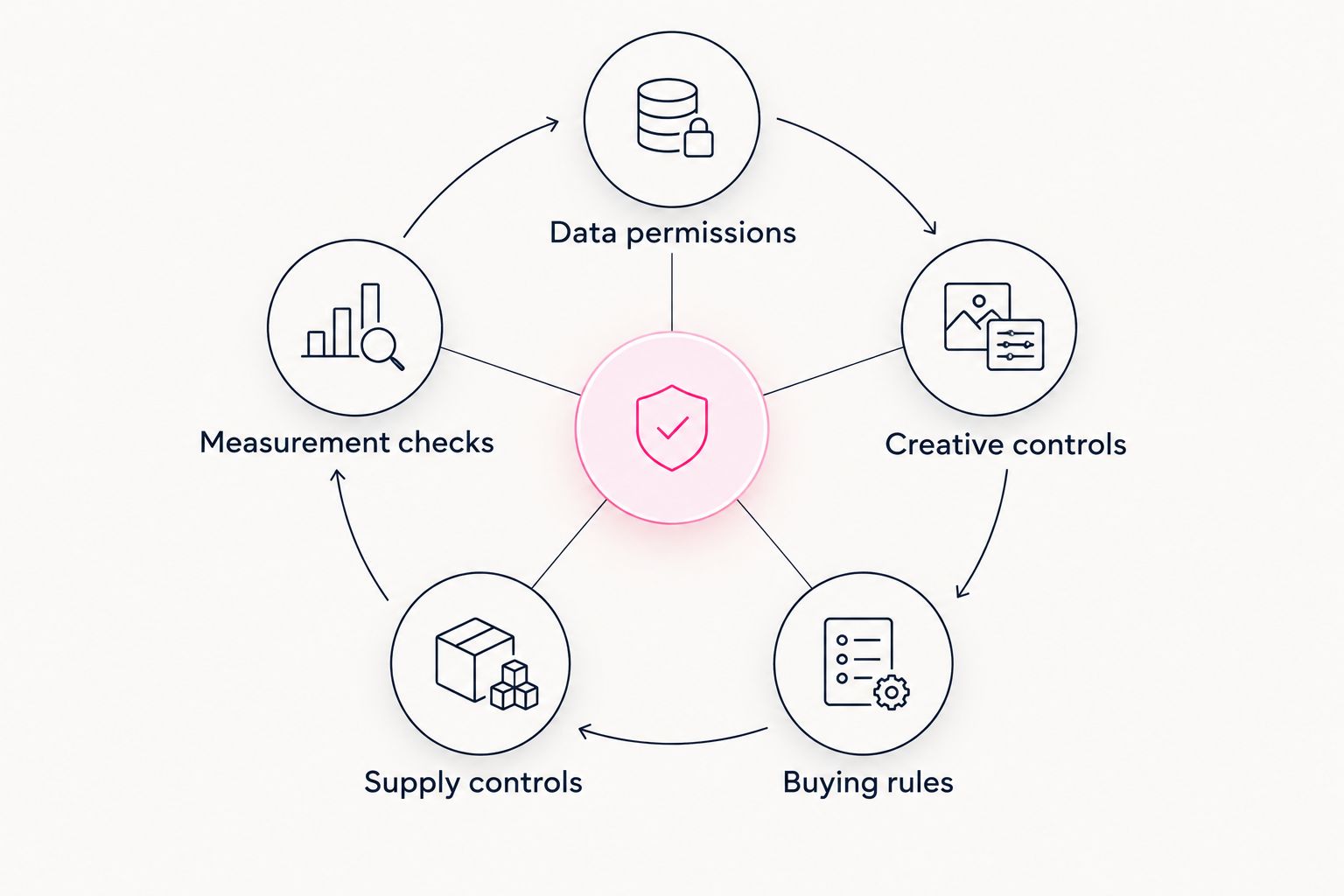
End-to-end automation needs controls at every connection, not just inside the bidder.
The extent of automation depends on the systems and operating rules you actually have. Use these factors to assess your 2026 requirements:
These are evaluation criteria, not reasons to abandon automation. They identify where you need configuration, integration work or a human approval step.
Keep the business objective, permission to use data, spending authority and material scope changes under named ownership. Software can execute instructions; it cannot take organisational responsibility for them.
Write the approval boundary before launch. State which changes can happen automatically, which require notification and which require explicit authorisation.
An agency might allow routine pacing adjustments within an approved campaign boundary but require client approval before expanding that boundary. An in-house team might automate report preparation while reserving the interpretation of business impact for its marketing and finance owners.
Neither example requires manual handling of every auction. Both preserve a clear answer to a basic question: who authorised the decision?
No. Automated bidding does not, by itself, prove incremental sales. Attribution assigns credit to advertising interactions; incrementality asks whether the outcome would have happened without the advertising.
A campaign can optimise towards attributed conversions without answering that second question. Define an appropriate evaluation design separately from the mechanism that selects bids.
For your 2026 brief, state whether the decision requires delivery reporting, attributed outcomes or evidence of incremental impact. Those are different measurement jobs, even when their results appear in the same reporting environment.
A measurement failure needs a predefined response, not an improvised explanation after the campaign has continued spending. Decide whether the affected workflow should pause, retain its existing settings or move to an explicitly approved fallback.
The right response depends on the campaign and the role of the missing signal. A reporting delay and a broken conversion event are not interchangeable problems.
Test the response before launch. Confirm that the responsible person receives the exception, can identify the affected campaign and has authority to intervene.
Cake.Shop provides modular programmatic advertising technology spanning media buying and reporting, rich media and DOOH creative, data clean rooms, and publisher supply. Its platform, swweetshop, powers in-housing; assess the full stack rather than treating it as only a standalone buying tool.
Cake.Shop serves independent agencies and brands building their own programmatic advertising stack. For an enquiry, bring a workflow map that distinguishes the functions you want connected from the decisions you want to retain.
Modularity gives you a way to discuss those functions separately. The trade-off is that ownership of each connection still needs to be clear; a modular design is not proof that every handoff is already automated.
Ask Cake.Shop to demonstrate your required workflow, including the relevant interfaces, permissions, reporting outputs and exception handling. Confirm supported behaviour rather than assuming that a full-stack offering means every action runs unattended.
For a useful 2026 demonstration, request evidence against these questions:
The answers should determine fit. A feature list alone does not establish operational control.
Can real-time bidding be automated end to end without a campaign manager?
Real-time bidding can automate execution, but someone still needs to own objectives, permissions, spending authority and exceptions. Removing manual tasks does not remove campaign accountability.
Is automated bidding the same as automated media buying?
No. Automated bidding concerns auction decisions, while automated media buying can also cover campaign setup, creative handling, delivery checks and reporting. Confirm the scope rather than relying on the label.
Do I need an API to automate programmatic campaigns?
You need a supported way for the relevant systems to exchange instructions and data. An application programming interface, or API, is one route; native workflow features can handle some actions without a separate integration.
Can a data clean room automate privacy compliance?
No. A data clean room can provide a controlled environment for permitted data work, but it does not establish your permission to collect, share or use that data. Define those responsibilities separately.
Does automated bidding guarantee better campaign results?
No. Automation executes a decision process; it does not guarantee that the objective, inputs or measurement are correct. Evaluate results against the approved business outcome, not the presence of automation.
What should I ask in a programmatic automation demo?
Ask the supplier to show a complete workflow and a failed-input scenario. Inspect approval controls, decision records, reporting outputs and the process for stopping or overriding execution.
Can rich media and DOOH sit within the same automation plan?
Yes, rich media and DOOH can be included in the same operating plan, but their creative and delivery requirements still need separate checks. Confirm actual channel support and workflow connections before launch.
Test the stop before you test the scale. A workflow that launches correctly has demonstrated execution; a workflow that handles a failed input has demonstrated a control.
Before expanding your 2026 programme, run a controlled failure test in a non-live environment where available. Check the response, the notification and the recovery path. That exercise tells you whether your automation plan includes the difficult part: knowing when not to act.
Is cookieless targeting as accurate as cookies? It depends on the task. Compare contextual, first-party and cookie targeting with a fair campaign test.
Read more →How much does real-time bidding cost per impression? Divide CPM by 1,000, then separate media, platform and service costs to compare budgets fairly.
Read more →Can real-time bidding be automated end to end? Yes—with controls. See what to automate, where approvals belong and how to assess your programmatic stack.
Read more →Book a 30-minute demo and see exactly how Cake.Shop works — no sales pitch, just the platform.