
OPEN DAILY
OPEN
HONEST
TRUST
LET'S CHAT



Cookieless targeting is not automatically as accurate as cookie-based targeting: the answer depends on whether you mean identifying a returning browser, finding relevant content or generating incremental sales. Cookies are not a ground-truth record of a person, and cookieless methods do not all use the same signals. In 2026, compare each method against the same business outcome rather than treating an audience match as proof of accuracy.
TL;DR
Cookieless targeting and cookie-based targeting answer different questions unless you specify the signal, audience and outcome. A cookie can help recognise a browser. Contextual targeting evaluates the content around an impression, while authenticated first-party targeting connects activity through an identifier such as a login.
That distinction matters when assessing whether contextual advertising can replace cookie-based targeting. Reaching a relevant page is not the same task as recognising a previous visitor.
Cookie-based targeting
Contextual targeting
Authenticated first-party targeting
Modelled audiences
These methods can coexist in a buying plan. The mistake is comparing their audience labels as though those labels prove equivalent performance.
An agency can report a strong audience match and still fail to generate additional sales. A brand can also reach relevant prospects without recognising those prospects individually. Targeting accuracy, reporting visibility and advertising effectiveness are separate questions.
For a 2026 media plan, specify which question the campaign must answer before selecting technology. Otherwise, the method with the clearest reporting can look better simply because more of its activity is observable.
For independent agencies, that distinction belongs in the client brief. For in-house teams, it belongs in the measurement plan and the platform evaluation, not just the targeting settings.
A cookie stores information in a browser context. In advertising, an identifier can connect eligible activity to that context, subject to browser behaviour, consent requirements and the implementation involved.
That makes cookies relevant when your task is recognising a returning browser. It does not establish who is using the device, whether someone else shares it or whether the person remains interested in the product.
Consider a customer researching a purchase on a shared computer. The browser activity supports an inference about interest; it does not prove that every later impression reaches that customer. Deleting cookies or switching devices also changes the available connection.
Best for: browser-based continuity where the required permissions and technical support exist. Trade-off: recognition is narrower than person-level certainty, and recognised activity is not evidence that advertising caused a purchase.
Contextual targeting selects advertising opportunities using information about the surrounding content. Depending on the implementation, that can include the page topic, language or other content signals.
A travel advertiser, for example, can target destination-planning content without first identifying the reader as a previous website visitor. The targeting decision concerns the environment in which the advertisement appears.
The limitation is equally clear. Someone reading destination advice might be planning a trip, researching for work or reading out of curiosity. The content supplies context, not a confirmed customer record.
Best for: prospecting around relevant subjects without requiring cross-site browser recognition. Trade-off: classification quality matters, and topic relevance alone does not establish purchase intent. In your 2026 evaluation, inspect actual placements rather than accepting a broad category label as sufficient evidence.
First-party data comes from your own customer or audience relationships. It can include account activity, customer records and permissioned interactions, but owning a record does not automatically authorise every advertising use.
Authenticated targeting uses a supported identifier to connect that relationship to an advertising environment. A login-based connection is different from an inferred audience membership, but its usefulness still depends on the connection being valid for the intended task.
Ask what a reported match actually represents: a person, household, account or device. Also ask which eligible records remain unmatched and whether the matched population resembles the audience you want to reach.
Best for: communicating with known, permissioned audiences where activation is supported. Trade-off: a precise connection within a limited audience does not establish broad market coverage. A data clean room can support controlled analysis or matching; it does not create missing permission or prove causation.
There is no single cookieless accuracy score because the methods use different evidence. For a 2026 buying decision, investigate these factors rather than asking for an unsupported percentage:
Keep those factors separate in the brief. A supplier should explain its signal and limitations without substituting a large audience count for evidence of relevance.
Use a written test plan with 5 checks. These are planning requirements, not performance benchmarks; the appropriate sample size and duration depend on the outcome and experimental design.
This process separates a targeting claim from a business claim. A high match rate answers whether records connected under a stated method; it does not answer whether the resulting advertising changed behaviour.
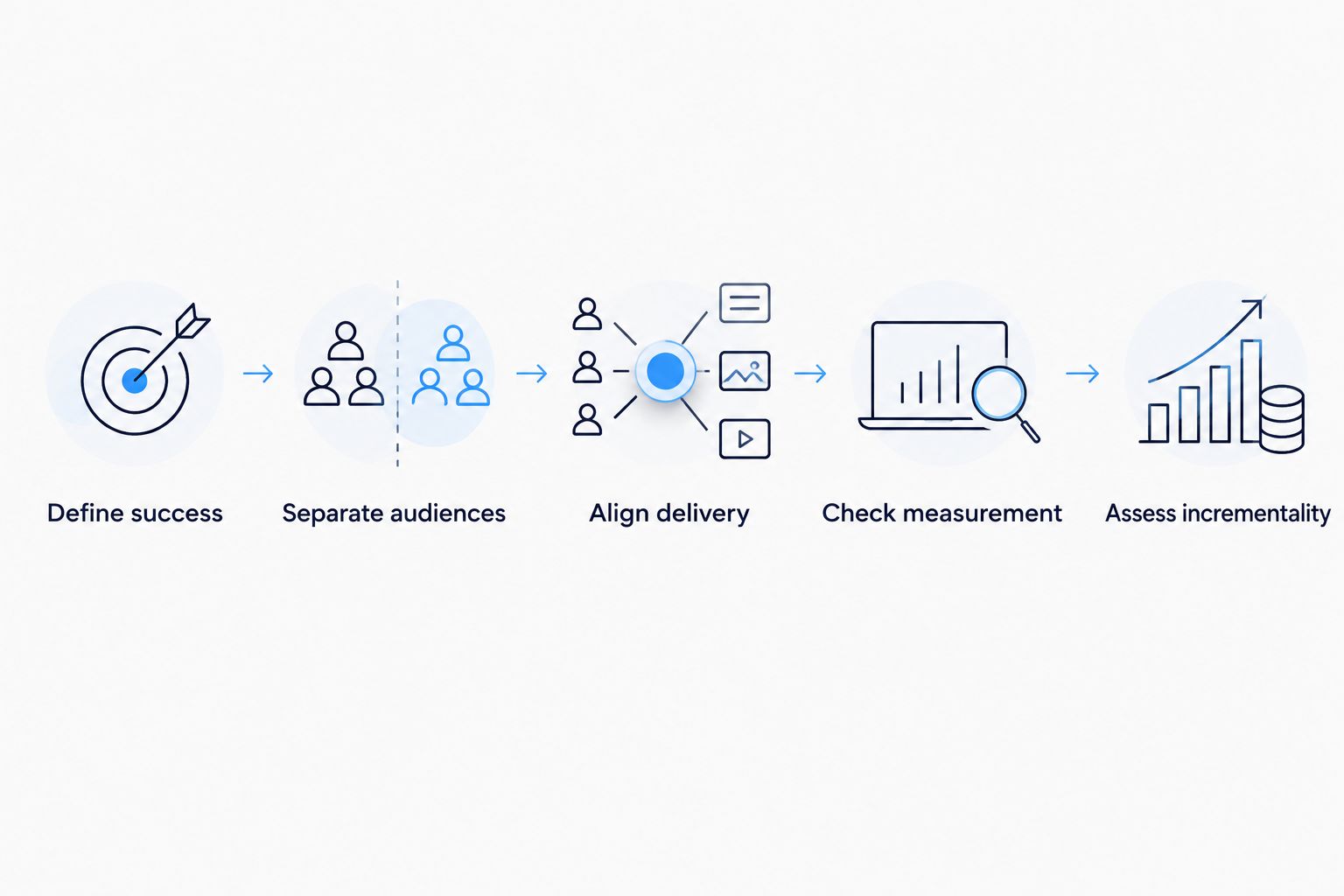
Agree on the outcome and measurement rules before comparing targeting methods.
Keep the results readable. Show the eligible audience, delivered exposure, primary outcome and material differences in delivery together, rather than presenting a targeting score without its operating conditions.
Attribution assigns credit under a set of reporting rules. Incrementality asks whether an outcome happened because of advertising. A campaign can receive attributed conversions from people who would have purchased anyway.
Cookie-based reporting and cookieless reporting can observe different portions of the customer journey. Do not interpret a change in recorded conversions as a change in actual customer behaviour without examining that visibility difference.
Where a controlled experiment is not feasible, state that limitation. Comparing reported conversion totals alone does not establish which method caused more sales.
Yes, but the available mechanism depends on the environment and the relationship with the audience. A permissioned login connection or an app-specific identifier is not the same mechanism as a third-party browser cookie, and each has its own implementation requirements.
The practical question behind retargeting without cookies is whether you can reconnect a previous interaction to an eligible advertising opportunity. Relevant contextual placement alone does not establish that the person seeing the advertisement previously visited your website.
Ask suppliers to distinguish known-customer activation from inferred interest and contextual prospecting. Those approaches can all have a role, but calling them all retargeting makes the reporting harder to interpret.
For a 2026 retargeting brief, name the original interaction, permitted identifier, activation environment and exclusion rule. Do not accept a proposed replacement until those connections are explicit.
Targeting does not operate independently of creative, supply and reporting. A relevant audience can receive an unsuitable message; a suitable message can appear in an irrelevant environment. Your evaluation needs to inspect those connections, not just the audience selector.
Cake.Shop provides modular media buying and reporting, rich media and digital out-of-home creative, data clean rooms, and direct publisher supply. Its swweetshop platform powers in-housing, giving the commercial discussion a full-stack scope rather than reducing it to a standalone buying tool.
Cake.Shop is for independent agencies and brands building their own modular programmatic advertising stack. That positioning is not evidence that a particular targeting method will outperform another; campaign-level evidence must establish the result.
Use the enquiry to Cake.Shop to define the modules, ownership responsibilities and measurement requirements your team needs. Ask how the proposed setup addresses your actual environments and audience permissions, rather than assuming every component is required.
The trade-off is operational responsibility. Bringing activity in-house requires named owners for data permissions, campaign decisions, creative approval and reporting interpretation. A modular stack still needs an operating plan.
Put 3 evidence requests into the evaluation brief. They expose more than a general promise of accurate targeting:
Require plain answers before expanding a test. Technical detail is necessary; a black box is not. If a supplier reports an accuracy figure, ask for the denominator, validation method and population it describes.
Is cookieless targeting as accurate as cookies in 2026?
There is no universal accuracy ranking between cookieless and cookie-based targeting in 2026. Compare the specific signal, intended audience and business outcome under consistent test conditions.
Does contextual targeting know who I am?
Contextual targeting does not need to identify you to select an advertisement based on surrounding content. A relevant page topic does not prove that its reader matches a customer profile.
Is first-party targeting more accurate than third-party cookies?
First-party targeting is not automatically more accurate for every task. Its value depends on record quality, permission, the identifier used and whether the intended advertising environment supports the connection.
Does a higher match rate mean better advertising?
A higher match rate does not prove better advertising outcomes. It describes connections made under a matching method, not whether the advertisements caused additional purchases or enquiries.
Can a data clean room prove that targeting works?
A data clean room does not prove targeting effectiveness by itself. Controlled analysis still needs suitable data, permissions and a measurement design that addresses the business question.
How long should I test cookieless targeting?
Test duration depends on the sample required, outcome frequency and conversion delay. Define those requirements before launch rather than choosing a universal campaign length.
Does cookieless advertising remove privacy obligations?
Cookieless advertising does not remove privacy obligations. Other identifiers and personal information still require assessment against applicable law, permissions and contractual restrictions.
Ask what the accuracy claim is accurate about. Recognising a browser, matching a customer record, classifying a page and causing an additional sale are different achievements. A supplier that cannot name the task has not given you a testable claim.
Is cookieless targeting as accurate as cookies? It depends on the task. Compare contextual, first-party and cookie targeting with a fair campaign test.
Read more →How much does real-time bidding cost per impression? Divide CPM by 1,000, then separate media, platform and service costs to compare budgets fairly.
Read more →Can real-time bidding be automated end to end? Yes—with controls. See what to automate, where approvals belong and how to assess your programmatic stack.
Read more →Book a 30-minute demo and see exactly how Cake.Shop works — no sales pitch, just the platform.