
OPEN DAILY
OPEN
HONEST
TRUST
LET'S CHAT



Real-time bidding has no fixed cost per impression: divide the clearing cost per thousand impressions, or CPM, by 1,000 to calculate the media cost of one impression. That figure excludes any separately charged platform, data, verification, creative or service costs. For a usable 2026 budget, compare the auction media cost with the fully loaded cost of delivering your campaign.
TL;DR
A low auction CPM does not tell you whether a campaign is economical. You still need to know what you bought, which charges sit outside the media line and whether the impressions contributed to your objective.
For an independent agency, that distinction affects client estimates and reporting. For an in-house brand team, it affects procurement and whether media, technology and production belong in the same budget. The guide to programmatic advertising cost per campaign covers that broader budgeting question.
Treat the impression price as a unit cost, not a complete business case. Get the denominator and the included charges straight before comparing providers.
The calculation is straightforward: media cost per impression = media CPM ÷ 1,000. CPM means cost per thousand impressions; it is a reporting unit, not a promise that every impression clears at the same price.
In real-time bidding, eligible buyers compete for individual impression opportunities. Auction rules, publisher floors and competing demand affect the clearing cost. Your reported CPM summarises the cost across the impressions included in that report.
Use the following breakdown when reviewing a 2026 proposal. These are different cost measures, not interchangeable names for the same figure.
Media CPM
Media cost per impression
Fully loaded delivery cost
Total campaign cost
Ask the provider to define each line before accepting a blended figure. In particular, establish whether a reported media cost includes platform charges, data usage or verification. Do not add a fee again if it is already included.
Auction media cost is the amount assigned to buying the impressions themselves. It helps you compare buying performance when the inventory, audience, format, geography and measurement basis are aligned.
Its weakness is scope. Two reports labelled media CPM are not comparable if one includes technology charges and the other excludes them. Request the underlying definitions, not just the dashboard label.
Fully loaded delivery cost adds the separately charged items required for the delivery being assessed. Define those items explicitly: buying technology, audience data, verification, serving or service work, where applicable.
This is the more useful view for procurement because it follows the budget you actually approve. It still needs a boundary: creative production and internal staff time belong in the calculation only when your comparison includes them consistently.
There is no universal 2026 rate that makes every inventory source, audience and format comparable. The price reflects the opportunity being bought and the conditions under which buyers compete.
Keep these drivers separate in your analysis. A higher fully loaded cost caused by an added measurement service is a different issue from a higher auction cost caused by changes in inventory.
Change one comparison dimension at a time. Otherwise, you cannot tell whether a different CPM reflects price, quality, audience composition or accounting.
Divide the media CPM by 1,000 to calculate the media cost of one RTB impression. For the fully loaded figure, divide the total included delivery cost by the same delivered impression count.
Use this sequence when building your calculation:
For a 2026 procurement worksheet, retain the formula alongside the result. A number without its scope becomes difficult to audit when different teams reuse it in forecasts or client reports.
Compare equivalent buying conditions and equivalent cost boundaries. A lower headline CPM is not evidence of a better deal when the proposals include different audiences, inventory or services.
Give each provider the same brief. Specify the objective, geography, formats, audience rules, exclusions, measurement requirements and reporting currency. Then request a written description of the proposed supply and charge structure.
Ask what inventory the proposal covers and how the buyer accesses it. Distinguish open-auction buying from negotiated arrangements rather than combining them under a single programmatic label.
The benefit of this detail is accountability: you can connect the proposed cost to the intended delivery. The trade-off is more planning work before launch. That work is preferable to explaining an apparently cheap campaign whose inventory does not match the brief.
A self-directed buying model puts campaign decisions and operational work with your team. A managed arrangement assigns defined tasks to a service provider; clarify which decisions, reporting responsibilities and approval rights remain yours.
Neither model is automatically cheaper overall. Compare the external charges alongside the work your team must perform. Keep internal workload visible rather than treating it as costless because it does not appear on a media invoice.
Request reporting that lets you connect spend, delivery and the agreed objective. Establish the treatment of invalid traffic, billing adjustments and attribution before launch.
Reporting access does not, by itself, prove campaign effectiveness. You need an agreed measurement approach and a clear distinction between observed conversions and incremental results caused by advertising.
Cake.Shop provides a modular programmatic advertising platform spanning media buying and reporting, rich media and DOOH creative, data clean rooms and publisher supply. Its platform, swweetshop, powers in-housing for brands and independent agencies.
Cake.Shop is for brands and independent agencies seeking a modular programmatic advertising stack. The relevant buying question is how those components fit your operating model—not whether a single headline impression rate looks attractive.
For example, a brand planning an in-house campaign needs to consider media buying, creative delivery, supply access and measurement together. An agency building its own stack needs to decide which responsibilities sit with its team and which services belong in the proposed arrangement.
Media buying
Rich media creative
DOOH creative
Data clean rooms
Publisher supply
The benefit of modularity is choosing components around your requirements. The trade-off is responsibility: your team still needs to define ownership, data permissions, creative approval and measurement. A platform does not remove those decisions.
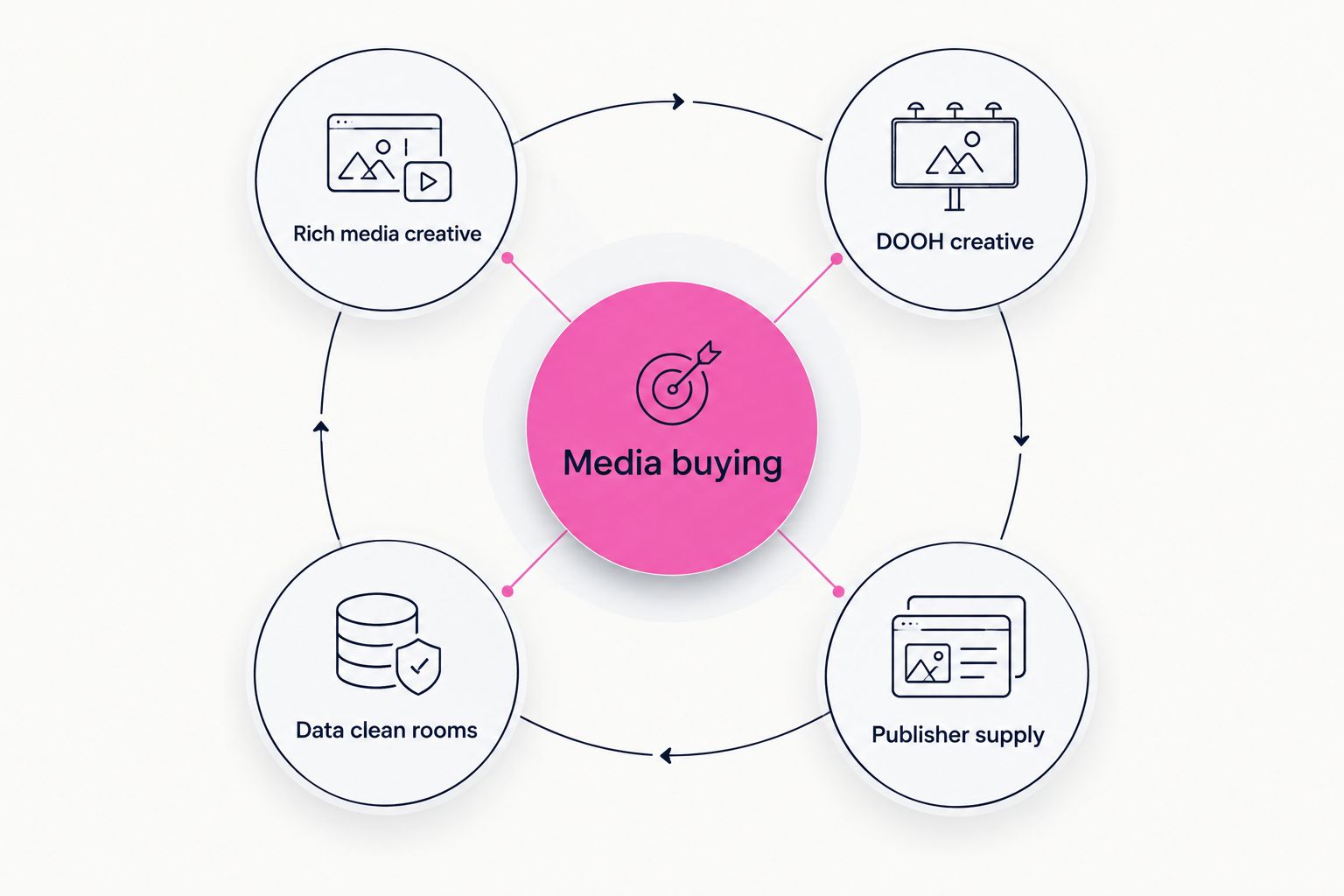
Assess buying, creative, data and supply together rather than pricing the buying layer alone.
A lower CPM means you paid less per 1,000 impressions on the stated reporting basis. It does not establish better audience delivery, stronger attention or more sales.
Start with the objective. For a reach campaign, inspect the agreed reach and frequency measures alongside delivery quality. For a response campaign, assess the relevant conversion outcome and the limits of its attribution method.
Cheap inventory has a legitimate role when it meets your requirements. Its drawback is that price alone tells you little about suitability. More expensive inventory also needs scrutiny: a premium label is not evidence that the campaign produced a better result.
Reject both shortcuts: cheapest is not automatically efficient, and expensive is not automatically effective. Keep the buying decision tied to the outcome you set out to achieve.
Request a written scope that connects the buying plan to the invoice and the report. Your 2026 approval should identify the accountable party for delivery, creative, data handling and measurement.
Use these questions in the commercial conversation:
Ask Cake.Shop to scope the modules and responsibilities against that brief. Keep the enquiry specific: describe your current stack, the work you want to bring in-house and the reporting you need to retain.
How much does real-time bidding cost per impression in 2026?
Real-time bidding has no fixed per-impression rate in 2026. Divide media CPM by 1,000 for the media unit cost, then account for separately charged delivery costs using a consistent scope.
How do I convert CPM into cost per impression?
Divide CPM by 1,000 to calculate cost per impression. Use a media-only CPM for media-only cost, or a consistently defined all-in CPM for all-in cost.
Is my bid the same as the amount I pay?
A submitted bid is not automatically the final billed amount. Auction rules determine the clearing outcome, while the commercial arrangement determines additional charges and billing treatment.
Does a low CPM mean my campaign is working?
A low CPM shows a lower cost per thousand reported impressions, not proof of campaign effectiveness. Assess delivery quality and the outcome specified in your campaign brief.
Does CPM include platform and data fees?
CPM does not have a universal fee-inclusion rule. Ask the provider to state whether platform, data, verification and service charges are included or billed separately.
Is real-time bidding the same as all programmatic advertising?
Real-time bidding is one method of buying programmatic advertising, not the whole category. Programmatic buying also includes arrangements that do not use an open real-time auction.
What should an agency compare before choosing a buying platform?
An agency should compare buying requirements, total charge structure, reporting access and operational responsibilities. Evaluate creative, data and supply requirements alongside the buying interface rather than assessing a standalone CPM.
Ask for the definition behind the denominator. An served impression, a viewable impression and a completed video view are different measurement events; costs calculated against them answer different questions.
Before approving a proposal, write the cost scope and measurement event on the same line. That simple discipline prevents a media-only impression figure from being presented as a complete measure of campaign value.
Is cookieless targeting as accurate as cookies? It depends on the task. Compare contextual, first-party and cookie targeting with a fair campaign test.
Read more →How much does real-time bidding cost per impression? Divide CPM by 1,000, then separate media, platform and service costs to compare budgets fairly.
Read more →Can real-time bidding be automated end to end? Yes—with controls. See what to automate, where approvals belong and how to assess your programmatic stack.
Read more →Book a 30-minute demo and see exactly how Cake.Shop works — no sales pitch, just the platform.