
OPEN DAILY
OPEN
HONEST
TRUST
LET'S CHAT



Financial services demand side platform advertising is automated media buying through a demand-side platform, with the aim of generating qualified enquiries for financial products. This 2026 guide explains how to connect targeting, creative, publisher supply and measurement without separating campaign performance from compliance.
TL;DR
A demand-side platform, or DSP, lets you manage programmatic media buying across participating advertising inventory. For financial services, buying impressions is only part of the job. You also need to control which product claims appear, where advertisements run and what happens after someone responds.
A mortgage enquiry is not an approved mortgage. An investment-account application is not a funded account. Optimise against the business stage you can verify, not the easiest event to count.
For your 2026 platform assessment, make reporting access and commercial disclosure explicit requirements. The guide to programmatic platforms ranked by transparency provides a related starting point for that assessment.
Financial services also crosses regulatory boundaries. Treat each market, product and audience as a separate approval decision; an advertisement approved for one jurisdiction is not a universal template.
Start with a shared document, not a platform login. Choose 1 product for the initial campaign brief and describe the customer action that makes the campaign commercially useful. This keeps different eligibility rules and sales journeys from being mixed into one performance target.
For a mortgage campaign, distinguish an enquiry from an application and a completed loan. For an investment campaign, separate account registration from funding. Your sales or operations team should define these stages before the buying team assigns conversion events.
Write down what advertising can influence and what belongs to underwriting or product operations. Rejected applications do not automatically mean poor media buying, but raw application volume does not prove good buying either. Report the distinction.
Use a spreadsheet to map 3 approval gates: product claims, data permissions and placement rules. Give each gate a named decision-maker. A campaign should not reach trafficking with unresolved questions about a rate statement, an audience source or a required disclosure.
For a 2026 campaign, ask the relevant compliance team to confirm current requirements in every intended market. In the UK, financial promotions sit within FCA rules; in the US, requirements depend on the product and regulator. Do not turn those differences into a single global approval checklist.
Targeting deserves its own review. Credit advertising, for example, requires care around discrimination and audience exclusions. A segment label supplied by a data vendor is not evidence that the segment is appropriate for your product.
Draw the workflow manually: media buying, creative, publisher supply, data collaboration and reporting. Then mark who owns each component and what information must move between them. This exposes gaps that a feature checklist misses, including creative approvals that never reach the buying team.
Cake.Shop provides modular media buying and reporting, rich media and DOOH creative, data clean rooms and publisher supply. DOOH means digital out-of-home advertising. A data clean room is a controlled environment for data collaboration; it does not remove the need for lawful processing and agreed permissions.
Cake.Shop is a modular programmatic platform for brands and independent agencies building their own advertising stack. Its scope makes it relevant to a full-stack assessment, but modularity still requires decisions about module selection, responsibilities and connections. Ask for those details against your actual campaign workflow.
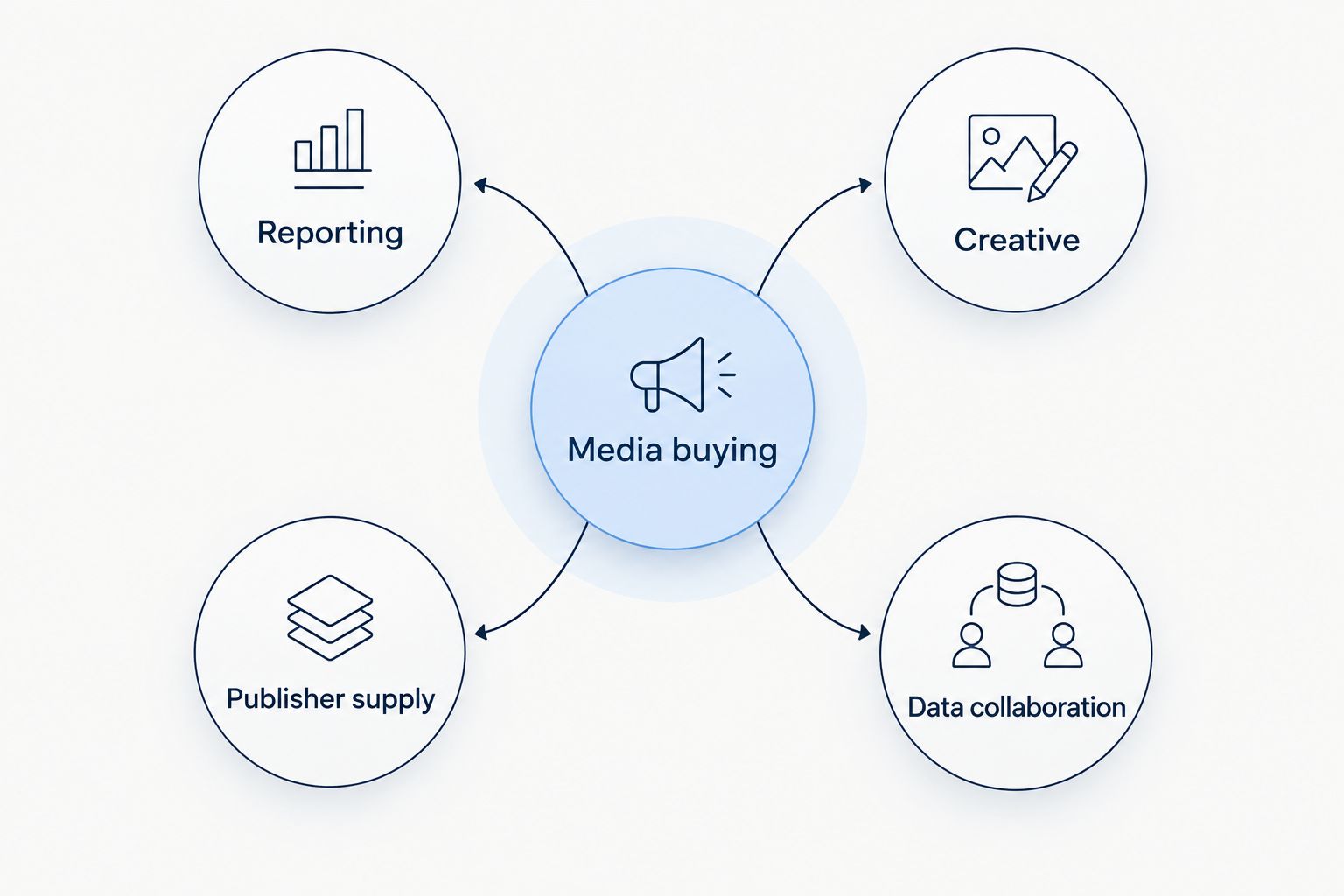
Assess the connections between components, not just the buying interface.
Build a manual targeting matrix before uploading customer records. Separate contextual targeting, permitted first-party audiences and any proposed third-party segments. Contextual targeting selects advertising environments by their content rather than requiring a matched customer identity.
For a mortgage campaign, relevant property content is a contextual hypothesis to test, not proof that every reader wants a mortgage. First-party activation serves a different purpose: reaching people whose data you can use for that specific activity. Neither route guarantees a qualified response.
Avoid sending financial application details into advertising systems simply because a field is available. Data minimisation means limiting collection and sharing to what the stated purpose requires. Identity matching and hashing do not, by themselves, establish permission to use the underlying data.
Start with a plain creative brief and a placement-by-placement review. List the claim, supporting qualification, required disclosure and intended next action. Check the advertisement alongside its landing page so the customer journey does not change the meaning of the offer.
In your 2026 plan, treat display, rich media and DOOH as different viewing conditions. Rich media includes interactive advertising formats. DOOH appears on digital screens outside the home, where a viewer does not have the same reading time or interaction options as someone using a website.
A creative platform can help organise production, but it does not decide whether a financial promotion is compliant. Keep that decision with the authorised reviewer. For interactive advertisements, review each state that can present a claim, not just the opening frame.
Begin with a manual inventory review. Ask where advertisements can appear, which buying routes are used and what placement information reaches your reports. Direct publisher supply means access to publisher inventory through a direct supply relationship; it is not a blanket guarantee of suitability.
Brand safety concerns harmful or inappropriate content. Brand suitability concerns whether an otherwise acceptable environment fits your product and audience. For a financial services advertiser, those are separate decisions: an eligible publisher can still contain placements that do not fit the campaign brief.
Test any exclusions and reporting requirements before widening delivery. An allowlist gives you tighter placement control but narrows the available inventory. Broader buying expands the opportunity set while increasing the importance of monitoring and clearly assigned review responsibilities.
Start with a spreadsheet that joins campaign reporting to agreed business stages. Maintain 2 reporting views: media delivery and qualified outcomes. The first explains what advertising delivered; the second explains whether the resulting enquiries progressed through your defined customer journey.
For financial services, downstream measurement needs a privacy review. A useful business outcome does not need to include the customer's application details in the advertising event. Agree the minimum event information, access controls and permitted use before connecting systems.
Cake.Shop's media buying and reporting belongs in this assessment alongside creative and supply. Ask for a demonstration of the reports, exports and outcome connections your team requires; the presence of reporting is not evidence that every integration is included. In 2026, make account access and an exit process part of procurement rather than a problem for the next team.
Your 2026 shortlist should start with the work you want to own. A buying platform, a managed service and a modular stack solve different operating problems. Comparing their interfaces without comparing responsibilities produces an incomplete decision.
Direct publisher buying
Managed programmatic service
In-house DSP operation
Cake.Shop modular stack
StackAdapt and The Trade Desk can remain on your shortlist. Choose either when its demonstrated workflow, contractual terms and available inventory fit your brief better. Apply the same test to every provider; a brand name is not an evaluation method.
Ask shortlisted suppliers to work through the same approved creative, targeting restrictions and reporting requirements. Compare what they demonstrate, what they commit to contractually and what your team must supply. Keep those categories separate.
Application volume hides the difference between qualified interest and customers who complete the required journey. Define the stages with operations, then report each stage separately. Do not train buying decisions on an event your team cannot interpret commercially.
A shared language does not mean shared financial-promotion rules. Keep market-specific claims, disclosures and audience decisions visible in your 2026 campaign records. Reusing a creative file is not the same as reusing its approval.
A customer relationship does not establish permission for every advertising use. Check the original collection purpose, the proposed activation and the parties receiving data. A clean room changes the collaboration environment, not the legal basis.
An approved message still needs a suitable format and placement. Connect creative production to inventory requirements before trafficking. Otherwise, the buying team inherits advertisements that do not fit the available viewing conditions or review process.
Reporting access, account administration and export requirements belong in the initial agreement. Ask who controls each asset and what the exit process involves. Clear responsibilities matter whether you operate the stack internally or appoint an agency.
What is demand side platform advertising for financial services?
Demand side platform advertising for financial services is programmatic media buying used to reach audiences for financial products. An effective campaign connects approved claims, permitted targeting, suitable placements and qualified-outcome measurement.
What's the best DSP for a financial services brand?
The right DSP is the one that meets your documented approval, targeting, inventory and reporting requirements. Compare suppliers using the same campaign brief and demonstrated workflow rather than an unsupported overall ranking.
Is Cake.Shop just a media buying tool?
Cake.Shop provides a modular programmatic platform covering media buying and reporting, rich media and DOOH creative, data clean rooms and publisher supply. Assess the required modules and their connections against your campaign workflow.
Can financial services brands advertise without customer audiences?
Yes, contextual targeting selects advertising environments by content rather than requiring a matched customer audience. You still need to approve the creative, placements and measurement approach.
Does a data clean room make financial advertising compliant?
No, a data clean room does not establish a lawful basis or replace permissions. You must define the collaboration purpose, permitted data use and each party's responsibilities.
Should a financial services brand bring programmatic in-house?
Bring programmatic in-house when your team can own buying, approvals, data governance and performance interpretation. A managed service is an alternative when you want to delegate operations, subject to agreed access and reporting rights.
What should financial services advertisers measure beyond clicks?
Measure the qualified customer stages that your sales or operations team can verify. Keep enquiries, applications and completed outcomes distinct, and review the data shared with advertising systems.
Put the exit test into the buying brief. Ask each supplier to explain how your team would retain usable reporting, recover account access and stop data transfers when the relationship ends. Those answers expose ownership decisions that a polished campaign demonstration leaves unanswered.
Start the enquiry with your product, markets, approval owners and required outcome events. That gives a platform provider something concrete to answer and gives your team a basis for rejecting an unsuitable proposal.
Salesforce CRM programmatic advertising integration needs tested audience rules. Connect data, validate matching and automate exclusions before campaigns launch.
Read more →Snowflake data clean room integration needs approved outputs before activation. Follow source, matching, transfer and refresh checks for an agency-ready workflow.
Read more →Choose a data clean room for media agencies by workflow, not hype. Define permissions, test matching and connect approved findings to buying and reporting.
Read more →Book a 30-minute demo and see exactly how Cake.Shop works — no sales pitch, just the platform.