
OPEN DAILY
OPEN
HONEST
TRUST
LET'S CHAT


QSR digital out-of-home (DOOH) advertising is advertising on digital screens in public places with the aim of increasing awareness and restaurant demand for quick-service brands. This guide covers your 2026 plan: connect screen locations and meal occasions to individual stores, then choose creative, buying controls and measurement that match the job.
TL;DR
QSR advertising has a local constraint: the restaurant must be a practical choice when someone decides where to eat. A screen near a store is not automatically useful. Travel direction, pedestrian access, opening hours and the advertised meal all affect whether the message makes sense.
DOOH lets you place a restaurant message in a physical setting. That makes screen selection part of the message itself: a commuter-facing placement and a shopping-centre placement serve different situations. Buy the location and occasion together, not the screen alone.
The limitation is equally important. A public screen serves a shared audience, and an ad play does not prove that a particular customer saw the message or visited a restaurant. Your plan needs a delivery standard and a separate business measurement standard.
For an in-house team or independent agency, Cake.Shop brings modular media buying and reporting, rich media and DOOH creative, data clean rooms, and publisher supply into the same stack discussion. Evaluate those components against your restaurant brief rather than treating platform access as the strategy.
Start manually with a spreadsheet containing the participating stores, campaign objective, relevant meal occasions and available business data. Choose 1 campaign objective for the initial brief. That is a planning discipline, not an industry benchmark: a store launch and a repeat-visit campaign need different messages and different evidence.
For your 2026 brief, state the decision the campaign must support. Do you need to understand whether a local launch reached its intended area, whether a meal message generated interest, or whether advertising contributed to restaurant transactions? Avoid combining those questions into a single success label.
Separate the business objective from the media metric. Ad delivery describes what ran. Restaurant transactions describe business activity. A campaign report should explain the relationship without pretending the metrics are interchangeable.
Also identify who owns each decision. A national brand team can approve the campaign idea while an agency handles buying and a franchise operator confirms local details. Unassigned responsibilities turn small store-level errors into campaign-wide problems.
Use a map and publisher screen lists before relying on automated targeting. A catchment is the practical area from which a store draws customers; it is not simply a circle around the address. Check access routes, barriers and competing store locations against the audience situation you want to reach.
Use 3 planning layers: store geography, screen context and meal occasions. These are recommended planning inputs, not measured performance thresholds. A roadside screen needs a different evaluation from a screen inside a retail venue, even when both appear close to the same restaurant on a map.
Your 2026 screen schedule should reflect restaurant operations. Dayparting means scheduling advertising for selected times of day. It helps align a breakfast message with breakfast service, but only if the selected inventory supports the required scheduling controls.
Turn the map into buying rules. Define acceptable locations and contexts, then document exclusions. Ask the publisher or buying provider to show how those rules translate into the actual screen list; a broad venue category is not a substitute for placement review.
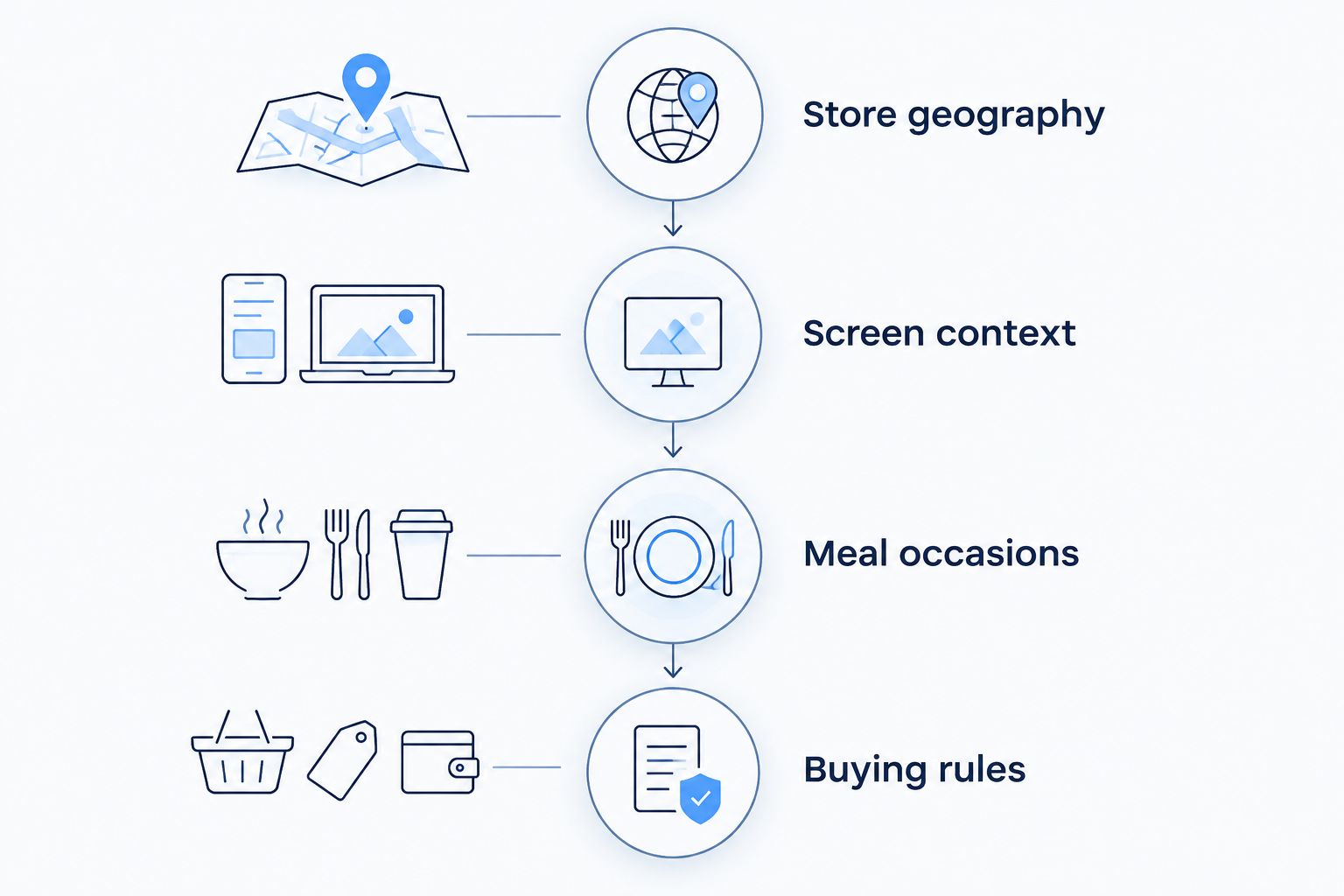
Translate local restaurant context into explicit buying rules before selecting inventory.
Begin with a written requirements sheet and direct conversations with publishers or buying partners. You do not need a new platform to establish which screens, schedules, reporting fields and approval responsibilities the campaign requires. That work remains necessary whichever buying route you choose.
A demand-side platform, or DSP, is software used to buy advertising inventory. Programmatic DOOH applies automated buying to digital out-of-home inventory, but the available controls depend on the publisher, deal and platform. Do not assume that an online advertising feature works identically on public screens.
For your 2026 evaluation, ask Cake.Shop to explain how media buying and reporting, DOOH creative and direct publisher supply would support the brief together. Its modular structure is relevant to teams assembling their own stack; the enquiry still needs to establish campaign-specific inventory access, workflows and reporting requirements.
A direct publisher relationship can suit a tightly defined placement brief. An agency-managed route can suit a team that needs buying support. Neither removes the need for transparent delivery evidence. Use the DOOH advertising platforms guide as a starting point for your requirements, not as proof of campaign fit.
Start with a simple storyboard and the publisher's creative specifications. Decide what a person must understand from the placement: the restaurant brand, the relevant food proposition and the action or location cue. A DOOH ad should work without a click. Public screens are not personal browsing sessions.
Use the viewing environment to shape the asset. A roadside placement calls for quick recognition; a venue where people wait allows a different reading experience. Do not assume motion, audio or interaction is available. Confirm supported formats and approval rules before producing variants.
Cake.Shop's rich media and DOOH creative belong in a broader creative plan, not in an assumption that the same execution works everywhere. Rich media refers to digital creative with features beyond a static image; public-screen specifications still determine what you can run.
Localisation adds another responsibility. If an asset names a restaurant, describes a meal or refers to opening hours, someone must verify that information for the participating location. Keep store-level details in a controlled source rather than scattering them across creative files.
Create a manual workflow diagram before connecting systems. Show where store information enters the plan, where creative is approved, where media is bought and where reporting lands. This exposes handoffs that a platform demonstration can hide behind a polished campaign screen.
The full-stack question is whether those parts work together under your operating model. Media buying controls delivery. Creative supplies the approved message. Publisher supply determines available placements. Reporting records campaign activity. Keep responsibility for each part explicit, even when a single provider covers several components.
A data clean room is a controlled environment for analysing data under agreed access and governance rules. It does not turn every public-screen exposure into a known customer, and it does not replace permission to use data. Before discussing a clean-room workflow, define the business question, available datasets and permitted analysis.
For QSR brands, that question might concern aggregated restaurant activity across campaign and comparison areas. The analysis design still needs scrutiny. If delivery records and transaction records cannot be meaningfully connected, report them separately rather than presenting an unsupported attribution result.
Start with a spreadsheet that separates 2 reporting streams: media delivery and business response. This is a recommended reporting structure, not a claim about performance. Record what the campaign delivered, then assess whether restaurant activity changed in a way the evidence can support.
Proof-of-play records show that an advertisement ran on a screen. Audience estimates describe potential exposure using the provider's methodology. Neither is the same as a verified restaurant visit, so ask how every reported metric is defined before combining reports.
For a 2026 pilot, select campaign stores and an appropriate comparison approach before launch. A comparison area or store group helps investigate what happened without the campaign, but differences in local trading conditions still matter. Promotions, opening-hour changes and other advertising can complicate interpretation.
Do not label a simple sales increase as incremental lift. Incrementality asks what happened because of the advertising compared with what would have happened without it. If your design cannot answer that question, present delivery and observed business changes separately. Honest limits make the next buying decision clearer.
Choose your 2026 buying route by the work your team needs to own. The options below describe operating models, not a performance ranking. A modular platform offers scope for assembling a stack; a publisher-led buy offers a narrower placement relationship. Both still need creative checks and measurement discipline.
Direct publisher buy
Agency-managed buying
In-house DSP workflow
Cake.Shop modular stack
Discuss your QSR stack
Bring your store plan, creative requirements and reporting questions to the platform discussion.
What is DOOH advertising for QSR brands?
DOOH advertising for QSR brands places restaurant messages on digital screens in public locations. A useful plan connects screen context, restaurant catchments and meal occasions to a defined business objective.
Is programmatic DOOH better than buying directly from a publisher?
Neither route is automatically better for a QSR campaign. Direct buying suits a defined publisher placement brief; programmatic buying deserves consideration when its available controls and reporting match your operating needs.
How do I choose DOOH screens near a restaurant?
Choose screens by practical restaurant access and viewing context, not proximity alone. Check travel direction, venue type, opening hours and the relevant meal occasion before approving the placement list.
Can DOOH advertising target individual restaurant customers?
A public DOOH screen does not deliver a private ad to an individual customer. Audience selection and reporting methods vary, so require a clear explanation of what the campaign targets and what its metrics establish.
What should a QSR brand ask Cake.Shop about?
Ask Cake.Shop how its modular media buying and reporting, DOOH creative, data clean rooms and publisher supply fit your restaurant brief. Confirm campaign-specific screen access, approval workflows, reporting fields and data responsibilities.
How do I measure a QSR DOOH campaign in 2026?
Measure media delivery separately from restaurant business response in 2026. Review proof-of-play records and audience methods, then use a defined comparison approach before claiming incremental transactions or visits.
Does a QSR brand need a data clean room for DOOH?
A data clean room is not a prerequisite for a QSR DOOH campaign. Consider one only when you have a defined analysis question, suitable datasets and the permissions required for that workflow.
Write the stop rule before you approve the launch. State what would make you remove a placement, revise an asset or pause a store-level campaign: an unsuitable viewing context, incorrect local information or reporting that cannot establish delivery.
That recommendation shifts the platform discussion from a feature tour to an operating decision. A strong QSR brief tells every partner what to run, what to verify and what evidence you need before committing to the next campaign.
Salesforce CRM programmatic advertising integration needs tested audience rules. Connect data, validate matching and automate exclusions before campaigns launch.
Read more →Snowflake data clean room integration needs approved outputs before activation. Follow source, matching, transfer and refresh checks for an agency-ready workflow.
Read more →Choose a data clean room for media agencies by workflow, not hype. Define permissions, test matching and connect approved findings to buying and reporting.
Read more →Book a 30-minute demo and see exactly how Cake.Shop works — no sales pitch, just the platform.