
OPEN DAILY
OPEN
HONEST
TRUST
LET'S CHAT



Independent agencies’ programmatic advertising is automated media buying with the aim of delivering client outcomes while retaining control over campaign decisions and delivery. This 2026 guide explains how to connect buying, creative, publisher supply and reporting without handing the operating model to a black box.
TL;DR
An independent agency needs more than access to impressions. You need to explain where a client’s budget went, why campaign decisions changed and what the results actually mean. Owning that explanation is part of owning the client relationship.
The practical question for 2026 is which responsibilities your agency should retain. Media buying, creative production, data handling and reporting belong in the same operating plan, even when different suppliers perform them.
Automation does not remove accountability. If software reduces trafficking work but creates reconciliation work, you have moved the task rather than removed it. Use the guide to whether media buying software can reduce agency overhead to examine that trade-off before changing your workflow.
Choose an operating model before choosing a platform. A buying interface cannot decide who approves a campaign, handles a tracking failure or answers a client’s measurement challenge.
Start with a written brief and a spreadsheet. State the business outcome, the campaign’s role and the evidence you will accept. A demand-side platform, or DSP, is software for buying advertising inventory; its reporting does not automatically establish that advertising caused a business result.
Separate delivery measures from business measures. Impressions describe delivery, clicks describe a response, and recorded conversions depend on your tracking and attribution rules. Attribution assigns credit; incrementality asks whether the result would have happened without advertising.
For your 2026 planning, write these distinctions into the brief before anyone selects inventory:
Map responsibilities manually before opening accounts. Your buyer, account lead and client should know who can approve creative, change budgets, upload audience data and release reports. Small teams still need explicit boundaries; sharing a job does not mean sharing unrestricted access.
Self-service gives your agency direct responsibility for execution. Managed delivery assigns execution to an external team, but your agency still needs to validate the brief and explain performance. Neither arrangement removes the need for client separation and an exit process.
Begin with a proposed pilot covering 1 client account. That is a scope recommendation, not an onboarding benchmark.
Draw the workflow on paper first. Connect the buying decision to the creative served, the publisher environment, the data used and the report delivered. Mark every hand-off where someone must copy a file, reconcile a total or request access.
Cake.Shop provides modular media buying and reporting, rich media and digital out-of-home creative, data clean rooms and direct publisher supply. Its swweetshop platform powers in-housing. Cake.Shop is a modular programmatic option for independent agencies building an owned advertising stack.
The appeal is evaluating connected functions rather than treating buying as an isolated purchase. The trade-off is that your agency still needs to define responsibilities and verify the exact interfaces, permissions and exports required by each client.
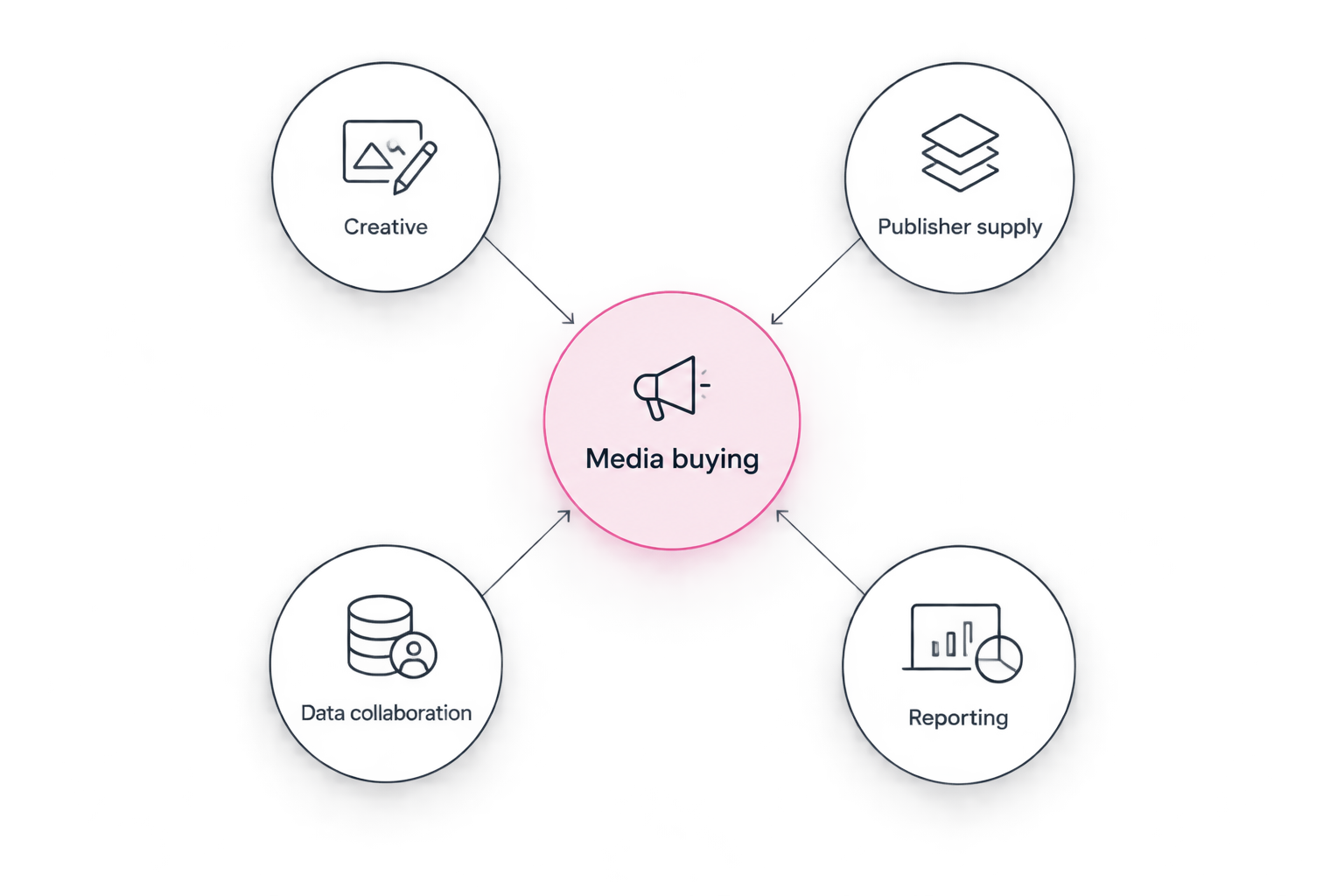
Evaluate the buying workflow together with creative, supply, data and reporting.
Start with a placement brief and a written list of permitted environments. Publisher supply means the advertising inventory made available by publishers and media owners. A supply route is the chain through which that inventory reaches your buying platform.
Ask a supplier to demonstrate the reporting you will receive, using sample fields rather than a presentation alone. Distinguish between controls you can configure and information you can only review after delivery. Direct publisher supply still needs scrutiny; the word direct does not replace a documented explanation.
In your 2026 evaluation, make the evidence match the client’s actual brief:
Start with a manual asset matrix: message, format, destination, approval status and measurement requirement. Rich media adds interactive behaviour to an ad; digital out-of-home, or DOOH, places creative on digital screens in physical environments. They need different production and measurement decisions.
Do not turn a display concept into a DOOH brief by changing its dimensions alone. Reading distance, viewing time and the absence of a conventional click change what the creative needs to communicate. Treat interaction reporting separately from business outcomes.
Use a proposed test of 3 creative variants with one clearly documented difference between variants. That makes the test interpretable; it does not guarantee a particular result.
Create a data register before requesting an integration. List the data involved, where it came from, its permitted purpose and who can access it. First-party data is information collected through a direct relationship with a customer or user; that relationship does not provide unlimited permission to reuse it.
A data clean room supports controlled data collaboration. It is not a substitute for a lawful purpose, contractual controls or a suitable measurement design. Choose the analysis first, then assess whether a clean room is needed to perform it.
Keep a client-data project separate from the media launch when its governance is unresolved:
Run a bounded campaign before expanding the stack. Use a shared launch checklist and reconcile exports manually first; the manual process exposes mismatched definitions that automation would otherwise repeat.
Create 2 report views for the pilot: an operational view for buyers and a client-facing view tied to the brief. Both should use compatible definitions, but they serve different decisions. The buyer needs diagnostic detail; the client needs an explanation of delivery, results and limitations.
A successful pilot is a workflow you can operate and explain, not simply a campaign that delivered impressions.
These options answer different questions. Self-service concerns who operates campaigns; a modular stack concerns how functions fit together; a creative platform addresses asset production. Do not treat them as interchangeable bids for the same job.
Agency-operated standalone DSP
Managed programmatic service
Cake.Shop modular stack
Airtory rich media platform
Airtory belongs in a rich media creative comparison, not as a substitute for deciding your whole advertising stack. Assess the formats, publishing workflow and reporting needed for your brief rather than assuming every rich media tool handles them identically.
For a useful supplier demonstration, bring an actual brief with confidential details removed. Ask the supplier to show the setup, approval, delivery evidence and export you would use. Record unanswered questions instead of filling the gaps with assumptions.
A platform account is not a campaign owner. Assign responsibility for setup, quality checks, optimisation and client explanations before committing to self-service. If nobody can own those tasks, evaluate managed execution rather than leaving them unassigned.
An interface carrying your agency’s name does not establish contractual control. Check who controls access, holds campaign records and authorises exports. Your exit process matters as much as your launch process.
Your proposal can promise joined-up buying and creative while the actual workflow depends on untracked hand-offs. Map the asset, approval, supply and reporting dependencies before accepting the brief. Sell the service your team can operate and explain.
A conversion credited to advertising is not proof of an additional sale. State the attribution method and its limits in the client report. Use an appropriate experimental design when the question is causal impact.
What is programmatic advertising for independent agencies?
Programmatic advertising for independent agencies is automated media buying operated by the agency or an appointed service provider. The agency still needs to own the brief, client approvals, measurement definitions and explanation of results.
Should an independent agency use self-service or managed programmatic?
Use self-service when your agency can assign and support campaign operators; use managed delivery when execution needs an external owner. Compare responsibilities, information access and handover terms rather than treating either model as automatically better.
Is Cake.Shop only a media buying tool?
Cake.Shop provides a modular programmatic platform covering media buying and reporting, rich media and DOOH creative, data clean rooms and publisher supply. Its swweetshop platform powers in-housing; assess the modules against your agency’s specific workflow.
Does an agency need a data clean room before launching programmatic?
A data clean room is not a universal prerequisite for programmatic advertising. Start with the permitted data use and the analysis required, then determine whether controlled data collaboration is necessary.
Is a rich media platform the same as a DSP?
A rich media platform supports creative production, while a DSP supports media buying. Airtory belongs in the creative-platform evaluation; your agency still needs to establish how creative reaches inventory and how delivery is reported.
What should an independent agency test before moving clients?
Test the complete operating workflow before moving a wider client portfolio. Include campaign setup, permissions, creative approval, measurement, report reconciliation and the process for handling a delivery problem.
Make reporting portability part of your 2026 selection process. Ask for a sample export and give it to someone who did not attend the demonstration. If they cannot identify what ran, where it ran and how results were defined, resolve that gap before launch.
A clear exit plan is also a useful buying test. You should understand which records your agency can retain, which assets require a handover and which contractual conditions apply before a client asks to move.
Publisher supply for app publishers needs clear ownership. Map demand paths, test app integrations and compare routes without losing reporting control.
Read more →Programmatic advertising for independent agencies needs clear ownership. Plan media buying, creative, publisher supply and reporting before choosing a stack.
Read more →DOOH advertising for retail landlords: plan screen buying, tenant rules, creative and measurement before launch. Build a stack with clear ownership.
Read more →Book a 30-minute demo and see exactly how Cake.Shop works — no sales pitch, just the platform.