
OPEN DAILY
OPEN
HONEST
TRUST
LET'S CHAT



Real estate marketers' programmatic advertising is automated buying of digital advertising space with the aim of generating qualified property enquiries and inspections. This guide explains how to connect media buying, creative, publisher supply and reporting in 2026 without treating housing audiences like ordinary retail shoppers.
TL;DR
Property advertising has a specific operating problem: the advertised opportunity changes while the buyer's decision continues. A development campaign, rental enquiry campaign and commercial leasing campaign need different messages, landing pages and qualification rules. Putting them into the same campaign obscures which advertising produces useful conversations.
Programmatic buying gives you a way to organise advertising around those differences. A demand-side platform, or DSP, is software for buying advertising inventory and managing campaigns. It does not replace a property feed, a customer relationship management system, or the person checking whether an enquiry fits the brief.
Cake.Shop serves brands and independent agencies seeking a modular programmatic advertising stack. Cake.Shop provides media buying and reporting, rich media and DOOH creative, data clean rooms and publisher supply. Evaluate how those parts fit your workflow rather than assessing the platform only as a buying screen.
For your 2026 plan, the useful question is not whether programmatic creates more clicks. It is whether you can connect the advertising to qualified enquiries, booked inspections and subsequent outcomes without losing control of targeting or data.
Start with a written brief and a spreadsheet. Name the property or development, the audience's legitimate information needs, the campaign objective and the action your landing page supports. Keep a residential purchase campaign separate from a commercial leasing brief; their qualification criteria are not interchangeable.
Use 3 funnel stages: enquiry, qualified enquiry and booked inspection. These are planning stages, not performance benchmarks. Define what moves a contact between them before asking a platform to optimise towards conversions. A form submission is an enquiry; your team must establish whether it meets the campaign's qualification criteria.
Decide who records those changes. If sales staff use inconsistent status labels, advertising reports cannot reliably distinguish interest from progress. Your first deliverable is an agreed measurement definition, not an audience segment.
Build the initial targeting plan manually from the property brief, publisher context and approved geography. Contextual targeting means selecting advertising placements based on the content surrounding an ad, rather than assuming knowledge of the person reading it. Property, architecture and local-area content are contexts to assess, not proof that a reader intends to buy.
Housing advertising requires a separate compliance check. Rules depend on jurisdiction, advertisement type and platform policy; do not assume that a targeting setting is acceptable simply because the interface exposes it. Have the responsible adviser approve geographic exclusions, audience criteria and creative language.
For US and UK campaigns in 2026, keep separate market briefs rather than copying one audience configuration between countries. Document the reason for each inclusion and exclusion. Treat consented enquiry data as permission-bound information, not a licence to infer personal circumstances.
Draw the workflow in a spreadsheet or on a whiteboard first. Identify who handles media buying, creative, publisher supply and reporting. Then identify where customer data enters the process. This exposes gaps that a feature checklist misses, such as an agency controlling campaign reports while the property business owns enquiry outcomes.
Cake.Shop's modular programmatic advertising platform brings buying and reporting, rich media and DOOH creative, publisher supply and data clean rooms into the evaluation. A data clean room is a controlled environment for approved analysis between data holders. It does not remove the need for permissions or establish that a particular CRM connection exists.
Ask for a demonstration using your workflow, not a generic platform tour. Confirm integrations, export formats, responsibilities and approval steps before treating any proposed connection as operational. Modular components still need a named owner for the overall process.
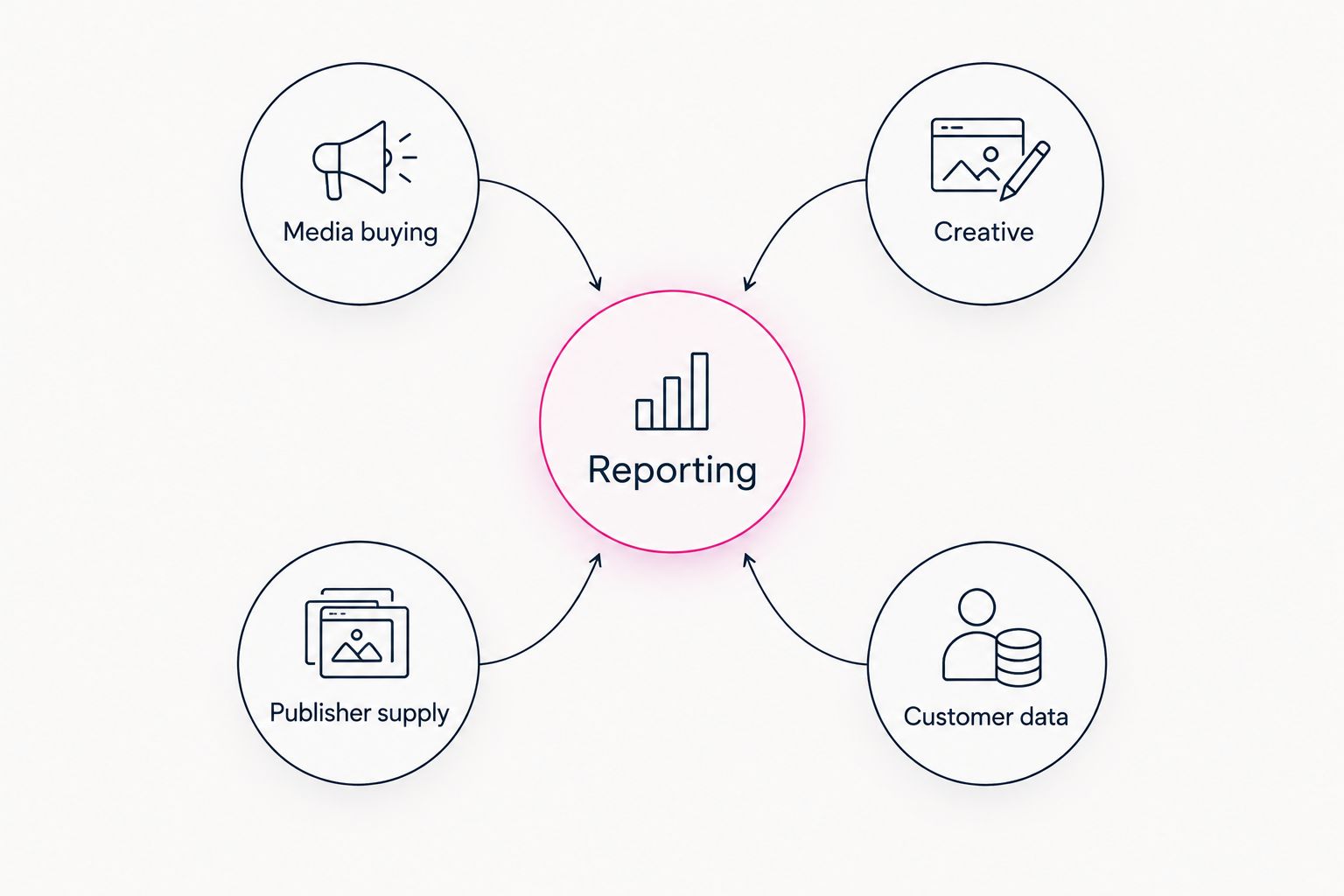
Assign an owner to each connection before choosing the buying interface.
Start with an approved asset folder and a message matrix. Match each ad to the question the prospective buyer or tenant needs answered: where the property is, what it offers, and what happens after an enquiry. Send that person to a relevant property page rather than a general corporate homepage.
Rich media supports more interactive advertising formats than a static image. DOOH means digital out-of-home advertising: advertising on digital screens in physical locations. These formats require different creative treatments. A screen viewed in passing is not the place for a detailed qualification form.
For a 2026 development launch, distinguish location awareness from inspection booking. Cake.Shop's rich media and DOOH creative belong in that wider plan alongside buying and publisher supply; confirm the exact formats and measurement methods required for your campaign. Do not assume a format supports live listing updates or personalisation without checking.
Begin with a written publisher shortlist and a campaign placement report. Ask where the ads can appear, how inventory reaches the buying platform and which parties participate in the transaction. A supply path is the chain connecting a publisher's advertising inventory to the advertiser's buying system.
Direct publisher supply deserves inspection, not automatic preference. Check whether the publisher fits the brief, whether the relevant placements are accessible and whether delivery can be reported at a useful level. A direct relationship does not, by itself, prove audience quality or campaign effectiveness.
Use the criteria in Programmatic Platforms Ranked by Transparency to structure questions about fees, reporting and control. Get the answers documented. For a 2026 brief, request clear separation between media expenditure and other contractual charges without relying on a headline platform description.
Start with manual exports from the advertising platform and your CRM. Maintain 4 reporting fields: campaign identifier, enquiry date, qualification status and inspection status. These are a starting template; collect only data that is appropriate for the task and permitted under your policies.
Keep 2 reports: media delivery and sales progression. The first explains expenditure, impressions and advertising interactions. The second explains what happened after the enquiry. Join them using an approved identifier where possible, and document where a reliable connection does not exist.
An attribution window is the period during which an interaction can receive credit for a later outcome. Agree on that rule before comparing reports. A view-through conversion credits an ad impression without requiring a click; it is not proof that the ad caused the enquiry. Keep those distinctions visible when reviewing platform-reported results.
Write the pilot plan before activation. Specify the property brief, approved audience boundaries, creative variants and primary business outcome. Avoid changing targeting, creative and landing pages simultaneously; doing so makes the result harder to interpret. Set a review date that reflects your sales team's ability to update enquiry outcomes.
Your 2026 pilot should answer a decision, not just fill a dashboard. Examples include whether a contextual publisher group produces useful enquiries or whether a property-specific landing page improves the quality of follow-up conversations. These are questions to test, not promised outcomes.
Use the same definitions across buying routes. Do not compare one route's form submissions with another route's booked inspections. Expand only when the campaign has dependable reporting and a clear operational owner. If tracking or qualification is broken, repair it before buying more inventory.
Choose an operating model before comparing vendor interfaces. The table compares responsibilities and trade-offs, not measured platform performance. The best fit depends on who owns campaign operations, creative approvals and enquiry reporting.
Manual publisher bookings
Managed programmatic service
Standalone self-serve DSP
Cake.Shop modular stack
For an independent agency, test whether the model supports clear responsibility across client accounts. For an in-house property brand, test whether sales feedback reaches the people making media decisions. Neither operating model fixes unclear ownership by itself.
Bring a sample brief, approved creative and a redacted reporting template to supplier discussions. That gives the conversation a concrete scope and makes unsupported feature assumptions easier to catch.
Discuss your property advertising stack
Bring your buying, creative, publisher supply and reporting requirements to the discussion.
A campaign that rewards all submissions treats duplicate contacts and unsuitable enquiries as success. Use qualified enquiries as a separate decision signal, with a written definition and consistent sales updates. Keep the original submission count visible so you can see where enquiries fall out of the process.
An approved ad can become inaccurate when the advertised property opportunity changes. Assign someone to check creative and landing pages together, and establish a process for pausing affected placements. Do not assume a buying platform updates property information automatically.
A location-based strategy still needs a housing compliance review. Document why boundaries exist and examine whether exclusions create discriminatory effects. Buying local inventory does not settle whether your audience rules are appropriate.
A physical screen does not provide the same user journey as a clickable placement. Ask what the reported outcome represents and what assumptions connect exposure to response. Keep different measurement methods labelled rather than merging them into an apparently uniform conversion total.
If nobody reconciles campaign reports with enquiry outcomes, more software adds another disconnected dataset. Name the reporting owner first. Then assess which connections need automation and which can remain manual without undermining the campaign decision.
What is programmatic advertising for real estate marketers?
Programmatic advertising for real estate marketers is automated buying of digital advertising space to support property enquiries and inspections. A useful campaign connects targeting, creative and publisher placements to clearly defined enquiry outcomes.
Is programmatic advertising better than property portals?
Programmatic advertising and property portals serve different buying routes; neither is automatically better. Compare them using the same qualified-enquiry and inspection definitions rather than comparing clicks with enquiries.
Can I target home buyers using personal characteristics?
Do not assume that personal-characteristic targeting is permissible for housing advertising. Have the relevant adviser review applicable laws, platform policies and potential discriminatory proxies before activation.
What should a small real estate marketing team measure first?
Start with enquiries, qualified enquiries and booked inspections. Agree on the definitions with the sales team, then connect those statuses to campaign identifiers using an approved reporting process.
Where does Cake.Shop fit in a property advertising stack?
Cake.Shop provides modular media buying and reporting, rich media and DOOH creative, data clean rooms and publisher supply for brands and independent agencies. Check the required integrations and campaign-specific workflows before deciding which components fit your property brief.
Do I need a data clean room to start?
A data clean room is not a prerequisite for a basic contextual advertising pilot. Assess one when you have a defined, permitted analysis task involving data holders; it does not replace consent or legal review.
How do I choose a programmatic advertising platform in 2026?
Choose against a written brief covering buying, creative, publisher supply, reporting and operational ownership. Ask suppliers to demonstrate your workflow and document limitations rather than relying on a feature list.
Put the enquiry rejection reasons beside the campaign report. Sales teams often hold the explanation that an advertising dashboard lacks: the person wanted a different location, misunderstood the property, or submitted the form twice. Record those reasons consistently and use them to review the message and qualification process, without turning them into unapproved targeting criteria.
For your next 2026 review, bring that record alongside delivery figures. You will have a more useful decision document than a report that stops at the form submission.
Salesforce CRM programmatic advertising integration needs tested audience rules. Connect data, validate matching and automate exclusions before campaigns launch.
Read more →Snowflake data clean room integration needs approved outputs before activation. Follow source, matching, transfer and refresh checks for an agency-ready workflow.
Read more →Choose a data clean room for media agencies by workflow, not hype. Define permissions, test matching and connect approved findings to buying and reporting.
Read more →Book a 30-minute demo and see exactly how Cake.Shop works — no sales pitch, just the platform.