
OPEN DAILY
OPEN
HONEST
TRUST
LET'S CHAT



Yes, retail media networks can be built without a DSP when you sell advertising on your own website, app or in-store placements using suitable ad-serving and campaign-management systems. A demand-side platform becomes relevant when you need programmatic buying across external publishers; removing it does not remove the need for delivery controls, data governance or credible sales measurement.
TL;DR
Yes. The deciding factor is where the ads run, not whether the retailer calls its business a retail media network. A DSP buys advertising inventory on the advertiser's behalf. An ad server selects and delivers ads into available placements; these are different jobs.
For your 2026 architecture, separate owned inventory from external media before selecting technology. The programmatic advertising for retail brands guide covers the broader buying context.
Owned-site and app advertising
Directly sold in-store advertising
Off-site media through an agency or buying partner
Off-site media operated in-house
These models can coexist. A retailer can manage on-site advertising internally while an agency handles off-site activation, without treating every placement as part of the same buying workflow.
Buying a DSP before defining the retail media offer confuses procurement with product design. If advertisers want sponsored product placements inside your app, external auction access does not solve the immediate problem: selecting eligible products, delivering placements and connecting exposure to reporting.
The opposite mistake is assuming a customer database and dashboard constitute a network. Advertisers still need a defined audience, available inventory, delivery rules and an explanation of what the reported results mean.
For a 2026 launch, specify the advertising service before specifying the software. Your commercial proposal should make clear what an advertiser buys, where it appears, who operates it and how performance is assessed.
On-site retail media can include sponsored listings, display placements and sponsored content within a retailer's properties. These placements do not require a DSP merely because advertisers pay to appear in them.
You do need a way to manage eligibility, allocation and delivery. For sponsored listings, that includes deciding which products qualify for a search or category context and separating advertising decisions from organic merchandising rules.
Start with an inventory specification:
Best for: retailers whose initial advertiser demand centres on their own shopping environment. The advantage is direct placement control; the limitation is that reach depends on the audience visiting those properties.
An ad server alone is not necessarily a complete retail media system. Check how booking, creative approval, product feeds, advertiser access and reporting connect before committing to an operating model.
A retailer can sell advertising on its own store screens through direct commercial agreements and schedule the content without a DSP. The essential delivery function is getting approved creative onto the intended screens at the intended times.
Digital out-of-home, or DOOH, describes digital advertising in physical environments. Programmatic DOOH introduces automated buying and selling, but a screen does not become dependent on programmatic buying simply because it carries advertising.
Best for: retailers selling defined placements across their own stores. Direct scheduling gives the retailer control over presentation, while the operational burden includes creative checks, screen management and delivery records.
Keep playback separate from audience measurement. A record that content played on a screen is not proof that a particular shopper saw it, and neither record establishes that the ad caused a purchase.
Off-site retail media uses a retailer's audience or shopping insights to support advertising beyond the retailer's own properties. That changes the architecture because external publishers control the placements.
A retailer does not have to operate a DSP account itself. An agency or buying partner can handle programmatic execution, while directly negotiated publisher campaigns can use a different buying workflow.
Best for: retailers and agencies extending campaigns beyond owned shopping environments. The benefit is access to external audiences; the trade-off is additional responsibility for permissions, audience activation, publisher access and measurement reconciliation.
Ask the buying partner to identify the actual execution route. A branded interface or retailer-facing dashboard does not tell you which organisation controls bidding, accesses audience data or retains campaign records.
For a 2026 off-site brief, document those responsibilities before discussing interface features. Outsourcing execution changes who operates the technology, not whether the underlying work exists.
A workable architecture separates the functions that sell, deliver and evaluate advertising. Use 5 functional layers as your procurement checklist: inventory, campaign operations, data governance, activation and measurement.
The sequence matters because it starts with what you sell. Selecting activation technology before defining inventory and governance leaves essential operating decisions unresolved.
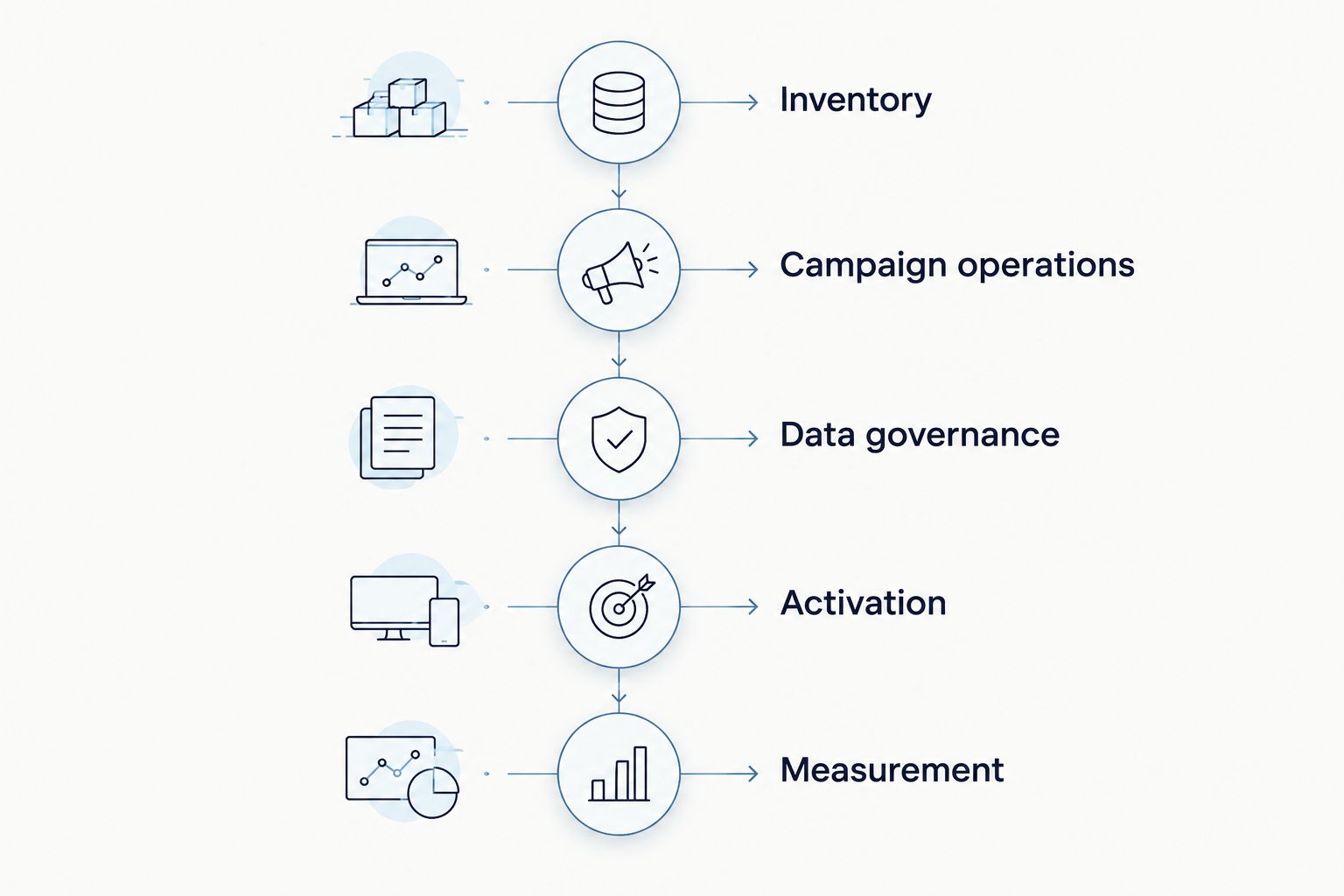
Choose the activation route after defining inventory, operations and data responsibilities.
For an agency building a retailer's stack, turn each layer into a named workstream with an accountable owner. For an in-house team, use the same structure to distinguish responsibilities retained internally from those assigned to suppliers.
Avoid a specification that says only that every component must integrate. State which records move between systems, what identifiers they contain, which permissions apply and how discrepancies are resolved.
The DSP decision changes with the operating scope. These factors determine whether external buying technology solves a real requirement:
Do not use advertiser count alone as the trigger. The more useful question is whether your current workflow can deliver the campaigns you have agreed to sell and provide the records needed to explain them.
Cake.Shop provides a modular programmatic advertising platform for independent agencies building their own stack and brands bringing programmatic in-house. Its stated scope includes media buying and reporting, rich media and DOOH creative, data clean rooms, and direct publisher supply.
Cake.Shop introduces swweetshop as the platform that powers in-housing. For a retail media enquiry, assess those modules together: buying determines the execution route, creative supports the advertising format, publisher supply concerns the inventory relationship, and data collaboration supports agreed analytical work.
That is a full-stack discussion, not simply a standalone buying-tool comparison. It also is not proof of a ready-made retail media deployment: establish whether retailer-specific requirements such as sponsored listings, product-feed handling, advertiser workflows and sales reporting are supported before selecting a configuration.
For your 2026 shortlist, request a demonstration against your actual operating model. The relevant trade-off is control versus operating responsibility: bringing functions in-house also means assigning people to manage them.
No. A data clean room is not a prerequisite for selling ads on owned inventory; its relevance depends on the collaboration and analysis you need to perform.
A clean room provides a controlled environment for working with data under defined access and query rules. It does not automatically establish consent, make every proposed use lawful or prove that advertising generated additional sales.
If your use case involves matching retailer transactions with another party's exposure records, specify the permitted analysis and outputs first. The guide to whether a data clean room can measure incrementality safely addresses that distinction.
Yes. Retail media sales reporting can connect advertising events and transactions without a DSP, provided the necessary records, permissions and matching method exist.
Separate 3 reporting concepts: delivery records describe advertising activity, attribution assigns sales under stated rules, and incrementality assesses the additional effect of advertising. An attributed order is not automatically an incremental order.
Before publishing a 2026 advertiser report, state the attribution window, eligible transactions, treatment of returns and whether the result reflects clicks, views or another interaction. Clear definitions matter more than a dashboard label claiming closed-loop measurement.
Build only the functions your team can operate and maintain. Owning the commercial relationship does not require writing every delivery, buying or reporting component yourself.
A custom build gives you responsibility for changes, monitoring and support as well as design control. A supplier-based stack shifts some implementation work outside your team, but requires careful agreements about access, portability and accountability.
Use 3 acceptance checks before signing: demonstrate the delivery workflow, reconcile a sample report and document data access on termination. Apply the same checks to an internal build, because internal ownership does not eliminate operational failure.
Can retail media networks be built without a DSP?
Yes, retail media networks can be built without a DSP when they sell advertising on owned websites, apps or directly managed in-store placements. They still need suitable delivery, campaign operations, data governance and measurement.
Do I need a DSP to sell sponsored products?
No, selling sponsored products on your own shopping properties does not inherently require a DSP. You need systems for product eligibility, placement allocation, delivery and reporting.
Can an agency run off-site retail media for a retailer?
Yes, an agency can operate off-site buying for a retailer. The agreement should identify who controls execution, accesses audience data and retains campaign records.
Is an ad server the same as a DSP?
No, an ad server selects and delivers ads, while a DSP buys advertising inventory on an advertiser's behalf. A retail media architecture can need delivery technology without needing its own external buying platform.
Does a data clean room prove retail media incrementality?
No, a data clean room does not prove incrementality by itself. Establishing additional sales requires a suitable measurement design, not just matching advertising exposure with purchases.
Can in-store screens run advertising without programmatic buying?
Yes, retailers can sell screen placements directly and schedule approved advertising without programmatic buying. Delivery records and audience measurement remain separate requirements.
What should I ask a retail media technology supplier?
Ask the supplier to demonstrate inventory management, campaign delivery, data permissions and reporting against your intended operating model. For external buying, also establish who controls execution and how campaign records are accessed.
Removing a DSP does not remove the buying function from an off-site campaign; it changes where that function sits. Before selecting technology, draw the route from advertiser booking to placement delivery to sales reporting, and put an accountable organisation beside each handover.
That map is your strongest procurement brief. It exposes whether you need another platform, a better integration or simply a clearer operating agreement.
Is a data clean room necessary for GDPR compliance? No. Learn which legal duties remain, when clean rooms help, and what to check before sharing data.
Read more →Can programmatic advertising target audiences without PII? Yes. Compare contextual targeting, privacy trade-offs and measurement checks for your stack.
Read more →How much does it cost to build a retail media network? Scope comes first. Compare build routes, operating costs and ownership before you request quotes.
Read more →Book a 30-minute demo and see exactly how Cake.Shop works — no sales pitch, just the platform.